Monthly Archives: August 2012

Horst Faas Exhibition & Memorial

AP’s Legendary Photographer’s Hong Kong Exhibition & London Memorial

Vietnam 1967 — AP photographer Horst Faas, with his Leica cameras around his neck, accompanies U.S. troops in War Zone C. (AP Photo)

Earlier this year, May 10th, saw the sad passing of one of our time’s greatest photojournalists and picture editors; the legendary Horst Faas. Best known for his amazing images from Vietnam, Horst was a double Pulitzer Prize winner. As AP chief photographer for Southeast Asia and picture editor, he was also instrumental in getting Nick Ut’s powerful ‘Napalm Girl’ on the AP wire, along with another definitive image from that war, Eddie Adams’ Vietcong prisoner execution.
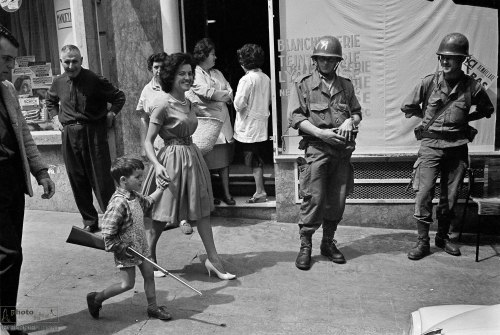
A boy carries a toy rifle as he walks with his mother past French soldiers in battle gear at the Bastille Palace in Oran, Algeria, May 4, 1962. Algeria’s eight-year battle for independence had reached a tense cease-fire pending a July referendum. (AP Photo/Horst Faas)

The sun breaks through dense jungle foliage in early January 1965, around the embattled town of Binh Gia, 64 km east of Saigon, as South Vietnamese troops, joined by U.S. personnel, rest after a cold, damp night of waiting in an ambush position for a Viet Cong attack that didn’t come. One hour later, as the possibility of an overnight attack faded, the troops moved out for another hot day hunting the elusive communist guerrillas. (AP Photo/Horst Faas)

Exhibition

The Foreign Correspondent’s Club, Hong Kong will be have a reception and exhibition on Horst’s work on September 4th. For further details, visit the FCC website. The exhibition of images will remain on display for the foreseeable future.

Memorial

In London, on October 18th at 11.30am, we will be having a memorial service for Horst. The service will be at St Brides Church, Fleet Street.

South Vietnamese civilians, among the few survivors of two days of heavy fighting, huddle together in the aftermath of an attack by government troops to retake the post at Dong Xoai, June 1965. Just a few of the several hundred civilians who sought refuge at the post survived the two day barrage of mortars and bombardment. After the government recaptured Dong Xoai, the bodies of 150 civilians and some 300 South Vietnamese soldiers were discovered. (AP Photo/Horst Faas)

The Taylor Wessing Prize 2012

The Taylor Wessing Photographic Portrait Prize 2012

It’s perhaps one of the most interesting awards to enter; prestigious to win as the works are hung at the National Portrait Gallery, yet one of the most difficult & expensive to enter, as prints are required, complete with protective sleeves. As large print sizes are needed (your entry will be the print that is hung if you win), having anything smaller than A2 in size means your work may simply not be noticed by the judges, compared to huge prints entered by others which may dwarf smaller prints. In this day and age of conservation, it can be quite a wasteful effort putting together six A1 (or bigger) images purely for judging.

Past years have brought surprising results in images chosen and sometimes shocking winners. It is though a great competition and generally always shows off some great work.

Alas it is a competition that I failed to get selected for, and after being requested by friends to do so, here I share my six entries into this year’s Taylor Wessing Photographic Portrait Prize 2012 .

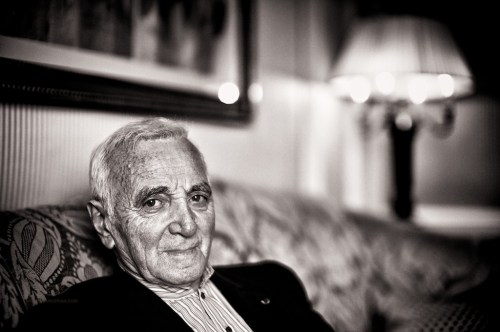
Portraits of Armenian singer Charles Aznavour in his suite at the Ritz Carlton Hotel in New York, NY, USA, ahead of an event by the Fund For Armenian Relief (FAR); 20 Years Of Armenian Independence Honoring Mr Aznavour. May 20, 2011. Photo: Edmond Terakopian

Grandmother for the first time. Photo: Edmond Terakopian

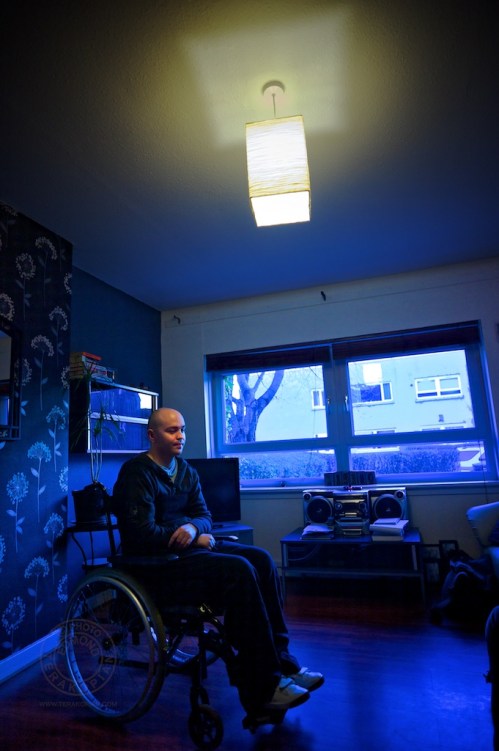
Knife violence in Glasgow, Scotland. Victim of a stabbing in the neck, quadriplegic Scott Breslin (26). He was stabbed when 16 and has spent his life in a wheelchair, paralysed from the neck down. February 10, 2011. Photo: Edmond Terakopian

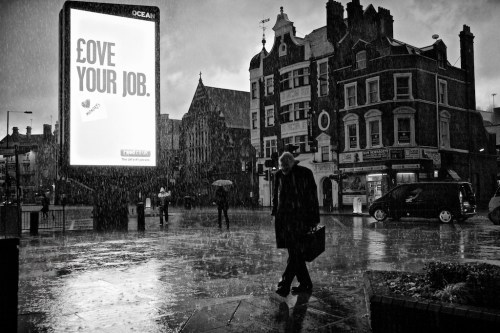
The businessman. A heavy downpour of rain soaks pedestrians as they pass an illuminated advertising sign saying “Love Your Job”. Hammersmith, London. January 14, 2011. Photo: Edmond Terakopian

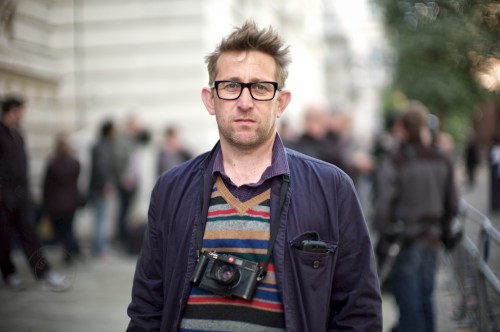
Photographer Jeff Moore in Downing Street, ahead of a visit by US President Barack Obama. London. April 24, 2011. Photo: Edmond Terakopian

Virgin Atlantic celebrate the launch of their flights to Vancouver. Fairmont Pacific Rim cocktail reception. Sir Richard Branson, founder and President of Virgin Atlantic Airways and members of the cabin crew. Vancouver, British Columbia, Canada. May 25, 2012. Photo: Edmond Terakopian

Nick Ut’s Iconic Napalm Girl Photo

40 Years On From AP’s “Napalm Girl” Photograph From The Vietnam War

Anyone with any interest in history or photography will know the image. It’s a photograph that grabs you and never leaves you once you’ve seen it. The image taken by AP’s Nick Ut on June 8th, 1972, shows crying children running away from their village after a Napalm aerial attack by South Vietnamese Forces.

In this June 8, 1972 file photo, crying children, including 9-year-old Kim Phuc, center, run down Route 1 near Trang Bang, Vietnam after an aerial napalm attack on suspected Viet Cong hiding places as South Vietnamese forces from the 25th Division walk behind them. A South Vietnamese plane accidentally dropped its flaming napalm on South Vietnamese troops and civilians. From left, the children are Phan Thanh Tam, younger brother of Kim Phuc, who lost an eye, Phan Thanh Phouc, youngest brother of Kim Phuc, Kim Phuc, and Kim’s cousins Ho Van Bon, and Ho Thi Ting. AP Photo/Nick Ut

It’s a disturbing image; one that shakes us to our core. The main subject in the shot is nine year old Kim Phuc; running, , wailing the words “Too hot, too hot”, crying and naked. As she was hit by the burning Napalm, it raced up her body and incinerated her clothing on contact. It burnt through the layers of her skin all over her back, leaving her heavily scarred to this day.

This moment brought together photographer and subject, not only to create the most powerful image from the Vietnam war but it also united a nine year old girl who would certainly have died, with her saviour; the young 21 year old Vietnamese photographer, Nick Ut. He drove Phuc to a small hospital, where he was told the small girl was too far gone to save. He showed them his American press badge and demanded the doctors treat the girl and left, assuring them that the girl would not be forgotten. “I cried when I saw her running,” said Ut. “If I don’t help her — if something happened and she died — I think I’d kill myself after that.”

AP staff photographer Nick Ut in Vietnam during the 1970s. AP Photo/Nick Ut

Although AP had strict rules about nudity, legendary AP photo editor Horst Faas broke the rules as soon as he saw the image, as it’s news value far outweighed any policy.

A few days later, Christopher Wain from ITN found out that the little girl had survived. He was on the scene and had given her water and doused her burning back with water from his canteen. He fought to have her transferred to a speciality unit run by the Americans. Although she had 35% of her body scorched with 3rd degree burns, she survived and 13 months later, after multiple painful skin grafts and surgeries, she was allowed to leave the Barsky facility.

Kim Phuc

Photographer Nick Ut with Phan Thi Kim Phuc; the girl in iconic Vietnam War photo “Napalm Girl”. Vietnam Veterans Memorial in Washington D.C. AP Photo/Nick Ut

Kim Phuc, now 49, says “I really wanted to escape from that little girl. But it seems to me the picture didn’t let me go”. After years of difficulty, feeling like a victim of war, then finding love, and finally defecting to Canada, the picture has changed it’s meaning for her. “Most of the people, they know my picture but there’s very few that know about my life,” she said. “I’m so thankful that … I can accept the picture as a powerful gift. Then it is my choice. Then I can work with it for peace.”

To help children caught up in war, she has created The Kim Foundation.

Nick Ut

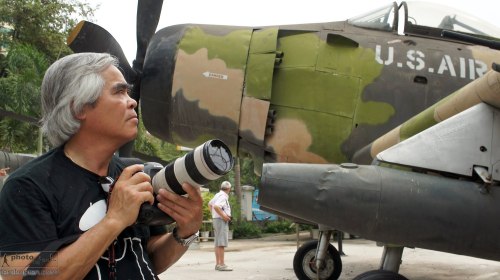
AP staff photographer Nick Ut views an A-1 Skyraider attack aircraft, as used in Vietnam, fitted with Napalm. April 2010. AP Photo/Nick Ut

Over 40 years have passed since AP’s most iconic image was taken, and Nick Ut, who won a Pulitzer Prize for the image, is very much a full time AP staff photographer, now based in LA. In August this year, Nick visited the AP offices in NY to see his original negatives for the third time ever, since having processed it in the darkroom in Vietnam.

During a visit to the Associated Press headquarters photo library in New York, Aug. 10, 2012, AP staff photographer Nick Ut holds a plastic sleeve containing the original “Napalm Girl” negative, for which he won the 1973 Pulitzer Prize for Spot News Photography. (AP Photo)

To find out more about the background to this amazing image and the surrounding story, I thoroughly recommend this AP article.

Here’s a must watch interview with Nick Ut, describing the events of the day, with some stunning photography.


All images ©AP

Other World Computing

The Fastest; Accelsior PCI Express SSD

Long Term Test

OWC stands for Other World Computing, a title which I felt was very apt for this article. Since I started using OWC’s adapter for modifying my Mac Pro to take multiple SSDs in the optical bay and installing their blisteringly fast SSD into the optical bay of my MacBook Pro, I’ve become a fan of this company. Their adapters and SSDs just seem out of this world; great design, well made and extremely fast.

It was with great interest when I first heard that a PCI Express SSD card was going to be introduced by the company. The advantages of using a PCI Express SSD card are numerous. Firstly, one is directly plugging into the motherboard, using the fastest interface, without having to go through the SATA connectors, adding some speed to operation. Secondly, it frees up your SATA connectors and drive bays for more SSDs or conventional hard drives for storage. In my Mac Pro, I now have four conventional hard drives in the drive bays which I use to store my RAW files amongst other data including documents, music, video and so on. I also have two SSDs installed in the optical bays. One is used to clone the Accelsior every night which is my OS drive, and the other is used for video files when editing  a project. Having FCP X run on the OWC Accelsior and the ProRes 422 video files run from a OCZ 120Gb SSD makes for a very fast and fluid editing experience.

If you’re on a PC, the Accelsior will also work. Regardless of which system you’re using, the helpful thing is the card does not need a driver, so will just work once installed. On a Mac, you will naturally need a Mac Pro as the iMac does not have PCI Express slots.

I decided to go for the 240Gb version which is enough space to store the OS, applications and Documents. Via iTunes I did move the iTunes folder to another drive though as it was simply too big. The card uses Sandforce controllers and several systems to ensure that the SSD chips are used efficiently and kept running smoothly. The SSDs themselves are on smaller circuit boards which clip into the PCI Express daughter card; this means that in time if you want to upgrade to a larger size, it’s easily done.

Speed

Using OWC’s own figures, comparing their top of the range traditional SSD (Pro 6G) to the Accelsior makes interesting reading.

OWC Mercury Extreme Pro 6G – Read 559MB/s Write 527MB/s (Peak Data Rate)
OWC Mercury Accelsior  – Read 762MB/s Write 763MB/s
Traditional 5400rpm Hard Drive – Read 75MB/s Write 77MB/s

These are test figures so real life use will vary, but it will vary proportionally, so the speed advantages are clear to see.

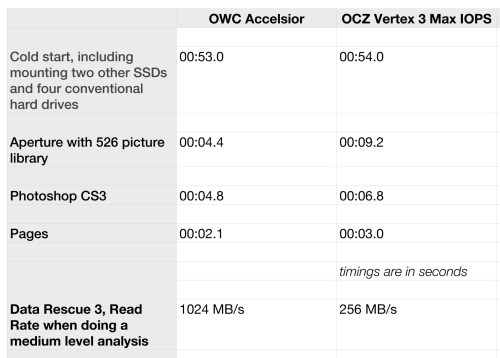
Compared to my previous OS SSD, the OCZ Vertex 3 Max IOPS which was very quick, the speed advantage of the OWC Acceslior is immediately noticeable, even without timing.

I did perform some comparisons though using my early 2009 model Mac Pro.

Reliability

Speed isn’t the only consideration to have though. I’ve had the Accelsior installed in my main imaging workstation, a Mac Pro, for three months now. It has performed without a single hiccup. I installed it when running OS Lion, cloned the OS drive onto the Accelsior using the superb CCC and upgraded to OS Mountain Lion a few days after it’s release. My Mac Pro is on 24/7, used for photo editing, photo archive use, Giclée printing, video and audio editing and general computing too. It’s hooked up to a Sonnet D800 raid with a PCI Express RAID card as well as countless other peripherals and I didn’t have a single issue at all! The Accelsior just performed with 100% absolute reliability and speed.

Final Thoughts

As new technologies come and go and we take leaps forwards, some leaps are giant. The leap to SSDs being one. They are still too costly for storage, but for using as our OS and program disks, the capacities are more than there and the prices have dropped to affordable levels. Although purely on paper the jump to PCI SSD doesn’t appear huge, it is much more than just the speed increase; it’s the convenience increase of freeing up a drive bay for storage too. I for one can’t recommend SSDs highly enough; however if you have a machine with compatible PCI Express slots, then the OWC Accelsior is an absolute no brainer. You’ll love it!

European Buyers – Macupgrade has kindly offered readers of this blog a 10% discount with the code: macupgradephoto

78 Perspectives

Tom Stoddart Exhibition

Photographer Tom Stoddart at his Perspectives Exhibition, More London Riverside. August 08, 2012. Photo: Edmond Terakopian

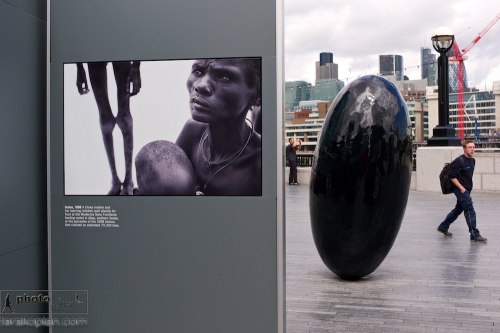
One of photojournalisms most powerful authors, photographer Tom Stoddart is having an extremely powerful, thought provoking, moving, educational, photographically brilliant, emotionally shocking exhibition until September 11th, 2012 in an open air display at More London’s Riverside (by Tower Bridge and City Hall).

Photographer Tom Stoddart at his Perspectives Exhibition, More London Riverside. August 08, 2012. Photo: Edmond Terakopian

Having seen the Perspectives exhibition today, I cannot recommend it highly enough to anyone with any interest in the recent world history, the planet, people, photography, photojournalism and life in general. Although very familiar with Tom’s work, there were quite a few images I had never seen before. With 78 of his signature images on display, with subjects as diverse as future Olympians training in China, the fall of the Berlin Wall, the HIV / AIDS pandemic in Africa, hostilities in Iraq, the siege of Sarajevo to the horrific famine in Sudan, it’s an exhibition which should definitely be seen.  Admission is free and the exhibition finishes on September the 11th.

Tom Stoddart’s Perspectives Exhibition, More London Riverside. August 08, 2012. Photo: Edmond Terakopian

Perspectives was created with the participation of the International Committee of the Red Cross (ICRC).

Tom Stoddart’s Perspectives Exhibition, More London Riverside. August 08, 2012. Photo: Edmond Terakopian

Tom Stoddart’s Perspectives Exhibition, More London Riverside. August 08, 2012. Photo: Edmond Terakopian

Tom Stoddart’s Perspectives Exhibition, More London Riverside. August 08, 2012. Photo: Edmond Terakopian

Police Threaten Press Photographer

“Video of police threatening to arrest me if I do not delete pictures. Absolutely absurd behavior by them and potential blackmail. No cordon was put in place and no police officer stopped me from walking up to where I was standing… hence the other photographer just walking up after me. Police officer also claiming that he will be “touching me” in the police van back to the station.”

The video has been pulled down by the photographer for various reasons. We hope it’ll be back online soon.

Disgraceful behaviour by a plain clothed Police officer (one assumes a detective, who says he’s in charge of the crime scene, who then clearly threatens the photographer quoted above, by saying “I’ll be touching you in a Police car back to Ilford Police Station”) and a Police sergeant against a press photographer doing his job and covering a story from an un-cordoned public footway. One might accept a Police officer new to the job not to know about the rights of the press, but for two experienced officers to abuse their powers like this and then give the photographer an ultimatum to delete the pictures or be arrested, is just wrong. They also bring forth arguments of morality which is clearly not within the Police service’s mandate of things to enforce.

After all the good work done by the BPPA and NUJ with the Police service, resulting in much better Police relations than has been had in recent years, it really is an absolute shame to see this behaviour emerging again.

The Police have no right to stop anyone taking pictures in a public place. They also have no right to ask for images to be deleted. This document by the Association of Chief Police Officers (ACPO) clearly reminds officers of their powers.

NB-I have kept the identity of the photographer hidden for now. Also as I get more details on what the incident was that was being photographed, I shall update the story.