Category Archives: viewpoint

Behind The Scenes

The RNOH Appeal Film

I was very honoured when Neil Patience (an extremely talented video editor) invited me to take part in a project he was going to be involved in. He mentioned it was the RNOH, a hospital which I had already done several assignments in (photographing Princess Diana and on a separate occasion my first ever award winning picture; a wheel chair basketball game, to mention a couple).

In April 2011 we had a meeting with Rosie Stolarski (Head of Fundraising, RNOH Charity) and Professor Tim Briggs (Consultant Orthopaedic Surgeon), the subject of which was to make a fundraising appeal film. The original brief was for a very short, straightforward appeal type film, but after the first few days of shooting, Neil and I had decided to go for more of a documentary feel. Neil put together a rough cut of what we had already and we were overjoyed when the RNOH went for it and changed the brief.
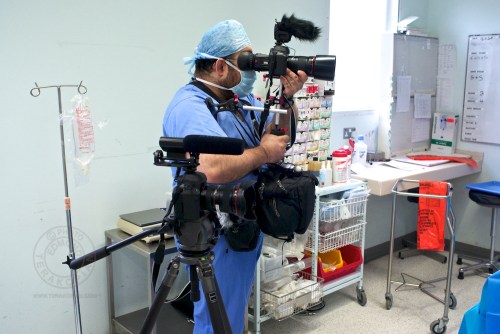
Photographer and film maker Edmond Terakopian filming at the Royal National Orthopaedic Hospital in Stanmore. Filming in an operating theatre with two Canon 5D MkII camera, one on a Gitzo (GT3531LSV + G1380 head) and the other on a Zacuto Striker with the Zacuto Z-Finder Pro attached). Both cameras have Rode microphones attached for ambient sound recording. The VideoMic (closer) and VideoMic Pro. A Think Tank Photo Multimedia Wired Up 10 belt pack is also being used. May 16, 2011. Photo: Neil Patience

We spent a long time planning various aspects of the film, including the patient interviews. With the hospital team, we chose a cross section of their previous patients who had had the full gamut of operations, thus transforming their lives. We covered a wide age range and conditions to paint a full picture.

Photographer and film maker Edmond Terakopian filming at the Royal National Orthopaedic Hospital in Stanmore. Filming in an operating theatre with a Canon 5D MkII camera on a Zacuto Striker with the Zacuto Z-Finder Pro attached and the Rode VideoMic Pro. A Think Tank Photo Multimedia Wired Up 10 belt pack is also being used. May 16, 2011. Photo: Neil Patience

The flip side to these life changing stories though was the conditions in which this amazing staff have to work. Huts that serve as wards dating back to the 1940s, crumbling, leaking building, sloping corridors that require special locomotives to pull beds along. A truly extreme juxtaposition of amazing medical work in such atrocious conditions.

Photographer and film maker Edmond Terakopian filming at the Royal National Orthopaedic Hospital in Stanmore. Filming in a prosthetic limb manufacturing section run by Blachleys. A Canon 5D MkII camera, on the Gitzo (GT3531LSV + G1380 head) tripod, with a Rode VideoMic Pro microphone. Extra equipment needed for the shoot is carried in a Think Tank Photo Multimedia Wired Up 10. May 16, 2011. Photo: Neil Patience

Having an amazing client though is the start of great work and I really must thank the RNOH in helping us be creative, change the brief to make it a more powerful film and for all the logistical help. All the coordination by Rosie Stolarski for the entire project and the patience of her team members Jenny Blyth and Sam Bowie when they accompanied us on site was paramount. A huge word of thanks goes to head of communications Anna Fox who spent the most time with us on site, making sure everything was planned and helping us get the shots we needed. We’d like to thank all the amazing surgeons who invited us into their operating theatres and all the physiotherapists, nurses, prosthetics team and other medical staff for their help. A big thanks also go to the ushers and the security team for all their help.

The biggest words of thanks go to the former patients who let us into their lives and inspired us with their strength and courage. Our thanks go to HRH Princess Eugenie of York, Molly Poole, Carol West, Phil Packer, Phil Coburn, Kat Reid and the amazing Caitlin Kydd.
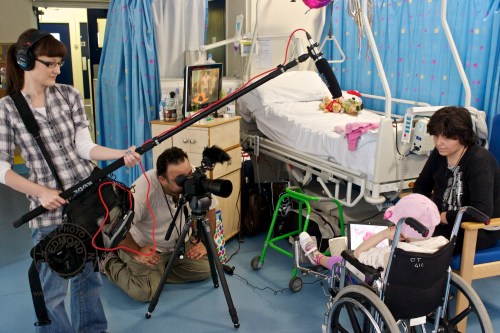
Camera assistant Nicola Taylor recording audio, using a Rode NTG3 on a Rode Mini Boom pole, onto a Zoom H4n audio recorder. This is in a Think Tank Photo Multimedia Wired Up 10. Edmond Terakopian uses a Canon 5D MkII and 135mm f2L and Rode VdeoMic Pro on a Gitzo (GT3531LSV + G1380 head) tripod. RNOH Children’s Ward, Stanmore. July 19, 2011. Photo: Neil Patience

Along with the invaluable help of my assistant Nicola Taylor (an amazingly creative photographer in her own right), Neil and I shot the project over a nine month period.

If you haven’t yet seen the film, you can watch it HERE.

Techniques & Technical

Behind the scenes photographs of the filming of the appeal DVD. Showing film maker Edmond Terakopian & Editor and Producer Neil Patience. An iPad is used for interview questions. RNOH, Stanmore. Photo: Nicola Taylor

I shot the entire video using two Canon 5D MkII cameras, using a range of Canon lenses; 15mm f2.8, 16-35mm f2.8L II, 24-105mm f4L, 35mm f1.4L, 50mm f1.2L and a 135mm f2L. My main tripod was a fluid head Gitzo (GT3531LSV + G1380 head). For the locked off shots with the tighter lens (135mm f2L) I used a carbon fibre photographic Manfrotto tripod. For the handheld shots, I used a Zacuto Striker and Z-Finder Pro eyepiece. Having to cover long distances across the hospital grounds and wards with the kit meant needing to plan not only the right and relevant kit, but the right bags too. We used a Think Tank Photo Airport Internal v2 and also a Multimedia Wired Up 10. On the last interview with Consultant Orthopaedic Surgeon Professor Briggs, I also used a Marshall 5” monitor (V-LCD50-HDMI).

Behind the scenes photographs of the filming of the appeal DVD. Showing film maker Edmond Terakopian, editor and producer Neil Patience, Rosie Stolarski (head of fundraising) and ex-patient Phil Packer. RNOH, Stanmore. Photo: Nicola Taylor
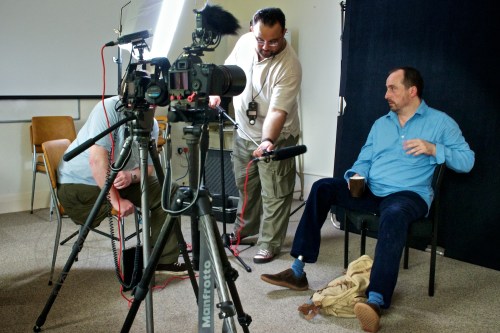
Behind the scenes photographs of the filming of the appeal DVD. Showing film maker Edmond Terakopian and ex-patient Phil Coburn. RNOH, Stanmore. Photo: Nicola Taylor
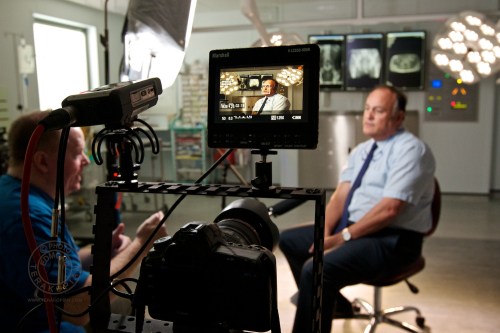
Operating Theatre 4 with Prof Tim Briggs. A Marshall 5″ monitor (V-LCD50-HDMI) is used to check focus, lighting, composition and exposure). The light on the left is a Kino Flo Diva Light supplied by New Day Pictures. September 21, 2011. Photo: Edmond Terakopian

To keep the same feel and uniformity with the ex-patient interview scenes, we decided to shoot them against a black background. One of the problems though was that although some interviews would be done at the hospital, these were at different days and in different rooms. The other interviews would be on location at ex-patients’ homes. We needed a proper light absorbing black, but also a background which was sturdy and stable. On top of these requirements, it also needed to be highly collapsible and portable. After having a chat with our friends at Lastolite, we found just the trick. The Lastolite Plain Black Velvet Collapsible Background (which has a collapsible frame) and the Lastolite background support (1109).
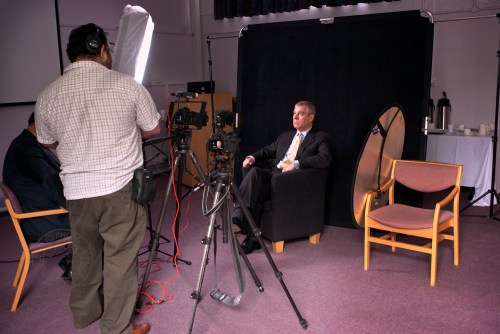
Royal visit to the Royal National Orthopaedic Hospital (RNOH), Stanmore, Middx. HRH Prince Andrew being filmed by Edmond Terakopian. For this shot two Canon 5D MkII cameras were used. One on a Gitzo (GT3531LSV + G1380 head) tripod. The other is on a lightweight Manfrotto carbon fibre tripod. The camera further away (Camera A) is mounted inside a K-Tek Norbert cage (mount frame) and has a Zoom H4n audio recorder mounted on it. This in turn is plugged into a Pinknoise splitter cable, with one end going to camera (to record audio in camera) and the other to headphones. A Rode NTG3 microphone is used for the main audio which is recoded onto the Zoom H4n in WAV format with the passthrough recording in camera. The B camera also has a Rode VideoMic Pro recording audio onto it. The black background and supports are Lastolite and were used in all the interviews. The lighting is by a single Kino Flo Diva Light (supplied by New Day Pictures) and a Lastolite reflector. June 02, 2011. Photo: Nicola Taylor

The other aspect to keeping this consistency was to make sure the lighting was as identical as possible. After consulting with the specialist hire company New Day Pictures, we went for a Kino Flo Diva Light (shot through it’s softbox diffuser). This has been the most amazing light I’ve ever worked with.

Audio

For audio, I used Rode microphones throughout. The cameras where fitted with the Rode VideoMic and VideoMic Pro for all of the cutaway and GV scenes. Although we had originally thought that all their audio would be replaced with the interviews with Professor Briggs, Neil ended up using a fair amount of the audio from them. The main audio, which was for all the interviews, was done using a Rode NTG3, recoding onto both camera A (using a Pinknoise splitter cable) and onto the Zoom H4n (in WAV format). We mounted the mic on a mic stand and had it just outside shot.

The Royal Connection

Royal visit to the Royal National Orthopaedic Hospital (RNOH), Stanmore, Middx. HRH Prince Andrew being filmed by Edmond Terakopian. For this shot two Canon 5D MkII cameras were used. One on a Gitzo (GT3531LSV + G1380 head) tripod. The other is on a lightweight Manfrotto carbon fibre tripod. The camera further away (Camera A) is mounted inside a K-Tek Norbert cage (mount frame) and has a Zoom H4n audio recorder mounted on it. This in turn is plugged into a Pinknoise splitter cable, with one end going to camera (to record audio in camera) and the other to headphones. A Rode NTG3 microphone is used for the main audio which is recoded onto the Zoom H4n in WAV format with the passthrough recording in camera. The B camera also has a Rode VideoMic Pro recording audio onto it. The black background and supports are Lastolite and were used in all the interviews. The lighting is by a single Kino Flo Diva Light (supplied by New Day Pictures) and a Lastolite reflector. June 02, 2011. Photo: Nicola Taylor

The first of our interviews was with HRH Prince Andrew, who not only only was the patron of the hospital, but is also the father of a former patient; Princess Eugenie. We also did an interview with the Princess and both pieces added so much to the film. These weren’t only essential, but were also an absolute joy to shoot.

Royal visit to the Royal National Orthopaedic Hospital (RNOH), Stanmore, Middx. HRH Princess Eugenie being filmed by Edmond Terakopian. For this shot two Canon 5D MkII cameras were used. One on a Gitzo (GT3531LSV + G1380 head) tripod. The other is on a lightweight Manfrotto carbon fibre tripod. The camera to the left (Camera A) is mounted inside a K-Tek Norbert cage (mount frame) and has a Zoom H4n audio recorder mounted on it. This in turn is plugged into a Pinknoise splitter cable, with one end going to camera (to record audio in camera) and the other to headphones. A Rode NTG3 microphone is used for the main audio which is recoded onto the Zoom H4n in WAV format with the passthrough recording in camera. The B camera also has a Rode VideoMic Pro recording audio onto it. The black background and supports are Lastolite and were used in all the interviews. The lighting is by a single Kino Flo Diva Light (supplied by New Day Pictures) and a Lastolite reflector. June 02, 2011. Photo: Nicola Taylor

Editing Workflow

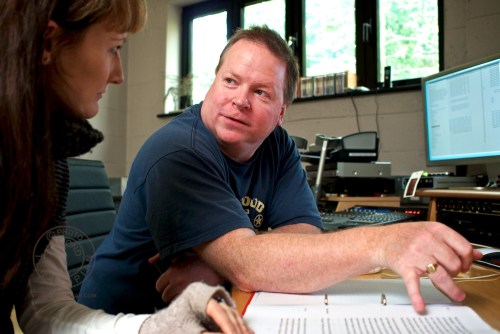
Editing the fund raising video for RNOH at New Day Pictures’ Final Cut Pro editing suite in Surrey. Assistant Nicola Taylor and video editor Neil Patience at work, discussing the interview transcripts. November 08, 2011. Photo: Edmond Terakopian

After every day’s shoot, we would make copies of all the CF cards (video) and SD card (audio) onto both Neil and my MacBook Pros. Once back at our respective offices, we would both also make backups onto our Mac Pros and RAID systems. On top of this, I also made multiple off-site backups. With a project that has so much data and is shot over such a long period of time, it’s not worth risking losing something before delivering the final cut to the client. With this workflow we had multiple copies (RAID 1 and RAID 5) across three geographical locations.

Editing the fund raising video for RNOH at New Day Pictures’ editing Final Cut Pro suite in Surrey. L-R: Cameraman Edmond Terakopian, assistant Nicola Taylor and video editor Neil Patience at work. November 08, 2011. Photo: Edmond Terakopian

Once Neil had put together a long assembly, Nicola and I met with Neil at the New Day Pictures’ editing suite. Although able to edit video myself, I never thought of myself as anything but having rudimentary skills. Watching Neil at work was an amazing education. The philosophy behind editing is the most crucial thing; watching him operate the keyboard, mouse and various break out boxes full on knobs and sliders like a concert pianist was amazing, but understanding the reason behind constructing edits was just mind blowing. The three days that I spent with Neil were invaluable. The film naturally did take much longer than that to do though. If you’ve never worked with a professional editor, I highly recommend it; in fact, it’s essential.

To find out more about the editing, have a read of Neil’s post, Making The RNOH Appeal Film.

The Premiere

Our first screening was for the RNOH fundraising team. The silence and sniffles, combined with the teary eyes confirmed for us that we had succeeded in making a powerful and emotive documentary. It’s always difficult to fully judge a project until you’ve shown it to someone outside of the team. Close colleagues who had seen it had all been positive, but it was only when our clients at RNOH approved, that we were completely happy.

The premiere of the film was at the launch of the RNOH Funding Appeal at St James’s Palace, at an event hosted by HRH Prince Andrew and Princess Eugenie. Along with the screening was also a photographic exhibition of my work documenting the hospital. I must admit to being quite nervous when the film was shown; it’s again the fear of not knowing how it will be received. The huge room (bigger than a typical hall) fell quite and stayed quite for the entire length of the film, the silence only being broken by the occasional sniffle. As the film approached it’s end, the sniffles grew not only more frequent, but louder. A gentleman in front of me, who is the father of the amazing Caitlin who is featured in the film was in fact crying fully. It’s hard not to be moved and humbled when witnessing such an amazing reaction to one’s work. After the film finished, there was silence; a silence which carried on for a good five seconds and then the room burst into applause. Later, Neil and I shook hands.

Proud. This is one word which kept coming up between the TAPTV team; we were all proud of what we achieved with this project. When I look back at my career which started in 1989, although I give my all to everything I do, certain assignments stand out and I feel proud; this is certainly one of them.

My hope is that we have helped this amazing hospital to raise some of the money they need; they do amazing work there. I hope that you will help by making a donation HERE.
RNOH Appeal Film Launch

Film Premiere & Exhibition

What an amazing evening. We had the launch of our RNOH appeal film; a project we have been working on since our first meeting in April 2011. The film was premiered at a special event at St James’s Palace by HRH Prince Andrew and HRH Princess Eugenie. I shall be posting a in-depth article on the project with some behind the scenes photographs and technical briefing on techniques and equipment used. Firstly tough, it is my pleasure to show you our film:

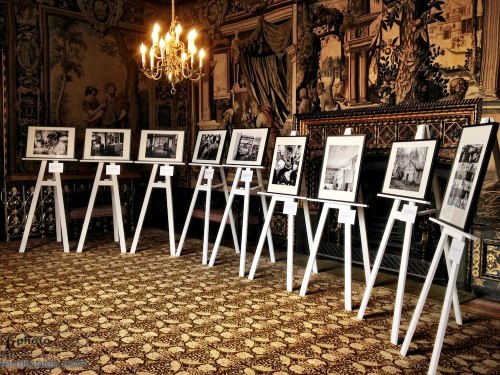
Alongside the film was also a photographic exhibition of images I had taken around the hospital, documenting the amazing work that goes on there, despite the conditions of the fabric of the hospital.

The RNOH launch their funding appeal at St James’s Palace in London. Photographer Edmond Terakopian’s exhibition of photographs documenting the state of the hospital. April 26, 2012. Photo: Edmond Terakopian

The RNOH launch their funding appeal at St James’s Palace in London. Photographer Edmond Terakopian with his exhibition of photographs documenting the state of the hospital. April 26, 2012. Photo: Theodore Wood / http://www.theodorewood.com

Here are some images of the exhibition of prints, and some photographs by Theodore Wood from the event, showing Princess Eugenie viewing the exhibition and being presented a print on her departure from the event.

The RNOH launch their funding appeal at St James’s Palace in London. Photographer Edmond Terakopian shows HRH Princess Eugenie a series of photographs documenting the state of the hospital. April 26, 2012. Photo: Theodore Wood / http://www.theodorewood.com

The RNOH launch their funding appeal at St James’s Palace in London. Photographer Edmond Terakopian and Rosie Stolarski (head of fundraising), present HRH Princess Eugenie with a portrait of herself (taken by Edmond Terakopian). April 26, 2012. Photo: Theodore Wood / http://www.theodorewood.com

To make donations to this extremely worthwhile project to rebuild one of the world’s top three orthopaedic hospitals, please visit the RNOH Charity website. Thank you.

HRH Princess Eugenie of York who had spinal surgery at the RNOH. RNOH Fundraising Film stills grabs from the film. June 02, 2011. Photo: Edmond Terakopian

HRH Princess Eugenie of York is also helping raise funds for the hospital by taking part in 100km bike ride; please pop by her page and make a donation if you can.

Making The RNOH Appeal Film

Neil Patience, Editor & Producer on the film, shares his thoughts about the project and also talks of his philosophy behind the editing as well as his workflow.

My own journey with the RNOH began in June 2004 when I was diagnosed with chondrosarcoma, a rare bone cancer. If it was not for Professor Tim Briggs and his staff I would not be here today. I literally owe them my life.

During one of my regular check ups in early 2011, Professor Briggs asked me if I would be willing to make an appeal film for the then upcoming RNOH redevelopment appeal. Of course I agreed without hesitation.

Behind the scenes photograph of the filming of the appeal film. Photographer Edmond Terakopian, Rosie Stolarski (head of fundraising), Editor Neil Patience and ex-patient Phil Packer. RNOH, Stanmore. Photo: Nicola Taylor

I had been an admirer of Edmond Terakopian’s work for some time and we had already briefly worked on a couple of minor projects and camera tests with the Red One together.

I knew his skill with a 5DMKII and journalistic instincts would be perfect for a project.

From our first meeting with the RNOH it was clear that the brief was a little complex as the film was to serve several purposes.

It needed to illustrate the ground breaking world class work that is carried out at RNOH but at the same time reflect the run down infrastructure of the hospital (the reason behind the fundraising appeal).

Patients and their families invariably spoke very highly of the staff at all levels and unsurprisingly had nothing but praise for the often life changing or indeed life saving treatment. Their feelings about the surroundings where that treatment was delivered was another story. So it was somewhat of a paradox that had to be addressed in making the film.

Edmond and I along with Professor Briggs and Rosie Stolarski, head of the hospital charity, decided to make the film in a documentary style to be able to intertwine patients stories, the work the hospital does. the new building projects and the reasons behind the appeal.

With the help of the hospital we selected seven patients who’s conditions, ages and treatments reflected the range of RNOH’s work. They, like me, all agreed to take part without any persuasion.

Tim Briggs was going to be the backbone of the film, his interview was key to providing the  information about the hospital, the appeal, and the aims of the redevelopment.

The patients would tell their own stories, and the GV’s around the hospital grounds and wards spoke for themselves.

So essentially we went into the edit with broadly 3 elements, Tim’s Interview, the patient interviews and the shots of the hospital both interiors and exterior.

We have both Avid and FCP editing options but I decided to edit the film using Final Cut Pro as I wanted the option to use Apple Color to grade and that gives me the easiest workflow.

I used the basic FCP Log and Transfer tool to transcode all the rushes to ProRes HQ (and made a back-up of all the media.)

Editing the fund raising video for RNOH at New Day Pictures' Final Cut Pro editing suite in Surrey. Assistant Nicola Taylor and video editor Neil Patience at work, discussing the interview transcripts. November 08, 2011. Photo: Edmond Terakopian

Initially I had to sync up all the audio recorded on the Zoom H4n with the 2 Canon 5D MKII cameras. I was going to use PluralEyes for this but quickly realised that the audio recordings for each interview were continuous and the cameras only stopped recording two or three times during each interview (due to limitations set in video length on DSLRs).

So it was very easy and quick to lay the pictures against the Zoom sound manually, matching the waveforms, and creating a multicam sequence for each interview.

Once all were assembled we had them transcribed (by UK Transcription in Brighton) which made editing them much easier.

First I made several long assembles of all the sync interviews that we wanted to include from Tim Briggs and each patient, editing and re-editing to get the most powerful comments as they each told their stories and spoke of their experiences at RNOH. Having two cameras meant that it was much easier to cut down without worrying about finding cutaways or having to re-order shots to get cuts. It gave me a lot of flexibility.

Once I had a long assembly I was happy with Edmond and photographer Nicola Taylor, who had been our assistant though-out, to join me in the edit suite.

We spent 2 more days cutting and recutting, slowly getting the duration down, selecting cutaways and GV’s. We revisited the transcriptions many times adding and replacing shots, interview segments and selecting music until we had our film.

I had intended to grade the whole film using Color but the rushes looked fabulous and needed less work than I had imagined at the outset. Instead I decided to use a combination of Color on some shots that required several secondary corrections and mask layers to get sky and foreground nicely graded and Gen Arts Sapphire plug-ins on other shots, namely the interviews and to provide some subtle vignettes here and there.

Sapphire Film Effect provided a lovely gamma curve while adding a very subtle softness to the shots. It also allows for some colour balancing and the trusty FCP 3 way colour corrector also played a part here and there.

The audio mix was quite straight forward as it was essentially sync sound, atmos and music. I mixed the audio directly in FCP. The suite at New Day Pictures has broadcast monitoring for both audio and video (Leader rasterizer and PPM’s) so everything was completed to UK HD broadcast spec.

We made Bluray DVD’s using Adobe Encore and standard def DVD’s using DVD Studio Pro. Transcodes were completed using a combination of Compressor, MPEG Streamclip and Telestream Episode.

By Neil Patience

Stay tuned as we launch the film on the TAPTV website and more behind the scenes posts, right here.

Canon C300 V 5D MkII

Comparing Footage From the C300 & 5D MkII

A short clip showing a quick comparison between a Canon C300 and Canon 5D MkII. The cameras were set up as identically as possible, using the same settings. Please note that this was shot during an open day event, so not ideal conditions as the settings were constantly being changed on both cameras by attendees to the event! Lastly, there’s a clip from the C300 which is ungraded. Many have asked to see footage which hasn’t been touched, so all of these clips are straight from camera.

Featuring model Vicki Blatchley  Shot at New Day Pictures

Thoughts

Putting aside for a moment that the Canon C300 is actually a proper video camera with all the video functions, flip screen and audio abilities, not to mention the form factor, that one needs for professional video (all of which are lacking on the 5D MkII) and looking at purely the image quality, at first glance, there appears to be little difference between the two.

It’s only when we brought the image into the full editing suite that the huge dynamic range and masses of detail in the extreme highlight and shadow areas started to show the C300 as vastly superior. Even on the non flat settings, the file was just lush with detail. Although I love the 5D MkII, the C300 is just on a completely different level.

The 5D MkII does have an edge in two ways; it has that gorgeous full frame sensor as opposed to the Super 35mm of the C300 (crop factor of x1.6) and is many, many times cheaper, even when taking into account finders / EVFs, rigs and external audio that’s needed to make it usable.

The C300 does have it all though. I for one am extremely impressed by this camera; it really is rather good.

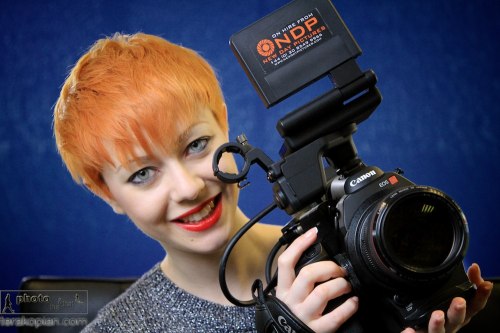
Model Vicki Blatchley at the Canon C300 Open Day and New Day Pictures, Surrey. January 26, 2012. Photo ©

Photographer and film maker Edmond Terakopian at the Canon C300 Open Day at New Day Pictures, Kingston Upon Thames, Surrey. January 26, 2012. Photo ©Model Vicki Blatchley at the Canon C300 Open Day and New Day Pictures, Surrey. January 26, 2012. Photo ©

You can see my longer, graded, demo reel from the Canon C300 below:

The French Privacy Law

One Suggestion At The Leveson Inquiry

Stunned by the way the Leveson Inquiry turned on photographers, (after having set out to be about journalistic ethics and phone tapping), I was even more horrified when a suggestion was made to introduce French ‘style’ privacy laws in the UK.

The French Privacy law and it’s effects really needs to be studied. It has turned a most cultured people into a nation of court going suers. The land which brought to the world amazingly talented photographers like Henri Cartier-Bresson and Robert Doisneau has made it impossible for their modern day counterparts to work.

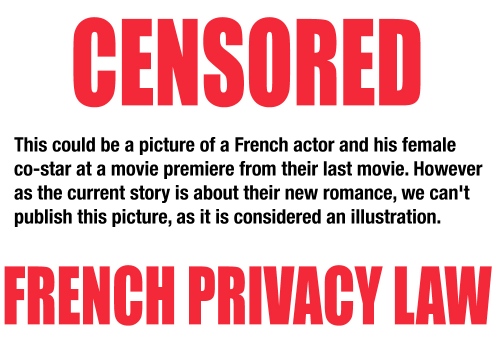
This could be a picture of a French actor and his female co-star at a movie premiere from their last movie. However as the current story is about their new romance, we can't publish this picture, as it is considered an illustration.

We were fortunate to have Nigel Dickinson join the NUJ London Photographers’ Branch to give a talk on the French privacy law and the difficulties faced by him and his colleagues in France:

FRENCH PRIVACY LAWS

Based on a talk given to NUJ London Photographers’ Branch
by Nigel Dickinson, February 2012

Article 10 of the European Convention affirms that there are human rights for the freedom of expression and public rights to receive information. But in FRANCE this right is not absolute and has to be conciliated with certain individual rights.

Laws about shooting and publishing photos and video

Before taking a photo of someone you are required by law to ask the individual’s permission. If you want to publish it in anyway you have to ask their permission for each specific usage. Any object that is created by or is the copyright of an artist, or designer must have permissions to be published in specific contexts. Any owner of property can assert rights of ownership of property, again the photographer needs permissions to publish, regardless of whether the image was shot from a public or private space.

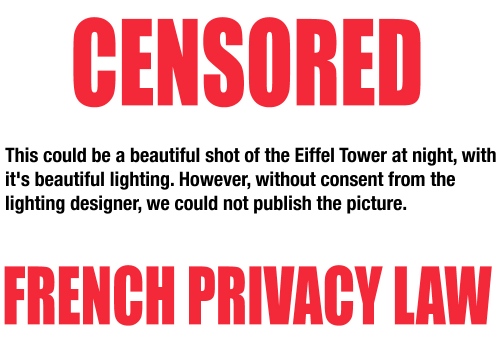
This could be a beautiful shot of the Eiffel Tower at night, with it's beautiful lighting. However, without consent from the lighting designer, we could not publish the picture.

It is advisable in France to always get a signed written permission by individuals, owners of property and creators of original works, whatever the situation whether in a public or private space.

Individuals can use two different French laws to defend their rights against publication of their image:

The right of your own image (Droit d’image)

In France each individual has the exclusive right to their image and of who uses their image. Not only publishing the image but even taking the photo of someone, the photographer has to have the individuals permission under French Law. The fact that the person accepts to be photographed doesn’t mean that they accept to have their image published. A minor aged between 12 to 14 years old can be considered responsible enough to decide whether he/she gives the right to use his image.

Circumstances where the public right of information might be stronger than the individual’s right of one’s image

When someone places himself or herself is in a public place then there is already a measure of tacit consent already presumed but this is reflected in each individual case. Normally the person only has a right of complaint if he/she is a principal subject in the photo.

If someone is in a photo but not an essential element – or when the person is not recognizable – or is an accessory by chance – say in an image of a public monument, or statue, then it is generally considered that consent is not necessary, even though people have taken photographers or publishers to court over this. The same goes when the person is part of a crowd. But again each case is taken on its own merits, as to what is considered a crowd or an accessory or not.

But in all circumstances the persons dignity must be respected.

Normally public figures, when going about their public life, such as politicians, sports stars, singers etc are not required to give their consent in such situations because the right of information supercedes their right to their own image, but this only for journalistic news purposes only not commercial ones, nor for illustration (the same image which was once a news image could be considered later on as an illustration, or when taken out of its news context).

Images of public figures must not violate the Privacy law. In other words the images must only deal with the individuals public life and role and not refer to anything which is about the individual’s private life.

In other words there mustn’t be anything which invades the private life of this person even though he/she is a public figure.

And an image which was part of a news event, with a public figure at one time, may be considered less relevant later on, in which case what was once a perfectly unusable news image – can be deemed unusable later. It is not newsworthy therefore becomes an illustration – and the photographer or publisher can be prosecuted for its publication.

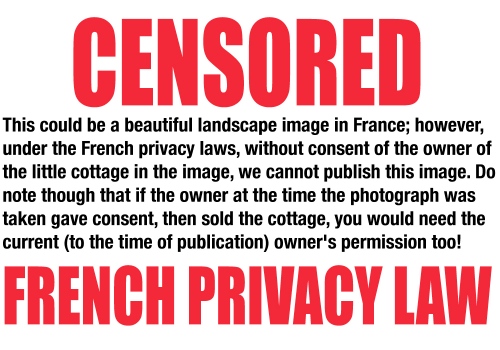
This could be a beautiful landscape image in France; however, under the French privacy laws, without consent of the owner of the little cottage in the image, we cannot publish this image. Do note though that if the owner at the time the photograph was taken gave consent, then sold the cottage, you would need the current owner's permission too!

Taking the picture itself will not necessarily be by itself against the law unless someone’s private life is affected or private property is invaded as a result.

In certain instances legal judgments have considered certain types of publications in exhibits and books not to require authorization:

When the research is considered artistic, cultural or sociological.

Set up pictures (studio or mis-en-scene)

In France in this situation: Anyone professional or not is considered as a model., The photographer cannot pay the model direct, the client must pay, on a salaried basis according to French law. In the case of a model working for an agency, the photographer must check the agency possess the relevant agreements. The client can be held responsible against problems with the agency.

An image needs a model release, everything has to be licenced – there are very strict rules in France. One needs an official French State licence and financial guarantee. Foreign agencies cannot place models in French soil.

If a photographer wants to put such images into a photo-library there could be 2 problems:

Authorisation and remuneration

1. Authorization might be considered too general (to put into a photo-library without a defined use) One needs explicit destination made clearly in the text contract.

2.Remuneration – a contract has to be made between the photographer and model saying not only how the image will eventually be used but what is the exact percentage of the financial remuneration.

La Loi Vie Privée (Law against making the Private Public)

The privacy law is applied when treating the personal characteristics of an individual. This concerns people themselves, not objects, unless the person is obviously or reasonably easily identified by those objects. The law doesn’t apply to a family album or a sporting event, but does when such images are used in public – press or internet etc – because they are shown to an unlimited public – therefore it is not in a private use anymore. However one can send by e-mail to the family or put images into a secured passworded website limited only to the family etc.

Application of this law is less strong when the person is part of a large group and not specifically targeted as the main person of the photo. But every image is judged on its individual merits. There is no absolute law.

Permission and consent has to be freely given by the individual and specifically for a certain use. In law it doesn’t have to be written but it has to be without doubt – so for our purposes it is almost impossible to prove without a written release. One would even need permissions for use in a school photograph, sporting event etc.

It is recommended that the model release signed by the individual should also give people information about what are their rights, that they have a choice whether to sign or not, and information about the appropriate laws.

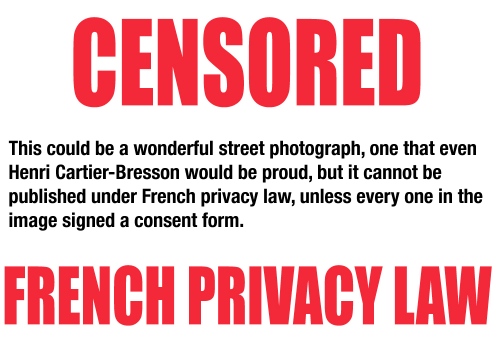
This could be a wonderful street photograph, one that even Henri Cartier-Bresson would be proud, but it cannot be published under French privacy law, unless every one in the image signed a consent form.

Minors

It is good to get the parent’s consent but a minor aged around 12-14 who is intelligent and discerning can have the right to give permission legally for use of his/her image.

Some personal characteristics are very strictly monitored under this law and considered very personal and sensitive issues – race, sexual orientation, health, political opinions.

Interpretation

Everything is seen in its context, for example; the skin color of someone is not in itself a private item, but if a photo of someone is used to identify of class someone by the color of their skin then this could go against the privacy law; also if from an image of someone one can deduce that person’s state of health, this is different to using an image, purposely to show someone’s state of health.

So it is both the context, the use and the purpose of the photographic/video image which is important; but again, everything is judged on its individual merits and it depends a lot of the judge, the place. One judgement maybe different to another on the same photo. It can also be a matter of chance, who judges it.

Privacy laws confer certain rights to individuals

• Right to be informed about how images will or can be used.

• Subjects right to ask questions, to be informed, by what right the person has to take a picture – the photographer has to answer this.

• Subject has right to access information, at any stage they want, and get information by telephone, written etc.

• A person photographed has the right of opposition at any time, when they have a serious reason for doing so, for editorial usage.

• A person don’t need a reason to oppose its use, if the image is used for direct marketing, commercial or publicity.

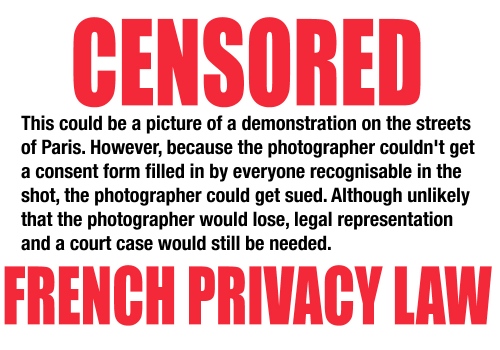
This could be a picture of a demonstration on the streets of Paris. However, because the photographer couldn't get a consent form filled in by everyone recognisable in the shot, the photographer could get sued. Although unlikely that the photographer would lose, legal representation and a court case would still be needed.

Specifically in respect for Journalism – in news (not illustration)

Exceptions to privacy are when it can be proven without doubt that the treatment of sensitive information, health or past legal history is for press, artistic expression or literature. And only when any or all of these aspects of an individual have a direct rapport with their public character or news events; then they can be brought into the public domain.

In such cases the person does not have the same rights to information or access to rights of privacy as set out above.

This forms part of the ‘democratic’ rights of journalists to perform their duties as ‘watch dog’ in a democratic society.

But journalists must not abuse this privilege. Whilst a journalist or accredited magazine might have rights to perform these duties, a school journal may not be afforded the same rights, so it becomes defamation – it is all about context, purpose and end result.

Property laws (2004 onwards)

Whilst an owner of a property or object doesn’t have exclusive rights over the use of the image of that object, they always have the right to oppose the use of the image of that object or property by a third party WHEN the use of the image causes an abnormal problem to them.

The French laws are fixed on this point. And this refers to images shot from a public space.

When an image is shot inside a private space, permission must always be granted, and a model release for persons and property must be arranged.

Rights of creation

Any sculptor, architect, artist has authors rights. Rights to the image of his/her creation. In certain instances the theory of the object as an accessory can take place in public or in private, but the author must always be mentioned by name.

One has to be extremely vigilant about the restrictions brought by the authors, examples of the recent “Le Corbusier judgement” where his inheritors have made it illegal for any photo/video image of Le Corbusier’s designs to be reproduced. Also for instance the Eiffel tower which one can photograph freely during the day but only certain circumstances at night; one is not allowed to photograph at night whilst the lighting display is in operation, as the lighting display itself is considered a copyrighted artistic work in its own right. Exceptions like this are numerous across France.

One has to research the specific rights in each object before publishing the image.

The photographer has to get written permission from the author, or his/her inheritors for up to 70 years after the author’s death.

For photographing in all Private places one always needs permission.

Text © Nigel Dickinson 2012

Illustrations © Edmond Terakopian

Sources, information and translations include amongst others:

The UPP France

L’Observatoire de l’image

__________________

There will be an audio recording of the talk available on the NUJ London Photographers’ Branch.

Edelkrone Pocket Rig

Absolute Design Genius!

I’ve just come across this product from a company I had not heard of before; the Edelkrone Pocket Rig and I am mightily impressed by it’s design and apparent functionality. Sadly I have not used this nor seen it for real, but it strikes me absolute genius!