The Fastest; Accelsior PCI Express SSD
Long Term Test
OWC stands for Other World Computing, a title which I felt was very apt for this article. Since I started using OWC’s adapter for modifying my Mac Pro to take multiple SSDs in the optical bay and installing their blisteringly fast SSD into the optical bay of my MacBook Pro, I’ve become a fan of this company. Their adapters and SSDs just seem out of this world; great design, well made and extremely fast.

It was with great interest when I first heard that a PCI Express SSD card was going to be introduced by the company. The advantages of using a PCI Express SSD card are numerous. Firstly, one is directly plugging into the motherboard, using the fastest interface, without having to go through the SATA connectors, adding some speed to operation. Secondly, it frees up your SATA connectors and drive bays for more SSDs or conventional hard drives for storage. In my Mac Pro, I now have four conventional hard drives in the drive bays which I use to store my RAW files amongst other data including documents, music, video and so on. I also have two SSDs installed in the optical bays. One is used to clone the Accelsior every night which is my OS drive, and the other is used for video files when editing a project. Having FCP X run on the OWC Accelsior and the ProRes 422 video files run from a OCZ 120Gb SSD makes for a very fast and fluid editing experience.
If you’re on a PC, the Accelsior will also work. Regardless of which system you’re using, the helpful thing is the card does not need a driver, so will just work once installed. On a Mac, you will naturally need a Mac Pro as the iMac does not have PCI Express slots.

I decided to go for the 240Gb version which is enough space to store the OS, applications and Documents. Via iTunes I did move the iTunes folder to another drive though as it was simply too big. The card uses Sandforce controllers and several systems to ensure that the SSD chips are used efficiently and kept running smoothly. The SSDs themselves are on smaller circuit boards which clip into the PCI Express daughter card; this means that in time if you want to upgrade to a larger size, it’s easily done.
Speed
Using OWC’s own figures, comparing their top of the range traditional SSD (Pro 6G) to the Accelsior makes interesting reading.
OWC Mercury Extreme Pro 6G – Read 559MB/s Write 527MB/s (Peak Data Rate)
OWC Mercury Accelsior – Read 762MB/s Write 763MB/s
Traditional 5400rpm Hard Drive – Read 75MB/s Write 77MB/s
These are test figures so real life use will vary, but it will vary proportionally, so the speed advantages are clear to see.
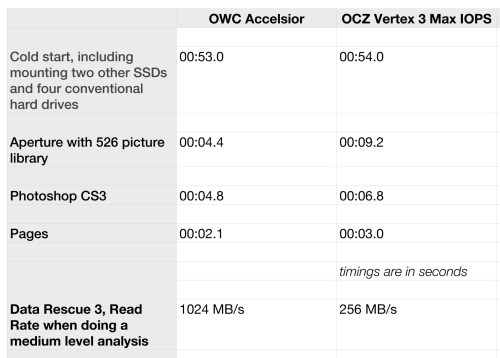
Compared to my previous OS SSD, the OCZ Vertex 3 Max IOPS which was very quick, the speed advantage of the OWC Acceslior is immediately noticeable, even without timing.
I did perform some comparisons though using my early 2009 model Mac Pro.
Reliability
Speed isn’t the only consideration to have though. I’ve had the Accelsior installed in my main imaging workstation, a Mac Pro, for three months now. It has performed without a single hiccup. I installed it when running OS Lion, cloned the OS drive onto the Accelsior using the superb CCC and upgraded to OS Mountain Lion a few days after it’s release. My Mac Pro is on 24/7, used for photo editing, photo archive use, Giclée printing, video and audio editing and general computing too. It’s hooked up to a Sonnet D800 raid with a PCI Express RAID card as well as countless other peripherals and I didn’t have a single issue at all! The Accelsior just performed with 100% absolute reliability and speed.
Final Thoughts
As new technologies come and go and we take leaps forwards, some leaps are giant. The leap to SSDs being one. They are still too costly for storage, but for using as our OS and program disks, the capacities are more than there and the prices have dropped to affordable levels. Although purely on paper the jump to PCI SSD doesn’t appear huge, it is much more than just the speed increase; it’s the convenience increase of freeing up a drive bay for storage too. I for one can’t recommend SSDs highly enough; however if you have a machine with compatible PCI Express slots, then the OWC Accelsior is an absolute no brainer. You’ll love it!
European Buyers – Macupgrade has kindly offered readers of this blog a 10% discount with the code: macupgradephoto