Category Archives: viewpoint

Fujifilm X-Pro1

Back To The Future


Fujifilm’s new X-Pro1 certainly looks like a very interesting camera. Very much looking forward to seeing what this camera can produce. I applaud Fujifilm on bringing out a large sensor, interchangeable lens camera with an optical finder; this is something I have been begging for from other manufacturers, way before Micro 4/3 or the Leica M9 were even announced.

As photographers we are now beginning to get what we want. There is a misconception amongst most camera manufacturers that pro photographers and serious enthusiasts want large, heavy, professional looking equipment with huge lenses-not true camera designers, please take note! Another issue I personally have is with mega complex menu systems that get in the way of photography; pro photographers we may be, but camera engineers we are not. It’s all about the photography, so please take a leaf out of Leica’s book and create simple, elegant menus which don’t need a manual and an entire day to try and understand.

It’s wonderful to see these small new cameras going back in time for their inspiration; Leica first came up with the 35mm format and designed small, mirror less cameras going back to the original  Ur-Leica, the screw mount interchangeable lens Leicas that followed and all the way to the current Leica M9. What’s wonderful is to hear that Fujifilm is producing a Leica M lens adapter for the X-Pro1 and the acknowledgement of just how good Leica lenses are. It remains to be seen how good the sensor is though, but the X-Pro1 may perform well as a second or third camera, or backup, to a Leica M9. Naturally as it has a cropped sensor, it will magnify the focal length of any lens attached.

What also made me smile was the way the short distance between the rear element on the lens and the sensor was described as producing better quality; it is naturally all true, but again, goes back in time to the original Leica. This is all great news for the photographer though. Image quality and performance is yet to be seen, but judging by their achievements on the X100, I’m sure Fujifilm have done a good job with the X-Pro1.

Addendum:

Dpreview have published their preview on the X-Pro1.

Police Censorship

Should Police Officers Censor What Press Photographers Photograph On The Public Streets?
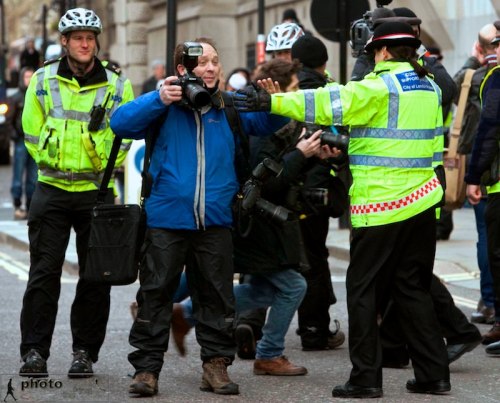
A PCSO puts her hand up to cover the lens of Nicholas Razzell, stopping him from taking pictures. The Old Bailey. January 4, 2011. Photo: Ian Vogler

It’s a very worrying question, with an extremely worrying answer coming from some members of the Police force and even more so from Police Community Support Officers. Having several friends in the Police, I know for a fact that no where in their training does it state that officers should censor this country’s free press. As long as members of the press aren’t breaking Police cordons, or on private property after being asked to leave, the Police (and I include PCSOs in this) have no power, nor rights to interfere with a photographer going about doing their job; in this case gathering news.

Sadly, last week’s court case at the Old Bailey, where two of the racist murderers of Stephen Lawrence were finally jailed, illustrated just how ill-informed some members of the Police and PCSOs are. Just what the motivation is to stop a story like this being covered is baffling.
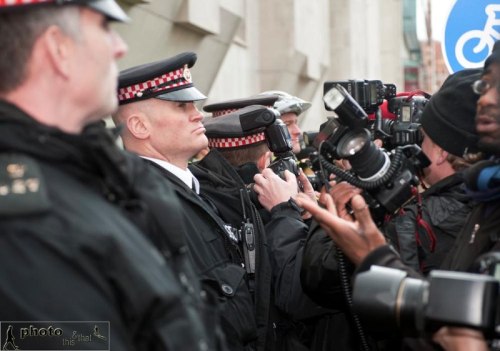
City of London police officers obstructing members of the press at the Old Bailey after the sentencing of David Norris and Gary Dobson for the murder of Stephen Lawrence. January 4, 2011. Photo: David Parker

Journalist, turned press photographer, Nicholas Razzell has been photographing high-profile criminal and civil court cases since 1999, including Jeffrey Archer, Paul Burrell, Kieran Fallon, Naomi Campbell, Paul McCartney, Charles Bronson, numerous murder and terrorism trials and more recently cases such as Julian Assange.

When asked about photographing these court cases, Nicholas says, “For most of that time the press and TV either self-police or on the odd occasion have had to work behind barriers. However, it is only in the last 5 years or so that I’ve found Policemen and particularly PCSO’s who have either no understanding of the law or it’s enforcement, getting involved”.

City of London police officers obstructing members of the press at the Old Bailey after the sentencing of David Norris and Gary Dobson for the murder of Stephen Lawrence. January 4, 2011. Photo: David Parker

“This came to head when Julian Assange was released from custody at the High Court in London when a Met Police Inspector (ably assisted by a Sky TV Producer) organised a “pool”…practically destroying any freelancers chance of getting a competitive picture.”

“Last week (Stephen Lawrence case, the Old Bailey) was just another occasion where we were prevented from doing our job. As yet there is no “right to privacy” in the UK (thank god) and it certainly isn’t up to uniformed and uninformed officers on the street, or PCSO’s to decide what we can and cannot photograph. Physically preventing us from getting a picture is one step away from moral and political censorship”.
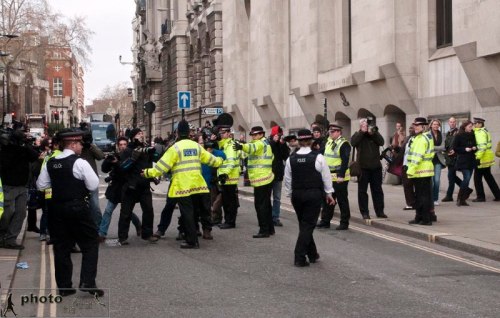
City of London police officers obstructing members of the press at the Old Bailey after the sentencing of David Norris and Gary Dobson for the murder of Stephen Lawrence. January 4, 2011. Photo: David Parker

Another photographer adds, ” It was a complete joke. The Police officers couldn’t decide which side of the street to make us stand on. One officer said we couldn’t stand under the scaffolding (open to the public) on kerb opposite because “the building company haven’t given you permission” – to stand on a public street? Then they insisted we stand about 50 yards away (to do a car shot) and when the car arrived one officer followed me across the street to make sure he blocked my view. I asked another officer if this was still a public street? She refused to answer”.

One thing is for sure; a member of the Police force should not put up their hand to cover a photographer’s lens and stop images being taken. These newsworthy moments happen in a fraction of a second and are gone forever. Press photographers have a duty to bear witness, not only for the next day’s newspapers and websites, but for historical reasons too.

For any members of the Police force and PCSOs unclear about the rights of citizens (including members of the media, because we are after all, citizens too) who wish to photograph in public places, may I encourage you to read the official Met Police Photography Advice page?

Addendum:

Any member of the media, regardless of if they are a member of the NUJ or not, can report any incidents to the NUJ. Please make sure you have badge numbers and if possible, audio and/or video recordings. This will not only help the press to do our jobs properly, but will also help the Police train their officers and PCSOs better.

The Police Respond:

A City of London Police spokesperson said: “We work closely with journalists and photographers at the Old Bailey to make sure they’re able to do their job and the public are able to go about their business. We continue to liaise with journalists, photographers and the local community to ensure this is the case”.

Twitter Tip

Keep Things Relevant!

Twitter is wonderful; very helpful, interesting and I’d say almost crucial. A community to learn from, share with, help out and interact with.

I’ve recently noticed one really huge problem; people mixing up all their various interests, all in one account. As an example, I’ve had several professional photographers follow in the last few weeks. Ordinarily, after checking their Twitter streams, I’d follow them back as being a photographer, we would normally share relevant information. Alas, these individuals use the same account for sharing Tweets about their major passion, in these cases, various football clubs around the country. I need to add that this isn’t a new phenomenon; I’ve had exactly this problem for a very long time. Having to unfollow people because they clog up my timeline with irrelevant to me information, or not follow them from the start.

The chances of finding a photographer on Twitter who is interested in your work and thoughts is one thing; finding one who also shares an interest in X, Y or Z Football Club for example, is much slimmer still. Also, in reverse, these football fan followers will have no interest in the newest, fastest lens, Canon’s new DSLR and probably will never even have heard of Leica or know what OS X means.

My suggestion is to have different Twitter accounts for your photography, football, stamp collecting, cooking and so on. It means you can write to a relevant crowd and not bore those who don’t share all your interests.

Happy Tweeting, from @terakopian

Chase Jarvis’ Photo & Video Workflow

“Nessie” Proof Backup Strategy

I’m a big believer in having a good backup strategy; it’s absolutely essential in this day and age of digital everything. My friend and colleague Chase Jarvis has put together a great video showing how he approaches the challenges of photo and video backup workflow; definitely check it out.

Happy Holidays!

Wishing all my readers a very happy holiday season, a merry Christmas and the very best for a wonderful 2012.

Leveson Inquiry Says No To The BPPA

BPPA Refused by Leveson Inquiry

I’m shocked and saddened to find out that the Leveson Inquiry has rejected the BPPA‘s (British Press Photographers’ Association) application to become core participants in the inquiry.

The inquiry which was set up to look into press ethics and working practices following various recent tabloid practices (some of which are now known not to have happened at the hands of the press) took a turn and began attacking the paparazzi and photographers as a whole. The reporting of the inquiry has muddled the distinction of the paparazzi and working press photographers, calling everyone a press or news photographer.

Michelle Heaton from Liberty X is chased by the gathered paparazzi at the invitation only dinner for cast and guests, after the X-Men 2 movie premiere at "Sketch", Conduit Street, London W1. April 24, 2003. Photo: Edmond Terakopian

The BPPA made an application to become a core participant to balance out the extremely one sided evidence which was given, but sadly has been rejected from doing this.

How is the Leveson Inquiry going to be balanced or even accurate if it won’t accept the BPPA?

Related Reading:

The BPPA & The Leveson Inquiry

I’m A Press Photographer & Very Proud Of It