Is FCP X right for the DSLR filmmaker?
Reviewed July 2011, FCP X version 10.0.0
Depending who you speak to, the world is either about to end or something wonderful happened when Apple launched it’s professional video editing program (June 2011), Final Cut X. Not so much of an upgrade but a completely new 64-bit program. I’ve never seen so much hysteria about a computer program; some it purely misinformed, others from individuals blindly following what the pro editors are saying and some from very justified sources.
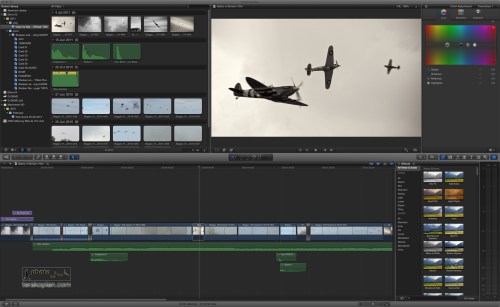
FCP X, showing the Event Library, Clips, Viewer, Inspector (Colour Adjustment), Timeline, Effects Browser and Audio Meters.
The professional editors who rely on Final Cut Pro to make a living do have a point and FCP X is not ready to meet all of their needs. To get an understanding of the issues faced, I contacted Editor and Colourist Neil Patience. “Its fair to say that FCPX received a very negative reaction from many sections of the editing community. The ones who seemed to be shouting “foul” the loudest were those working in TV facilities houses and broadcast environments. As someone who has been working in broadcast television for about 20 years I can understand why they were unhappy”.
“Making television programmes is rarely a solitary endeavour. Collaboration is a key part of the process. TV facilities need to be able to move media along the stages of post production process as efficiently and seamlessly as possible. Shoot, ingest, rough cut, fine cut, finishing, visual FX colour grading and audio dubbing and layback is a common path for many TV shows. Different people bring different skill sets along the way, kit wise, Avid, Apple, DaVinci, Baselight, ProTools and Fairlight are just a few that are used. Getting all those to integrate uses a combination of EDL, XML and OMF files depending on what is going where. The ability to open archive projects is also critical and with no support for opening FCP7 projects, FCPX is again left wanting.”.
“Tape is not dead in our world, we wish it was, but the archive of tape is huge. Apple’s tapeless utopia is no where near a reality. Fifty odd years of worldwide tape based acquisition and mastering adds up, not to mention all the film that was transferred to tape.
Final Cut X, in its current incarnation, literally allows none of the above to happen.
All the tools we need daily to collaborate with our colleagues are missing and the hardware to allow critical external monitoring and measuring to ensure technical compliance is not supported”.
“But it is not all doom and gloom. Not everyone has to meet broadcast delivery requirements or needs elaborate collaborate workflows. The first things that struck me about FCPX is that it feels quick and the timeline feels smooth. The 64 bit architecture is certainly a performance boost. DSLR film makers, for example, can take advantage of this speed and the easy file based importing, everything is geared towards the single user operator. Effects and “looks” can be quickly and easily auditioned and FCPX guides the less technically skilled editors along the way, automatically creating tracks as needed, avoiding clip collisions and keeping things in sync. Background render is a big advantage too. If your main skill is shooting, these features will initially make your life easier as you develop your editing skills”.
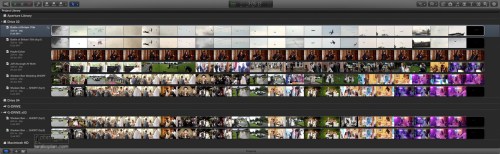
Projects Library in FCP X.
I think it’s important to understand all the issues and negativity from parts of the editing community as it will help make an informed decision on FCP X. I would imagine that the majority of the readership of the BJP will be from a background of photography and of creating photographs and video and like me, working on projects on their own or within a small team. For me, the Canon 5D MkII opened up a whole new world of creativity in film making; one that I thoroughly enjoy. Whilst I enjoy the editing process, it’s not my favourite thing. In fact the first time I ever opened up FCP 6, I had to shut it down and only returned to it days later after mustering up enough courage. FCP X is different; the interface is radically different and no longer looks or feels like an ageing OS 9 program. It’s 64 bit which means it can access all of your system’s RAM. It’s also designed to utilise all CPU cores and also use the GPU. I’ve found it to be super fast and stable. It’s also a bargain compared to the £850 or so FCP 7 Studio cost; FCP X is £179.99 and the two other modules, Motion and Compressor, are both £29.99 each and are all available from the App Store.
Armed with Larry Jordan’s brilliant FCP X Complete Training course (which I thoroughly recommend), I downloaded FCP X and began my exploration. Not having much of an iMovie background, it did initially take me a short while to grasp FCP X but it’s so intuitive that I took to it very easily and quickly. This review addresses whether FCP X is right for the DSLR filmmaker. As always, I decided to do real world tests and spent several days editing a project involving video, photographs, music and recorded audio. For another test, I edited from scratch using native Canon 5D MkII files a piece on the 70th Anniversary of the Battle of Britain; the entire process took around four hours:
What’s New?
One of the biggest things is the new magnetic timeline. FCP X has done away with tracks and it’s just a canvas that let’s you drag your video, audio and photographs onto and they just snap on and into place. It lets you move and insert clips and automatically moves the other clips around for you without the need for modifier keys like previously. You can easily connect clips together (such as effects, titles and so on) so when they are moved around, they always stay together and in sync. Compounding clips takes this a step further allowing various elements to be consolidated into a single clip and as such, edited as one clip. All of these make entire process easier, quicker and much less prone to user error. As a bonus, it also takes up much less space which means working on a smaller screen is so much easier. On the subject of photographs, the previous version’s 4000 pixel limit no longer applies; larger photographs can be imported and used.
The Inline Precision Editor lets you do very intricate and accurate trimming straight on the timeline. With Auditions, you can take a segment and try various clip edits, grading and so on until you have got it spot on.
Importing files has also radically improved, especially for the DSLR video user; the import dialogue lets you not only import, but have your video transcoded to Pro Res 422 and have both the video and audio analysed. All of this happens in the background, so even when these processes are occurring, you can still begin your rough cuts, saving a huge amount of time. A misconception is that FCP X won’t work with tape at all; if you have a firewire controlled video camera which is supported (check with manufacturer for a driver), you can import from tape. Importing from professional broadcast decks or exporting to tape is not supported though. A point to note is that you can always use FCP 7 to log and capture your tape, export this as a Quicktime file (say Pro Res 422) and then import that into FCP X for editing.
The transcoding is optional but recommended. If you’re on deadline and editing a small piece, you can just import your DSLR movie files and edit them natively. For best results though, transcoding is always best; with this happening in the background, it’s no longer such a time waster. Another feature is that all rendering is also done in the background, making the entire editing process fluid as you no longer have to keep stopping to wait for rendering to finish.
Another massive improvement is media organisation; the Event Library is where imported clips are saved; you can choose to have Event Libraries on various connected hard drives. The browser lets you easily look through clips and the skimming feature lets you very quickly skim through a clip to find the segment you are looking for. The ‘I’ and ‘O’ let you easily add In and Out points or you can just use the mouse to click drag a selection straight onto the clip. Once you’ve created your Project, it’s then a simple question of adding (by dragging, keyboard shortcuts or clicking on the relevant button on screen) these clips to the Timeline to begin your rough cut. The whole system, of Events and Projects makes it very easy to share or backup your work through the Duplicate function (which can included source and render files too). This new structure has made organising and backing up extremely simple and manageable. Tagging of clips with ‘favourite’ or ‘reject’ tabs in the browser helps speedily locate useful clips and hiding the ‘rejects’ makes for a tidier workspace. Keywords and smart collections help organise your archive as it grows.
There’s also an abundance of control over audio editing, effects, titles and colour corrections and grading with helpful export presets for commonly used sites for the solo filmmaker like Vimeo as well as export to DVD and even BluRay.
All’s Not Perfect
For me, perhaps the biggest disappointment is that previous FCP projects are not compatible, which means that I must keep FCP 7 installed. I do wish that either Apple or a third party comes up with a translator but it doesn’t seem likely as FCP X has an entirely new project architecture and trackless timeline. I’m also puzzled to why Soundtrack Pro was dropped, although there are more audio facilities built in to FCP X. Although not a user of it myself, I think dropping Colour may have been a mistake.
As far as plugins (such as Magic Bullet), camera and video card support and so on, it’s only a matter of time until 64bit compatible plugins and drivers are released. Most of the big name plugin manufacturers have already openly said they are working on upgrades.
Conclusions
I spent a while discussing FCP X with a photographer colleague on Twitter. He was enraged, quoting video editors as to how bad this release is and he can’t trust Apple and is switching to Adobe Premiere and so on. Funny thing was, two days later, this DSLR using colleague actually tried FCP X and had nothing but praise.
With FCP X, Apple has done what Apple does best; it’s looked into the future (remember the outrage when it dropped the floppy drive?). FCP X seems to be designed for the coming decade and not for what went before it. It has revolutionised the ageing look, feel and workflow of FCP 7 and really brought it in line with OS X; it’s intuitive, elegant, solid and stable. With multi-cam and XML support on the way from Apple, with OMF, AMF and EDL support on the way from third parties, I feel that even the video editing community with all their specific needs will begin using FCP X in 8-12 months.
If you rely heavily on plugins or use specific hardware, my advice is wait a month or two until the upgrades for FCP X arrive. It can co-exist with FCP 7 anyway, so you can carry on using it and begin learning FCP X. One thing is for sure though, FCP X is definitely the future and for the indy filmmaker and DSLR shooter, FCP X is absolutely ideal. Having used it for all of the past week, I dread ever having to open FCP 7 again. I rather like it!
Reviewed, July 2011







 Photo This & That