The Perfect Camera Bag?

Think Tank Photo Retrospective 7 shoulder bag. Shown with two Leica M cameras; L-R: Leica M9 with 50mm Noctilux ASPH and M9-P with 35mm Summilux ASPH. May 31, 2012. Photo: Edmond Terakopian
As photographers we spent our years searching for that perfect image. Any photographer who has been in the industry for any length of time has most probably spent a sizeable amount of time also searching for the perfect camera bag!
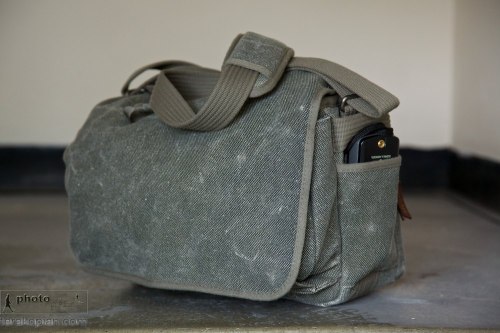
Think Tank Photo Retrospective 7 shoulder bag. Front view, showing a lightmeter in the side pocket. May 31, 2012. Photo: Edmond Terakopian
Firstly, I would say that no such thing exists as “the perfect camera bag”. It’s taken me a couple of decades to come up with this conclusion. I would say though that the perfect camera bag system does exist. One type of bag simply will not work for all situations, types of equipment or types of assignment, therefore having a system of bags is the answer. I’ve been a user of Think Tank Photo bags for many years now and was so impressed with them that I even joined the design board a couple of years ago, for a year. (I hasten to add that I’ve had no input into this bag, so it is a straight forward review). I now use a system of roller bags and backpacks which allow for transportation of gear to an assignment, and then a selection of belt pouches, chest bag (the Change Up) and shoulder bags, to work from (I choose what suits the assignment best). I choose what will suit a particular assignment as carefully as I choose my camera or video gear. This way I can work both comfortably and quickly, with the equipment not getting in the way of the job at hand.

Think Tank Photo Retrospective 7 shoulder bag. Rear view, showing a lightmeter in the side pocket. May 31, 2012. Photo: Edmond Terakopian
I’ve been actively using the Retrospective 7 on assignment for several weeks now and must say I am very, very impressed. It now houses my Leica M outfit, comprising of an M9, M9-P, 21mm Elmarit, 28mm Summicron ASPH, 35mm Summilux ASPH, 50mm Noctilux ASPH, 90mm Summarit, SF 58 flash and various accessories. The main thing with this bag though was that it was designed to take an Apple 11″ MacBook Air or iPad too, so depending on what I’m doing, I will slip the appropriate computer in the rear zipped and padded compartment.

Think Tank Photo Retrospective 7 shoulder bag. Rear view, showing an Apple 11″ MacBook Air in the rear pocket. May 31, 2012. Photo: Edmond Terakopian
Like the other Retrospective Bags, it’s lightweight, unconstructed and soft, with a moving base (made up of several padded sections that move with the movement of the bag). This makes the range, and this bag too, an extremely comfortable shoulder bag to work with and work from. It also has the genius silent velcro system which comes in very handy in quite press conferences (and will suit every wedding photographer when it comes to working in a church environment).

Think Tank Photo Retrospective 7 shoulder bag. Rear view, showing an Apple iPad 3. May 31, 2012. Photo: Edmond Terakopian
Although I house my rangefinder outfit in the Retrospective 7, it will also be perfect for any Micro 4/3 system by Panasonic or Olympus and the Fuji X-Pro 1 kit. It will also take smaller DSLRs (without grips), including the 5D MkIII or D800, with lenses up to the 24-70 f2.8s and smaller prime lenses. It’s an extremely versatile size and can be configured to house a wide variety of gear, including a means to edit and send pictures.

Think Tank Photo Retrospective 7 shoulder bag. Interior shot, with dividers set up specifically for a Leica M outfit. May 31, 2012. Photo: Edmond Terakopian
Is it the perfect bag? Well, I’d say it’s the perfect shoulder bag and it’s now my favourite shoulder bag of all time. Highly recommended.
The Retrospective 7, along with most of that range is available in Black, Pinestone and the new Blue Slate colours. If you’re in the UK, check out SnapperStuff where you can order directly or find your local dealer. Otherwise, check out the Think Tank Photo.
Addendum: Macjim has kindly sent me this picture showing his Retrospective 7 with the Apple 13″ MacBook Air in the front pocket. I wouldn’t say it’s ideal, but appears a workable solution if needs must.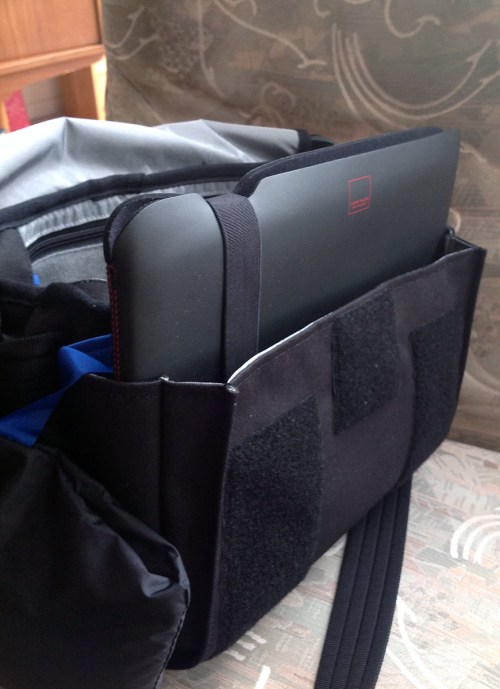









 Photo This & That
What’s Wrong With The Newspaper Industry
Press Photography & The Papers
A press card and a selection of media accreditation from over the years. June 12, 2012. Photo: Edmond Terakopian
The problems with the industry (normally and not just during this recession) are multiple; some do lay with the accountants who run most things (being qualified with arithmetic and spread sheet skills, or the understanding of formulas, in my mind does not give someone aesthetic understanding or the ability to have a news sense), weak picture editors, bad editors, visually less capable mass audience and the pandering of the papers to the weakest common denominator as opposed to trying to visually educate the readership a little. Not too long ago we had newspapers that ran the most amazing photography; informative, accurate, ethical, creative and mind blowingly powerful – and no, I’m not just talking about the broadsheets (as they were then) but a few tabloid papers too.
Another huge issue is the switch to digital and the ‘everyone’s a photographer’ syndrome; backed by accountants who see a picture as something that has four sides to it but have no ability to comprehend it’s content, importance or power. This also lead to the birth of the mass paparazzi – the most money paid for photography is for this type of content and the publications who print this material, sell the most, so have the biggest budgets.
The ‘new’ technology, called the internet also has had a detrimental effect to the traditional model of newspapers. A day late, even with great analysis and checked, journalistically correct information, is sometimes too late for readers. I saw new in quotes as anyone looking at most newspaper websites would thing the internet came to being a couple of months ago. It’s been with us long enough, yet few papers have learnt to design good, usable websites that harness the power of the web and deliver amazing content. The business model has to change too; good content needs to be paid for properly. Content is king; no good content means lower visitor hits, equalling less advertising revenue. It’s not rocket science! It is however beyond doubt the future (including mobile devices using the internet for delivery of content).
Let’s not forget though, as photographers we have our share of the blame. Some of this ignorance comes from the educational sector who are happy to teach Susan Sontag and theory, but when it comes to actual skills needed by photographers to survive, like knowing one’s rights and the law of copyright, they teach nothing. The rest of the blame is purely with us for not finding out.
We are signing away our copyright and future rights to our work, even though the law states that it’s ours. This is shortsighted and every time such a contract is signed, another nail is hammered into our collective coffin. There is no going back from this. Sooner than you know, we will retire and have no picture library of our own to fall back on; so, no books, no print sales and no exhibitions. My thoughts are that the bigger picture needs to be looked at; after all, this is a career and so, is long term.
We are killing our own industry too.
Leave a comment
Posted in Business, education, newspaper, Photography, viewpoint
Tagged comment, copyright, industry, intellectual rights, law, newspaper, photography, press, rights