Year in pictures 2011
A superb selection of images, showcasing Getty Images photographer Peter Macdiarmid’s favourite shots from 2011.

A superb selection of images, showcasing Getty Images photographer Peter Macdiarmid’s favourite shots from 2011.
Posted in newspaper, Photography, Pictures
Tagged end of year, pictures of the year, press photography, review, year in pictures
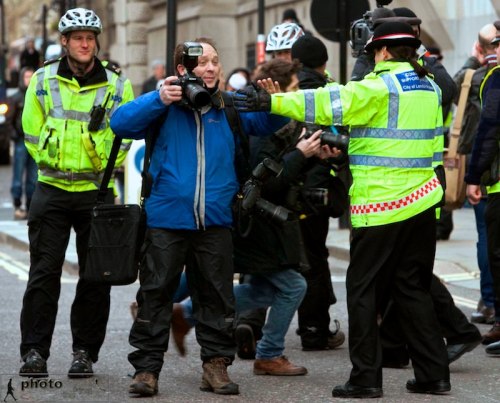
A PCSO puts her hand up to cover the lens of Nicholas Razzell, stopping him from taking pictures. The Old Bailey. January 4, 2011. Photo: Ian Vogler
It’s a very worrying question, with an extremely worrying answer coming from some members of the Police force and even more so from Police Community Support Officers. Having several friends in the Police, I know for a fact that no where in their training does it state that officers should censor this country’s free press. As long as members of the press aren’t breaking Police cordons, or on private property after being asked to leave, the Police (and I include PCSOs in this) have no power, nor rights to interfere with a photographer going about doing their job; in this case gathering news.
Sadly, last week’s court case at the Old Bailey, where two of the racist murderers of Stephen Lawrence were finally jailed, illustrated just how ill-informed some members of the Police and PCSOs are. Just what the motivation is to stop a story like this being covered is baffling.
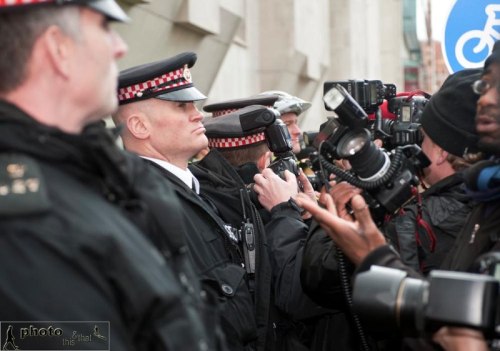
City of London police officers obstructing members of the press at the Old Bailey after the sentencing of David Norris and Gary Dobson for the murder of Stephen Lawrence. January 4, 2011. Photo: David Parker
Journalist, turned press photographer, Nicholas Razzell has been photographing high-profile criminal and civil court cases since 1999, including Jeffrey Archer, Paul Burrell, Kieran Fallon, Naomi Campbell, Paul McCartney, Charles Bronson, numerous murder and terrorism trials and more recently cases such as Julian Assange.
When asked about photographing these court cases, Nicholas says, “For most of that time the press and TV either self-police or on the odd occasion have had to work behind barriers. However, it is only in the last 5 years or so that I’ve found Policemen and particularly PCSO’s who have either no understanding of the law or it’s enforcement, getting involved”.

City of London police officers obstructing members of the press at the Old Bailey after the sentencing of David Norris and Gary Dobson for the murder of Stephen Lawrence. January 4, 2011. Photo: David Parker
“This came to head when Julian Assange was released from custody at the High Court in London when a Met Police Inspector (ably assisted by a Sky TV Producer) organised a “pool”…practically destroying any freelancers chance of getting a competitive picture.”
“Last week (Stephen Lawrence case, the Old Bailey) was just another occasion where we were prevented from doing our job. As yet there is no “right to privacy” in the UK (thank god) and it certainly isn’t up to uniformed and uninformed officers on the street, or PCSO’s to decide what we can and cannot photograph. Physically preventing us from getting a picture is one step away from moral and political censorship”.
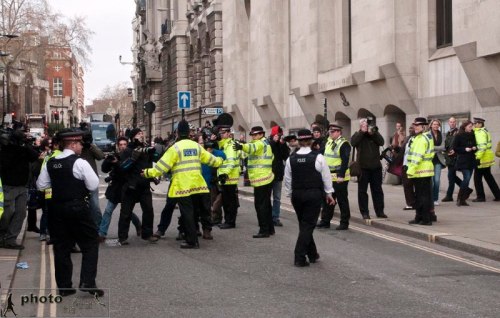
City of London police officers obstructing members of the press at the Old Bailey after the sentencing of David Norris and Gary Dobson for the murder of Stephen Lawrence. January 4, 2011. Photo: David Parker
Another photographer adds, ” It was a complete joke. The Police officers couldn’t decide which side of the street to make us stand on. One officer said we couldn’t stand under the scaffolding (open to the public) on kerb opposite because “the building company haven’t given you permission” – to stand on a public street? Then they insisted we stand about 50 yards away (to do a car shot) and when the car arrived one officer followed me across the street to make sure he blocked my view. I asked another officer if this was still a public street? She refused to answer”.
One thing is for sure; a member of the Police force should not put up their hand to cover a photographer’s lens and stop images being taken. These newsworthy moments happen in a fraction of a second and are gone forever. Press photographers have a duty to bear witness, not only for the next day’s newspapers and websites, but for historical reasons too.
For any members of the Police force and PCSOs unclear about the rights of citizens (including members of the media, because we are after all, citizens too) who wish to photograph in public places, may I encourage you to read the official Met Police Photography Advice page?
Addendum:
Any member of the media, regardless of if they are a member of the NUJ or not, can report any incidents to the NUJ. Please make sure you have badge numbers and if possible, audio and/or video recordings. This will not only help the press to do our jobs properly, but will also help the Police train their officers and PCSOs better.
A City of London Police spokesperson said: “We work closely with journalists and photographers at the Old Bailey to make sure they’re able to do their job and the public are able to go about their business. We continue to liaise with journalists, photographers and the local community to ensure this is the case”.
Posted in News, newspaper, Photography, police, viewpoint
Tagged censorship, court, nicholas razzell, pcso, police, police community support officer
I’ve just come across a project shot by Don McCullin for Asus and Intel, called In Search of Incredible. There are some interesting behind the scenes videos by Clive Booth.

Twitter is wonderful; very helpful, interesting and I’d say almost crucial. A community to learn from, share with, help out and interact with.
I’ve recently noticed one really huge problem; people mixing up all their various interests, all in one account. As an example, I’ve had several professional photographers follow in the last few weeks. Ordinarily, after checking their Twitter streams, I’d follow them back as being a photographer, we would normally share relevant information. Alas, these individuals use the same account for sharing Tweets about their major passion, in these cases, various football clubs around the country. I need to add that this isn’t a new phenomenon; I’ve had exactly this problem for a very long time. Having to unfollow people because they clog up my timeline with irrelevant to me information, or not follow them from the start.
The chances of finding a photographer on Twitter who is interested in your work and thoughts is one thing; finding one who also shares an interest in X, Y or Z Football Club for example, is much slimmer still. Also, in reverse, these football fan followers will have no interest in the newest, fastest lens, Canon’s new DSLR and probably will never even have heard of Leica or know what OS X means.
My suggestion is to have different Twitter accounts for your photography, football, stamp collecting, cooking and so on. It means you can write to a relevant crowd and not bore those who don’t share all your interests.
Happy Tweeting, from @terakopian
A fascinating look at how National Geographic Magazine photographer Joe McNally shoots a story called The Sense of Sight and how the editing process of the 1200 rolls of film takes place, including all the various editorial meetings which result in the 40 page magazine story.
Posted in Interview, Photography, Pictures
Tagged joe mcnally, nat geo, national geographic
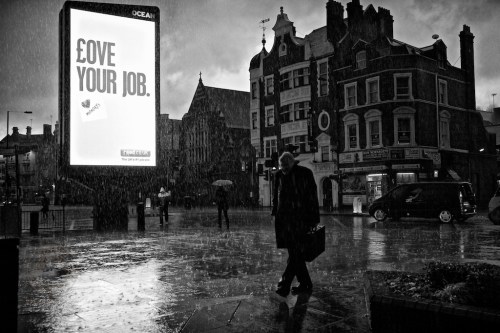
Heavy rain soaks a businessman as he passes an advertising sign saying "Love Your Job". Hammersmith, London. January 14, 2011. Photo: Edmond Terakopian
I’m delighted to say that one of my pictures has made The Huffington Post Pictures of the Year 2011. Interestingly the feature was done by asking photographers to choose their favourite image of the year. I chose mine and I’m delighted it’s in and what’s more, is the front cover image to the slideshow.
This is the one image which really stands out for me from 2011. I’ve been fortunate and had some great press and commercial jobs, both in the UK and the US (New York and Miami), but something keeps bringing me back to this picture taken in a rainy winter’s afternoon in Hammersmith, west London. I was on my way back to my car after visiting an expo at a nearby hotel. The rain was absolutely torrential and people were running for shelter all round. I first spotted the illuminated sign as it was side lighting the rain and giving a surreal look to the entire scene. It was a rolling sign with several adverts, but this particular one was the brightest. It was only then that I realised the message and as luck would have it, after several minutes, a businessman ran across my frame and I managed to get this picture on my Leica M9 and 35mm Summicron ASPH lens. The RAW image was processed in Apple’s Aperture and the black and white work was carried out in Nik Software’s Silver Efex Pro 2.
For me the image works on several levels. In it’s simplest form, it’s a rainy and great day with a dreary businessman and the message to love your job. It also works on a deeper level of world recession, doom and gloom. The message now taking on a different meaning; love your job as there are no other jobs, or as you may lose it. There’s also a lot of interesting aspects to the image, various figures, interesting light and bucket fills of mood.


 Photo This & That