Should Police Officers Censor What Press Photographers Photograph On The Public Streets?
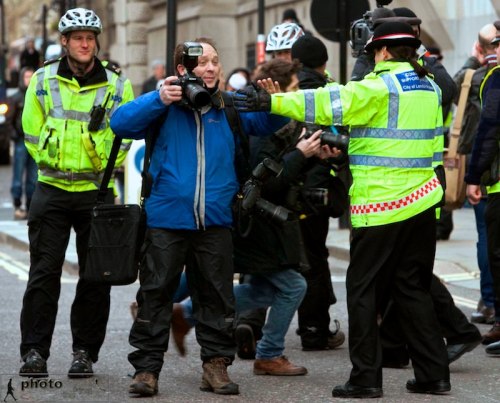
A PCSO puts her hand up to cover the lens of Nicholas Razzell, stopping him from taking pictures. The Old Bailey. January 4, 2011. Photo: Ian Vogler
It’s a very worrying question, with an extremely worrying answer coming from some members of the Police force and even more so from Police Community Support Officers. Having several friends in the Police, I know for a fact that no where in their training does it state that officers should censor this country’s free press. As long as members of the press aren’t breaking Police cordons, or on private property after being asked to leave, the Police (and I include PCSOs in this) have no power, nor rights to interfere with a photographer going about doing their job; in this case gathering news.
Sadly, last week’s court case at the Old Bailey, where two of the racist murderers of Stephen Lawrence were finally jailed, illustrated just how ill-informed some members of the Police and PCSOs are. Just what the motivation is to stop a story like this being covered is baffling.
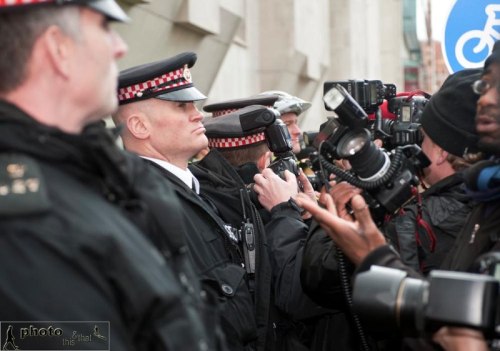
City of London police officers obstructing members of the press at the Old Bailey after the sentencing of David Norris and Gary Dobson for the murder of Stephen Lawrence. January 4, 2011. Photo: David Parker
Journalist, turned press photographer, Nicholas Razzell has been photographing high-profile criminal and civil court cases since 1999, including Jeffrey Archer, Paul Burrell, Kieran Fallon, Naomi Campbell, Paul McCartney, Charles Bronson, numerous murder and terrorism trials and more recently cases such as Julian Assange.
When asked about photographing these court cases, Nicholas says, “For most of that time the press and TV either self-police or on the odd occasion have had to work behind barriers. However, it is only in the last 5 years or so that I’ve found Policemen and particularly PCSO’s who have either no understanding of the law or it’s enforcement, getting involved”.

City of London police officers obstructing members of the press at the Old Bailey after the sentencing of David Norris and Gary Dobson for the murder of Stephen Lawrence. January 4, 2011. Photo: David Parker
“This came to head when Julian Assange was released from custody at the High Court in London when a Met Police Inspector (ably assisted by a Sky TV Producer) organised a “pool”…practically destroying any freelancers chance of getting a competitive picture.”
“Last week (Stephen Lawrence case, the Old Bailey) was just another occasion where we were prevented from doing our job. As yet there is no “right to privacy” in the UK (thank god) and it certainly isn’t up to uniformed and uninformed officers on the street, or PCSO’s to decide what we can and cannot photograph. Physically preventing us from getting a picture is one step away from moral and political censorship”.
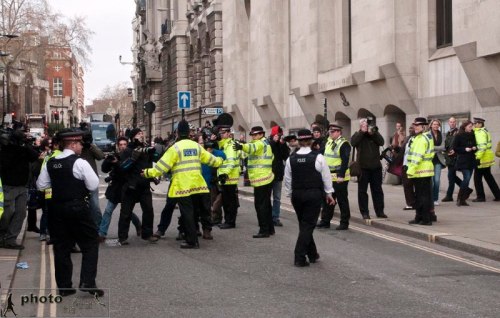
City of London police officers obstructing members of the press at the Old Bailey after the sentencing of David Norris and Gary Dobson for the murder of Stephen Lawrence. January 4, 2011. Photo: David Parker
Another photographer adds, ” It was a complete joke. The Police officers couldn’t decide which side of the street to make us stand on. One officer said we couldn’t stand under the scaffolding (open to the public) on kerb opposite because “the building company haven’t given you permission” – to stand on a public street? Then they insisted we stand about 50 yards away (to do a car shot) and when the car arrived one officer followed me across the street to make sure he blocked my view. I asked another officer if this was still a public street? She refused to answer”.
One thing is for sure; a member of the Police force should not put up their hand to cover a photographer’s lens and stop images being taken. These newsworthy moments happen in a fraction of a second and are gone forever. Press photographers have a duty to bear witness, not only for the next day’s newspapers and websites, but for historical reasons too.
For any members of the Police force and PCSOs unclear about the rights of citizens (including members of the media, because we are after all, citizens too) who wish to photograph in public places, may I encourage you to read the official Met Police Photography Advice page?
Addendum:
Any member of the media, regardless of if they are a member of the NUJ or not, can report any incidents to the NUJ. Please make sure you have badge numbers and if possible, audio and/or video recordings. This will not only help the press to do our jobs properly, but will also help the Police train their officers and PCSOs better.
The Police Respond:
A City of London Police spokesperson said: “We work closely with journalists and photographers at the Old Bailey to make sure they’re able to do their job and the public are able to go about their business. We continue to liaise with journalists, photographers and the local community to ensure this is the case”.


 Photo This & That
What’s Wrong With The Newspaper Industry
Press Photography & The Papers
A press card and a selection of media accreditation from over the years. June 12, 2012. Photo: Edmond Terakopian
The problems with the industry (normally and not just during this recession) are multiple; some do lay with the accountants who run most things (being qualified with arithmetic and spread sheet skills, or the understanding of formulas, in my mind does not give someone aesthetic understanding or the ability to have a news sense), weak picture editors, bad editors, visually less capable mass audience and the pandering of the papers to the weakest common denominator as opposed to trying to visually educate the readership a little. Not too long ago we had newspapers that ran the most amazing photography; informative, accurate, ethical, creative and mind blowingly powerful – and no, I’m not just talking about the broadsheets (as they were then) but a few tabloid papers too.
Another huge issue is the switch to digital and the ‘everyone’s a photographer’ syndrome; backed by accountants who see a picture as something that has four sides to it but have no ability to comprehend it’s content, importance or power. This also lead to the birth of the mass paparazzi – the most money paid for photography is for this type of content and the publications who print this material, sell the most, so have the biggest budgets.
The ‘new’ technology, called the internet also has had a detrimental effect to the traditional model of newspapers. A day late, even with great analysis and checked, journalistically correct information, is sometimes too late for readers. I saw new in quotes as anyone looking at most newspaper websites would thing the internet came to being a couple of months ago. It’s been with us long enough, yet few papers have learnt to design good, usable websites that harness the power of the web and deliver amazing content. The business model has to change too; good content needs to be paid for properly. Content is king; no good content means lower visitor hits, equalling less advertising revenue. It’s not rocket science! It is however beyond doubt the future (including mobile devices using the internet for delivery of content).
Let’s not forget though, as photographers we have our share of the blame. Some of this ignorance comes from the educational sector who are happy to teach Susan Sontag and theory, but when it comes to actual skills needed by photographers to survive, like knowing one’s rights and the law of copyright, they teach nothing. The rest of the blame is purely with us for not finding out.
We are signing away our copyright and future rights to our work, even though the law states that it’s ours. This is shortsighted and every time such a contract is signed, another nail is hammered into our collective coffin. There is no going back from this. Sooner than you know, we will retire and have no picture library of our own to fall back on; so, no books, no print sales and no exhibitions. My thoughts are that the bigger picture needs to be looked at; after all, this is a career and so, is long term.
We are killing our own industry too.
Leave a comment
Posted in Business, education, newspaper, Photography, viewpoint
Tagged comment, copyright, industry, intellectual rights, law, newspaper, photography, press, rights