Hands On Review Of The Olympus OM-D E-M1 Camera
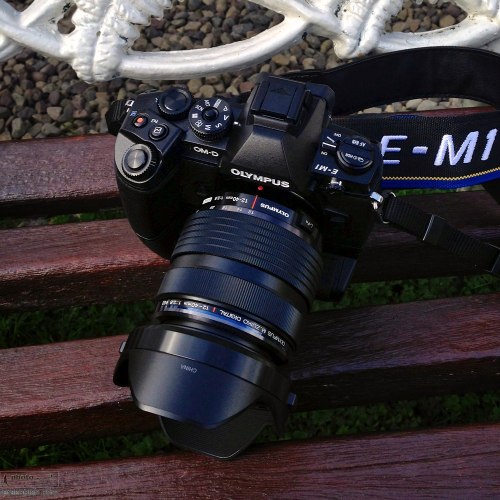
The Olympus OM-D E-M1 with the new Olympus M4/3 12-40mm f2.8 zoom and grip. Castle Leslie, Glaslough, Ireland. September 10, 2013. Photo: ©Edmond Terakopian
The E-M1 was about to join a list of cameras which had made an impression on me from the moment I had picked them up; the Nikon FE, FM, FE2, FM2, F3. The Canon T90, 5D MkIII, 1D MkII, MkIII (after the sub mirror fix), Mk IV and 1DX, Leica R6.2 and every single Leica M camera from film to digital, but excluding the M5, M8 and M8.2.
I was sitting in the airport terminal, waiting for our plane to Ireland. That’s when I first saw the 16MP Olympus OM-D E-M1 in the flesh. The second I held the camera, it just felt right. It was solid like no other micro four thirds camera I’d used, more like a pro DSLR. The ergonomics were right; the grip was the perfect size and the buttons just fell to hand perfectly. It definitely felt right. I knew then I was in for a treat. The little Olympus had joined a very exclusive list of cameras that conveyed a feeling upon first touch.

Olympus OM-D EM-1 Test Shot witht he Olympus 12-40mm f2.8 lens. Castle Leslie, Glaslough, Ireland. September 10, 2013. Photo: ©Edmond Terakopian *jpeg image processed in Aperture and Silver Efex Pro 2*
Olympus had arranged for a few photographers and trade journalists to fly off to Ireland’s lovely Castle Leslie and spend seven to eight hours with the camera. Various scenarios were arranged to give us the opportunity to try out the camera’s various functions and also to put Olympus’ Micro Four Thirds and older Four Thirds lenses (which are compatible and also AF, using an adapter) to use. Everything from models, lighting (flash and continuous tungsten), galloping horses, dark and dingy situations and an amazing light drawing artist were all at hand, as was the beautiful surroundings of the castle itself. I have to say that the event was organised and executed perfectly.

Olympus OM-D EM-1 Test Shot with the new Olympus 12-40mm f2.8 lens. Lit with a portable Pro Photo studio flash triggered wirelessly. Photo: ©Edmond Terakopian
We were each given a camera bag with the E-M1, grip and brand new Olympus 12-40mm f2.8 Pro lens (in 35mm terms, this becomes a 24-80mm f2.8 – we were in fact the first photographers worldwide, outside of Olympus staff to use this lens), a second lens (in my case a 12mm f2.0) and a flash (which I didn’t get a chance to try). We were split into three groups and within the groups we had access to all other micro four thirds lenses, including the simply brilliant 45mm and 75mm f1.8 lenses. We also had the knowledgeable Florian from Olympus Germany on hand to help with any technical questions.

A horse and rider gallop through a lake. Olympus OM-D EM-1 Test Shot with the Olympus 75mm f1.8 lens. Castle Leslie, Glaslough, Ireland. September 10, 2013. Photo: ©Edmond Terakopian *jpeg image processed in Aperture*

The Olympus OM-D E-M1 with a Four Thirds Olympus 300mm f2.8 lens, attached with an adapter. This combination was used to take the photograph below. Castle Leslie, Glaslough, Ireland. September 10, 2013. Photo: ©Edmond Terakopian
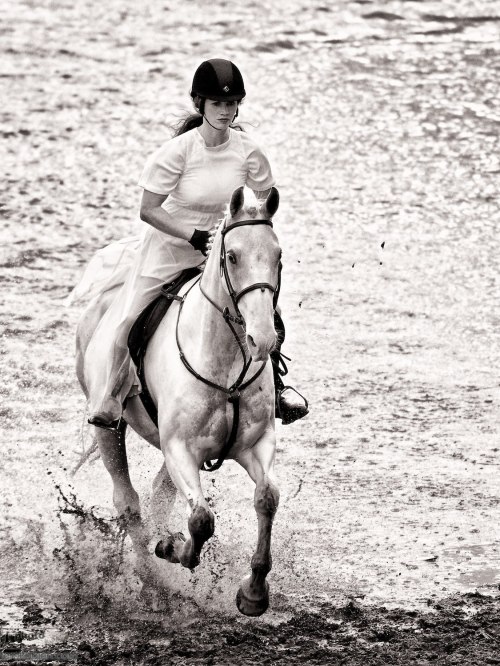
A horse and rider gallop through a lake. Olympus OM-D EM-1 Test Shot with the Olympus 300mm f2.8 Four Thirds lens (effectively a 600mm f2.8). Castle Leslie, Glaslough, Ireland. September 10, 2013. Photo: ©Edmond Terakopian *jpeg image processed in Aperture and Silver Efex Pro 2*
One lens not yet available, but a mock up of which I saw, was a 40-150mm f2.8 Pro lens (80-300mm f2.8 equivalent). With this addition to the system, I feel the E-M1 is ready for most things and could well be the news photographer’s perfect kit. Two E-M1 bodies, the 12-40mm and 40-150mm, all roughly pack into the same area as a traditional pro DSLR and 24-70mm f2.8 lens would take. It would also probably be lighter and roughly cost around the same.
The E-M1 In Use
Having spent around eight hours with the camera, I can definitely give my impressions of it, but it’s not long enough to be able to run a full test. Hopefully I shall do this in the future. As I mentioned in my intro, the camera just feels right as soon as you pick it up. Several photographers made the same comment and we were all surprised that we all said the same thing, using identical words! The design has obviously been really well thought out and tried out too.

Olympus OM-D EM-1 Test Shot with the Olympus 75mm f1.8 lens. Castle Leslie, Glaslough, Ireland. September 10, 2013. Photo: ©Edmond Terakopian *jpeg image processed in Aperture*
Although there was no time to read through a manual, the camera’s buttons and menu system are easy enough to figure out and after a little fumbling, one gets very used to it. I’m a big fan of having buttons and dials for major operational features and as a result of incorporating these, the camera is easy and quick to operate. The rear LCD is extremely crisp; a high res, bright and touch capable screen that also flips up or down. Very handy indeed.
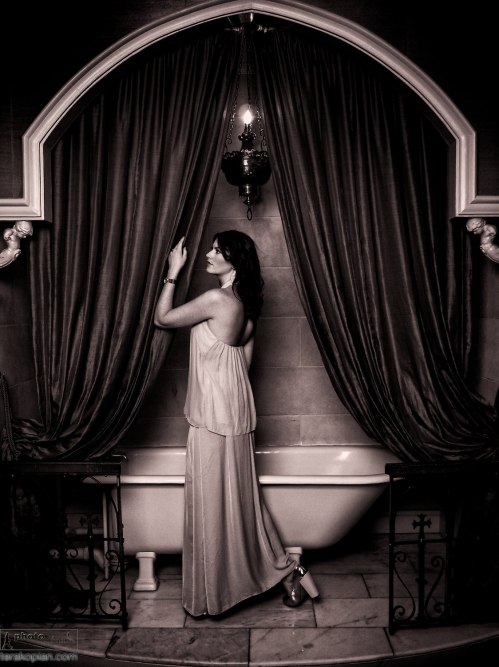
Portrait of a model. Olympus OM-D EM-1 Test Shot witht he Olympus 45mm f1.8 lens. Castle Leslie, Glaslough, Ireland. September 10, 2013. Photo: ©Edmond Terakopian *jpeg image processed in Aperture and Silver Efex Pro 2*
Being a micro four thirds camera, it doesn’t have a mirror box, so it’s not an SLR. This means that the camera is much smaller (around half the size of a pro DSLR) and lighter. This in turn means the lenses are also much smaller and lighter too, even the fast f1.8 offerings. Being a Leica M photographer small is something I appreciate in my cameras and lenses; well, the Olympus lenses are even smaller than Leica M optics.

A floating bubble with the reflection of a glass roof. Olympus OM-D EM-1 Test Shot Castle Leslie, Glaslough, Ireland. September 10, 2013. Photo: ©Edmond Terakopian *jpeg image processed in Aperture*
Not having a mirrorbox naturally means no optical viewfinder, but Olympus have incorporated the very best EVF on the market (electronic viewfinder) into the camera. It’s bright, sharp, fast (no streaking or smearing) and supremely sensitive in the dark – it’s practically night vision. I’ve been using EVF’s since my Leica Digilux 2, then on my Olympus PEN E-P2. I now have an EVF for my Leica M (Type 240) and nothing I have used or tested before comes close to just how good the E-M1 and it’s built in EVF work. If you’re a sceptic, definitely pop to a shop and try it out when the camera is available from October 2013.

A closeup of a flower, shot with the macro function of the new Olympus 12-40mm f2.8 lens. Olympus OM-D EM-1 Test Shot Castle Leslie, Glaslough, Ireland. September 10, 2013. Photo: ©Edmond Terakopian *jpeg image processed in Aperture*
The EVF allowed me to work in normal portrait conditions, in the bright sun, in a practically black, darkened library and also tracking galloping horses coming straight at me and also across from me. It worked flawlessly. During the day’s shooting, I didn’t once feel an optical finder would have helped me make better pictures.

Ghosts in the library. Olympus OM-D EM-1 Test Shot with Live Time mode (bulb but with updated view of the long exposure, shown on the rear screen as the image develops), using the new Olympus 12mm-40mm f2.8 lens. Castle Leslie, Glaslough, Ireland. September 10, 2013. Photo: ©Edmond Terakopian *jpeg image processed in Aperture*
The speed of the drive is also very impressive; 10fps, falling to 6.5fps for continuous AF. The buffer is also huge, allowing 50 raw files to be buffered whilst writing to card.
Auto Focus
Ok, this really is surprising. The speed and accuracy of focus felt on par with my Canon 1DX. I haven’t done side by side testing, but the speed of the AF using Micro Four Thirds lenses really does astonish. No sooner have you touched the shutter button that the subject pops into perfect focus. I found this both is single and continuous mode.
The camera uses a dual AF system, combining phase detection and contrast AF, switching between the two depending on the lens in use.

Portrait of a model. Olympus OM-D EM-1 Test Shot witht he Olympus 75mm f1.8 lens. Castle Leslie, Glaslough, Ireland. September 10, 2013. Photo: ©Edmond Terakopian *jpeg image processed in Aperture and Silver Efex Pro 2*
Being old school, I very much tend to choose my AF point and work. A professional portrait photographer who was at hand convinced me to try the face detection, with eye detection during a portrait shoot. Very reluctantly, I did, as I don’t believe in gimmicks. Well, it’s no gimmick and works perfectly! The camera picked the face of the model and focused on the eyes. Shooting at f1.8 on the 45mm and also 75mm lenses, the results were spot on, pin sharp.
ISO and Low Light
The ISO also impresses, topping out at 25,600 ISO and giving clean and crisp results. The low light operation also has the immense benefit of the camera’s built in 5-axis image stabiliser. Being built into the camera means that every lens can be stabilised. The system works tremendously well, both in stills and in video mode.

Detail Crop: ISO 6400. Portrait of a model. Olympus OM-D EM-1 Test Shot with the Olympus 12-40mm f2.8 lens. Castle Leslie, Glaslough, Ireland. September 10, 2013. Photo: ©Edmond Terakopian *jpeg image processed in Aperture*

ISO 6400. Portrait of a model. Olympus OM-D EM-1 Test Shot with the Olympus 12-40mm f2.8 lens. Castle Leslie, Glaslough, Ireland. September 10, 2013. Photo: ©Edmond Terakopian *jpeg image processed in Aperture*

Detail Crop: ISO 12,800. Portrait of a model. Olympus OM-D EM-1 Test Shot with the Olympus 12-40mm f2.8 lens. Castle Leslie, Glaslough, Ireland. September 10, 2013. Photo: ©Edmond Terakopian *jpeg image processed in Aperture*

ISO 12,800. Portrait of a model. Olympus OM-D EM-1 Test Shot with the Olympus 12-40mm f2.8 lens. Castle Leslie, Glaslough, Ireland. September 10, 2013. Photo: ©Edmond Terakopian *jpeg image processed in Aperture*

Detail Crop: ISO 25,600. Portrait of a model. Olympus OM-D EM-1 Test Shot with the Olympus 12-40mm f2.8 lens. Castle Leslie, Glaslough, Ireland. September 10, 2013. Photo: ©Edmond Terakopian *jpeg image processed in Aperture*

ISO 25,600. Portrait of a model. Olympus OM-D EM-1 Test Shot with the Olympus 12-40mm f2.8 lens. Castle Leslie, Glaslough, Ireland. September 10, 2013. Photo: ©Edmond Terakopian *jpeg image processed in Aperture*

Olympus OM-D E-M1 Test Shot with the new Olympus 12mm-40mm f2.8 lens. The 5 axis image stabilisation has kept this 1/5th of a second shot pin sharp. Castle Leslie, Glaslough, Ireland. September 10, 2013. Photo: ©Edmond Terakopian *RAW image processed in Olympus Viewer 3 and Aperture*
Video
Alas, this is the area where the camera could do more. Positively, the 5-axis stabiliser makes this the most suitable stills camera in the world for shooting video on. Stabilising, smooth clips are to hand. Another boon is the E-M1 has a built in mic socket. Sadly, the negatives are too many at this stage. No headphone socket. As far as I could see, no way to monitor manual audio whilst shooting (I may be wrong as time was limited). The huge omission though, and one which I hope with firmware upgrades can be changed, is that the camera only shoots in 30P in full 1080P HD. I really don’t understand why 24P and 25P were not included. Judging by the size of the buffer and processing power, I would guess that 50P and higher should have also been possible, allowing beautiful slow motion to be shot with the camera.
With the 5-axis stabiliser, Olympus have a winning feature that elevates them over the entire competition. They need to take this seriously and update the firmware to allow for the missing frae rates. Also future models need to have headphone sockets.
There are a huge list of other features; the built in WiFi with iOS App control, and amazing live bulb mode, it’s weather sealing and expandability all add up to impress. To get a full specification list, visit this Olympus page.
Final Thoughts
I really like the Olympus PEN range and they impressed me from the start. Olympus has shown itself to be one of a small number of camera manufacturers who really innovate. I played with the first OM-D, the E-M5, which impressed. However, the E-M1 just jumps ahead, light years, over anything Olympus have produced and most cameras on the market.

A shot of me with the Olympus OM-D E-M1. Test Shot with Live Time mode (bulb but with updated view of the long exposure, shown on the rear screen as the image develops), using the new Olympus 12mm-40mm f2.8 lens. Castle Leslie, Glaslough, Ireland. September 10, 2013. Photo: Damian McGillicuddy
It feels right from the first time one holds it. The lenses are brilliant, the system works. Speed, accuracy, small size, unobtrusive. It’s a shame the video aspects aren’t up to scratch as the camera is pretty much perfect otherwise. With the addition of a professional service plan (Service Plus), Olympus shows it’s serious about the pro market. A few longer Micro Four Thirds lenses alongside the 40-150mm f2.8 and I think the system will be ready for most types of professional photography.
Give the camera a try. You won’t be disappointed. I for one was seriously impressed.
Visit my Olympus OM-D E-M1 Flickr Set to see more images shot with the camera.




 Photo This & That