What Would You Do If You Won The Lottery?

It’s a question often asked by people. Sometimes the answers are more predictable but occasionally they are completely unique and full of character. To mark the 15th anniversary of the National Lottery, I had the pleasure of photographing 15 lottery winners who have spent some of their winnings on the quirky to the life-changing. Its been a fascinating journey that has taken me all over England, Scotland, Wales, Ireland, and all the way to Canada. The shooting of the project took around five months, sometimes spending days getting to location. Its been an absolute joy to do, and I’d just like to send a big thanks to all who helped from the Camelot press office, and the kindness and patience shown by all my photographic subjects.


Meredith Davies from Carmarthenshire won £2,069,730 in October 2004. He set up a stud farm with around 25 Welsh Cobb ponies for £100,000. Photographed with his partner Kate Chester.

The project will be exhibited at the Fulham Palace Gallery from November 14 to 22 (check the gallery’s opening hours, on their web site). The exhibition is spread across two huge rooms with some of the images being printed by Metro Imaging to over 2 meters across. Its going to be well worth seeing.

Technically speaking, I decided to carry identical kit to all the shoots. This would help keep the same flavour across the shots. I packed everything into a ThinkTank Photo Airport International, including a Change-Up and Skins pouches to use when on location. Camera kit consisted of two Canon 5D MkII bodies (5D for the first shoot as I didn’t have the Mark II yet!). Lenses were the Canon 15mm f2.8, 16-35mm f2.8L II, 35mm f1.4L, 85mm f1.2L II and the 70-200mm f4L IS. Looking through the images, it looks like my favoured lenses were the 16-35mm and 85mm.
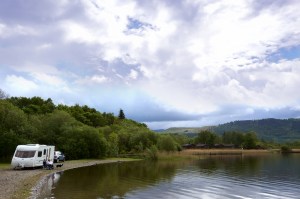
Sue & Peter Busby from East Yorkshire won £1,660,769 as part of the Tesco syndicate who scooped £18,268,465 in July 2005. They purchased a luxury, top of the range Lunar caravan for £14,500. With their dog Jasper by the shore of Derwentwater, Northern Lake District. Keswick Camping and Caravanning Club Site, Keswick, Cumbria.

The many thousands of RAW images, occupying many gigabytes of storage were backed up across several drives, including the brilliant Sonnet Fusion D800 and in the ‘cloud’, giving me peace of mind. All the editing, captioning, colour corrections, raw conversions and output were done on Apple’s Aperture and finishing touches added on Nik Software’s Viveza and Sharpner Pro 3.0. The ultimate compliment came from master printer John Cleur at Metro Imaging when he said that the files looked great and needed very little work done to them before printing!
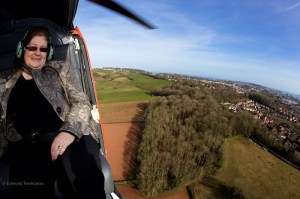
Thea Bristow, who won £15 million in July 2004, features in this landmark exhibition and is pictured flying over her 13-acres of woodland – a purchase which meant the land was saved from housing development. Over 300 new trees have been planted and a walkway built through the woodland before it is opened up for the public to enjoy.

So, don’t forget to check out the exhibition from November 14 to 22 at Fulham Palace Gallery, Fulham Palace, Bishop’s Avenue, London, SW6 6EA.

First Open Workshop

A montage of images of me at work, ranging from 1994 to 2009

I’ll be having my first ever open workshop on November 28th, 2009. The general themes will be photojournalism and street photography. It’s going to be most suited to intermediate and advanced photographers, both amateur and professional. Although having done many workshops, lectures and presentations in the UK and abroad, this is the first ever open one, meaning anyone can book and pop along.


Part of the workshop is also a portfolio review, so if you think your work might benefit from some one to one attention, you can also book this.
I’ll be showing some work from my 20 year career as a press photographer, answering any questions you may have and then getting down to the actual workshop, so make sure your batteries are charged and your cameras ready!

The business and booking side of things is being dealt by Ghene Snowdon, so visit the Photosocialise site to make bookings.
As it’s a first and there’s a recession, we’ve decided to keep it mega cheap. These prices will definitely never be repeated again, so if you’re interested, do make a booking sharpish – places are limited and are booking up already!

To see a report from the workshop, click HERE.

Kew’s Seed Bank Hits 24,200 Species

Kew Seed Bank 2009 – Images by Edmond Terakopian


Kew’s Millennium Seed Bank partnership celebrates banking its 24,200th species, a Yunnan banana seed – a pink wild banana from China which is an important staple for wild Asian elephants (Musa itinerans). Royal Botanical Gardens Kew is celebrating collecting, banking and conserving 10% of the world’s wild plant species. Kew’s Millennium Seed Bank, Wakehurst Place, East Sussex. The seed is banked inside the vault which is kept at minus twenty degrees centigrade.

Must admit, I thoroughly enjoyed this assignment. Its astonishing to see the size of the project and how much has been achieved already. It still leaves 90% to be collected though, so visit their web site and see if you can help out.

At work with my 5D MkIIs and Think Tank Photo bag and pouches

Photographically speaking, I took a couple of Canon 5D MkII bodies and mostly used the 15mm f2.8 Fisheye, 16-35mm f2.8L II, 35mm f1.4L, 50mm f2.5 Macro and the 85mm f1.2L II.
What really surprised me was how well the cameras and lenses behaved, but more so the batteries; I was going from minus 20 degrees centigrade (which reached minus 30 near the coolers because of the wind chill) to hot and humid greenhouses and then back again to the arctic temperatures. After having shot over 1000 RAWs, both cameras’ batteries showed full power! Astonishing.

Focus on the Rainforest by Daniel Beltra

Press preview and soft opening of photographer Daniel Beltra’s exhibition Focus on the Rainforest with The Prince’s Rainforests Project and Sony exhibition, Nash Conservatory, Kew Gardens, London. September 30, 2009.

Daniel Beltra, Focus on the Rainforest from Edmond Terakopian on Vimeo.

Winner of this year’s Prince’s Rainforests Project via the Sony World Photography Awards, Daniel Beltra, has his new exhibition is opening to the public from October 3rd to December 6th, 2009 at Kew Gardens. The theme is the project shot for the PRP, Focus on the Rainforest.


The exhibition is a collection of very graphical and interesting images from the Amazon, Democratic Republic of Congo and Indonesia, depicting deforestation around the world, and showing some of its effects to our environment.


Beltra’s list of awards is impressive. He has two World Press Photo awards, winning Best of Photojournalism and International Photography/Lucie contests and is a fellow of the International League of Conservation Photographers. He has also won the Global Vision Award from the Pictures of the Year International contest, to name but a few. His career began by being a photojournalist in his native Spain and he has shown the same journalistic approach to documenting the state of our environment, concentrating on man’s effects on it.
His love of nature and the environment drove him to freelance for Greenpeace for the past 20 years. He is represented by the prestigious Reportage by Getty Images.


The standard of photography is stunning, and only outdone by the versatility shown by Beltra’s approach. Images taken from the air showing natural beauty and toxicity of the human condition are only matched by the sensitivity and respect shown to the subjects of his photographs on the ground. He is equally at home in the air with his Canon 100-400mm lens, as he is on the ground with a 24-70mm on his Canon 5D MkII.


I can’t recommend this exhibition highly enough; definitely put aside some time and go and see it.
If you’d like to be kept up to date with his projects, become a fan on Beltra’s fan page on FaceBook or visit his website and follow the blog link there.

Leica M9 & X1 – Hands On Preview

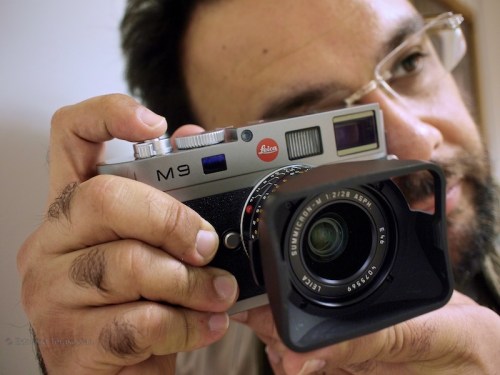
Leica M9

Edmond Terakopian tries out the new Leica M9. September 17, 2009. Photo: Antje Bormann

Yesterday I had the opportunity to have a look at the new Leica M9 and also the X1. The M9 was a final pre-production model, so it was pretty much what you would get if you bought one. However, the X1 was a mid pre-production sample so my comments should be taken lightly until I get a chance to try out a final sample.

A small bit of background info on me; I used to shoot quite a lot of my film work on Leica M rangefinders. I’ve had the M4-2, the M4P and the M6. My lenses back in the day ranged from the 21mm f2.8 to the 75mm f1.4. I’ve always loved the quality of the cameras and more so the lenses. The silent approach to picture taking has always suited me.

Test shots with final pre-production Leica M9 at Jacob's Pro Lounge, London. Antje Bormann. September 17, 2009. Photo: Edmond Terakopian


Alas the M8 put an end to the love affair and I had to definitely close the door on Leica; I just didn’t think the quality was there. Terrible image noise when trying to work in low light, a cropped sensor and that silly filters on every lens thing just put me off. I tried the M8 when it first came out and recently a few months ago, and it still didn’t do it for me.

Seems that the M9 has put a stop to that though and I find myself yearning to get back to my rangefinder days; well, the recession’s kind of getting in the way, as there’s no way for me to justify the £4850 price tag, but at least now its not the quality that’s putting me off, but merely the cost. As Richard, the chap from Leica said yesterday, it’s reassuringly expensive!

Test shots with final pre-production Leica M9 at Jacob's Pro Lounge, London. Antje Bormann. September 17, 2009. Photo: Edmond Terakopian

At first glance the camera’s very similar to the M8 but now thankfully has a dedicated ISO button. The interface is usable but no way is it near the ease of use offered by the latest Canon DSLRs. Still, its a big improvement on the M8.

Where the camera really shines though is that it now has a full frame sensor. The cropped sensor of the M8 was a huge disappointment for me. The other huge improvement is that there is much less image noise, so working in low light is again a possibility. Whilst the camera’s high ASA ability doesn’t come anywhere near matching a 5D MkII, its still very impressive and a million times better than it used to be on the M8. At 160 ASA its faultless; absolutely stunning. I pushed it higher to 1250 ASA and its still extremely good. There’s some grain, but it looks right and the colours also look right. I shot a load of tests indoors under mixed lighting and also outdoors in daylight and apart from some shifts in the auto white balance, the colours where great.

Test shots with final pre-production Leica M9 at Jacob's Pro Lounge, London. Antje Bormann. September 17, 2009. Photo: Edmond Terakopian

Whilst the shutter is no were near as silent as the old cloth shutters, it has several quite modes which allow the cocking to be done on release of the shutter button; this makes operation much more quite.

As far as the quality of the files concerned, I’m extremely happy with the jpegs which you can see here. As the camera has only just been announced, I’m waiting for Apple to release a RAW update so I can have a look at the RAW’s using Aperture. If the jpegs are this good, I’m sure the RAW’s will be a knock out.

As I mentioned earlier, I’m really happy with this camera; Leica and Kodak who make the sensor chip have done a great job and made the camera usable as a professional tool. With the M8, you got great shots if all the elements were right and the light was perfect; now with the M9, it looks like you can adapt to the elements and not just give up.

My full review of the Leica M9 is now available HERE.

Leica X1

The other camera of note which has recently been announced is the X1. Initial rumours suggested that it was based on the Panasonic Lumix GF1 which is a micro four thirds, interchangeable lens camera. It isn’t the case though, as the sensor is a bigger APS-C sensor with a lower crop. The X1 however doesn’t allow you to change its 24mm f2.8 lens as its fixed. This 24mm lens translates into 35mm in 35mm terms. I really wish that it was an f2 though.
Its a very handsome little camera and feels nice in the hands. I was rather impressed by the lens as distortion is very well controlled and the optics are pin sharp. However, I must admit that I wish they had made it an interchangeable lensed camera. However, to use this camera properly, I’d seriously suggest an external finder as otherwise its just a flashy compact camera. At 500ASA, the image quality was very good and noise was well controlled. Focusing was sure footed and pretty speedy. My only initial thoughts are that its a shame there is no face-detect, as this would work well when using the external finder – I have since found out that it does have face detect. Although an early sample, I must admit to being very impressed by the image quality.
As mentioned before though, I’m going to reserve full judgement as this was a mid pre-production camera.

For a gallery of images check out my Flickr.

Addendum 1: I was so impressed with the Leica M9 & X1 that I have since writing the review bought both cameras.

Addendum 2: You can now read my full review of the Leica M9 in the BJP (British Journal of Photography).

Conflict Photography

How does one cover a conflict? The conventional way is to show either frontline action with soldiers or the effects it has on human life by photographing death and suffering of people caught up in the conflict. Both, very powerful ways of documenting our inhumanity.

I came across a third way, which had I not seen it, but only been described the method, I would have automatically have suggested that it would not work. It was of the remains of war and specifically the places, or spaces which are abandoned as war settles in and destroys.

Furniture is seen in the living room of a house that was damaged during the Hezbollah-Israel summer war 2006, in Bint Jbeil, south of Lebanon.


The project is called Abandoned Spaces by photographer Dalia Khamissy. I first saw the project at her presentation at Photo Forum in London. It was a unique and surprisingly emotional look at the Lebanon war of 2006. The reason I say emotional is because there isn’t a single person in the photographs, but the spaces which they have left abandoned, destroyed by bombs and gunfire, speak so much about who they were and how they lived during happier and more sedate times.

You can see the project HERE and there is an interesting article on her work HERE.