Category Archives: viewpoint

I’m A Press Photographer & Very Proud Of It

The Leveson Inquiry

*Stands up from the gathered folk sat on chairs in a circle in the community centre hall* My name is Edmond Terakopian and I’m a press photographer of 22 years. Following the Leveson Inquiry, anyone would think that being a press photographer in this country is wrong and the devil’s work and that we’re all villains. Well, I’m Edmond Terakopian, a press photographer and extremely proud of it.

On assignment for AP, covering the 46664 Concert: In Celebration of Nelson Mandela's Life. Hyde Park, London. June 27, 2008. Photo ©

Wave after wave of celebrities (and others) with their own personal agendas (always interesting to look back on the ethics and behaviour of such people as they attempt to take the moral high ground) have been giving testimonials on press intrusion. The unfortunate thing is that this has gone from press intrusion (for which there are some very valid cases) to a witch hunt against photographers. The paparazzi  who are making life hell for those in the spotlight are now in the spotlight. I personally have no major issue with this as I have witnessed the behaviour of the paparazzi and hate what they have done to the industry I so love. People in their ignorance, and the wider media (reporters, both in newspapers, radio and TV) who know better, are branding every press photographer a paparazzi. This is absolutely wrong and a disgrace. Another disgrace is the way some reporters are trying to distance themselves from press photographers by pointing fingers! I’d like to remind these small minded print journalists that without pictures to illustrate and highlight stories, most stories would either go unread or will at best lack impact. A newspaper without strong and interesting photography would indeed be extremely boring and I would suggest, will not sell. To my colleagues in TV I would like to say that we are all journalists; some use a TV camera, others a microphone, some a camera and others a keyboard. If by all this ridiculous finger pointing and sensationalising that’s going on, carries on and laws are passed, this will effect the entire industry. The whole notion of freedom of press will be in dire peril. Be responsible and please be careful. Perhaps all of this is being done on purpose by some news editors to help shift the public’s attention away from the phone hacking and unethical journalism which is the question at the core of the inquiry?

Allow me to remind everyone what press photographers do; remember the ultimate sacrifices made by our colleagues over the years as they put their lives on the line and cover conflict and inhumanity around the world. Let me remind you of luckier colleagues who ‘only’ lost limbs whilst doing this most honourable of jobs. Don’t tar us all with this brush.

The funniest thing of all though is that on the whole, a paparazzi has a higher income than a press photographer does – yes, even those that risk their lives in conflict zones. The reason for this is simply that the public buy newspapers and magazines that carry this material. As a result, papers and magazines pay top whack for this material. The biggest selling publications are those that run this rubbish; it’s a question of supply and demand. Stop buying this trash and the market for paparazzi pictures will shrink. To the finger pointing public who find it funny to throw abuse at photographers and call us paps, take a look in the mirror and see which publications you and you families buy; you may well find that you’re funding this issue you’re so outraged by. I hasten to add that my colleagues who are celebrity photographers aren’t tarred with this brush either. Honourable and skilled photographers who cover premieres and parties, all by invitation, who are a huge part of the image building of actors and singers.

I’m worried by this inquiry as it has been extremely one sided. So far, neither the NUJ (I have now found out the NUJ has are a statement at the inquiry, but very early on, and before the entire thing turned into an anti-photographer campaign; please see the bottom of this article) or BPPA have been invited to speak. There are also a huge number of politicians who were stung because of the recent MPs expenses scandal. This group of people I’m guessing would jump at any opportunity to try and pass into law some of the ludicrous suggestions made by some at the inquiry.

One cannot have a democracy without a free press. If we can’t do our jobs, bring corruption, injustice and inhumanity before the eyes of the world, just imagine to what depths society can sink to.

I would suggest those who at this point are shrugging their shoulders to go and get a few good photojournalistic books and imagine a UK history where such a book does not exist as these images could not be taken. Then get a few books on street photography and imagine a situation where this sociological history was not documented in the UK.

There is no excuse for bad journalism; fiction or sensationalism should not see the light of day in our papers or TV news segments. However, there is a credible danger that we may end up ruining the people’s right to a free press. Imagine a country where the government is not held to account by the media, or one where criminals get away with all sorts without being shown in the media. There are many consequences to this.

World Press Photo in de Oude Kerk. Press Photographers (L-R) Chris Hondros (who was sadly killed on assignment in Libya, 2011), Mohamad Azakir, Ben Smith and Edmond Terakopian with their awards for the Spot News and Spot News Stories categories. Photo: Bastiaan Heus

My colleague Christopher Pledger has put a lot of what’s been on my mind perfectly in his open letter, which I’m reproducing with permission, in full below:

Christopher Pledger: Press Photography and the Leveson Inquiry

“The testimony of witnesses this week at the Leveson inquiry has included damning condemnation of the behaviour of the paparazzi. Both the celebrity and ‘ordinary’ victims of phone hacking have told of being chased, spat at and terrified by photographers. These experiences could have fatal consequences for the news photographer, a vital part of a truly free press

There are important distinctions to be made between a paparazzo and a press photographer. A comparison of the two is like that between the cowboy builder and a professional tradesman. It is also important to distinguish between the paparazzi and celebrity photographers. Celebrity photographers work with the permission, and often to the benefit of, their subjects. This can range from red carpet premieres to organised and set up photo shoots of a celebrity out shopping or on the beach. I do not class them in my definition of paparazzi. Lacking moral or ethical guidance the paparazzi work with little respect for the law. The composition, quality, or origin of a photograph is a distant second to its commercial value. Paparazzi agencies will often employ people with little or no knowledge of photography. The agency will provide cameras with settings taped over so they cannot be changed. It is not a photographer that is sent out of the office, simply a man with a camera.

Press photographers by contrast are skilled professionals with years of training and experience. They work within the strict guidelines of both the Press Complaints Commission and their newspaper or news agency. These guidelines include respecting both peoples right to privacy and the boundaries of private property. A good news photograph will be technically excellent and able to tell the story in a single frame. In contrast to the paparazzi financial rewards are low.

This is not to imply that all press photographers are angelic super-humans working to expose the truth to an unwitting public. Like any industry there are a minority of ‘rogue traders’ who are prepared to bend or break the rules to get a picture.

The problem for legitimate press photographers is they are seen as no different from the paparazzi. Regardless of the assignment they are covering all press photographers now experience regular abuse from strangers in the street. When photographing something as mundane as a the outside of a high street bank it is not uncommon to hear shouts of ‘pap scum’ or ‘leave them alone’ from passers by. If a group of press photographers are gathered outside a court or government building the first question asked by curious passers-by is not ‘what’s happening?’ but ‘which famous person is coming?’.

The problem of public perception stems from two different sources, celebrity magazine culture and television news. The dominant celebrity culture makes it hard to avoid a constant stream of images cataloguing the daily lives of the A to Z list. It is no surprise that the general public perceive the primary role of photographers as being to feed this machine. The problem is complicated by disreputable publications being prepared to buy pictures on a ‘no questions asked’ basis. This makes it hard to distinguish between photographers working in a professional way and those who aren’t.

Television news coverage is the other major factor in the problem of perception. During most stories a clip of press photographers is included as a ‘cut away’ shot to add visual interest. If the clip includes the subject of a story being surrounded by the media reporters will often refer to a scrum of photographers. This ignores the numerous TV cameras both in the scrum and filming from a distance. This has been demonstrated during TV reports on the Leveson inquiry. Press photographers have been working from an official area behind a barrier to give witnesses arriving space. TV reports have consistently referred to ‘hordes of photographers’ while ignoring the seven video cameras surrounding witnesses as they arrive. By using these tactics TV news aim to draw a distinction between the dirty press and the clean media. In doing so they may perhaps be driving the Leveson inquiry toward concluding tough privacy laws are required, privacy laws that will include a ban on photographing people in public without their permission.

A ban of this type would be the death of the free press in the UK. Current guidelines require that individuals should not be photographed while they have ‘a reasonable expectation of privacy’. In practical terms this means anyone in a public place can be photographed without permission, as they cannot expect privacy in a public space. If laws were introduced requiring the written consent of an individual before they were photographed, it would mean press photographers would have to ignore events unfolding before them. Some of the biggest news stories in the last year could not have been reported. Pictures of Charlie Gilmour swinging from the Cenotaph would have been taken illegally, likewise pictures of Oliver Letwin disposing of government documents in a park bin. Press photographers would be as ham strung as reporters prevented from covering stories of public interest that are subject to super injunctions.

The problem of finding a solution that avoids this type of privacy law is extremely difficult. Legitimate press photographers already have licensed press cards that are required to be shown to work in places like Downing Street. This system has not stopped any of the behaviour reported this week, or prevented the use of faked press cards. Digital cameras are cheap and easy to use making it hard for anybody to distinguish between professional and amateur, press photographer and paparazzo. If 99 out of 100 photographers comply with a code of conduct, one will always break the rules and tar the rest with the same brush. Introducing government or police regulation and control over licensing of press photographers would affect impartiality and freedom.

It would be very hard to argue that there can be no changes following the Leveson inquiry. We must be very careful what these changes are and where they will take us. Press photographers are in danger of being so restrained by regulation that we become like the fire fighter who cannot enter a burning building for fear of breaking health and safety regulations.

These are my personal views and are not intended to be representative of any organisation I work for as a freelance photographer. Christopher Pledger.”

Please spread this link to as many people as you can. This is an important issue which has extremely far reaching consequences; ones that can have a hugely negative impact on society as we know it. I’m Edmond Terakopian and proud to be a press photographer.

Addendum:

I have just found out (26 Nov, 16:57) that the NUJ has indeed made a statement at the enquiry. However, the NUJ statement was made very early on in the inquiry and was before the entire thing turned into this one-sided, anti-photographer campaign by the famous. When photographers are being attacked in this extremely one sided way, why the BPPA hasn’t been invited is beyond me. The NUJ statement can be read in full in this Media Guardian article. My thoughts are that the NUJ London Photographer’s Branch needs to now be invited to address the points being raised.

More food for thought on some of the ridiculous proposals being aired at the inquiry. Can you imagine if press photographers had to ask for permission every time they needed to  photograph someone in public? Having to stop emergency personnel from doing their jobs, to get written permission when on a breaking news story. How often would criminals give written permission? MPs who are stealing from the tax payer via their expense claims…how many of them would give permission? Documenting the horrors of the July 7th bombing of the tubes and bus; would it be right to stop injured people and ask them to fill in and sign forms? On a different note, this would also completely stop any social documentary – street photography of daily life? Forget it. All those natural and real moments will be lost forever. Can you imagine a world without the brilliant images of Henri Cartier Bresson?

On a related note, illustrating why we should not all be tarred with he same brush; has anyone had a bad builder? A bad doctor? A bad dentist? A bad meal in a restaurant? What are we going to do, ban builders, doctors, dentists and chefs? There are always rogue elements in the world. Coming up with ridiculous suggestions which apply to the entire industry and upset the exact freedoms this country fought for in several wars is disrespectful, immature, self centred and just plain wrong. Bad journalism should not be tolerated. Absolutely not. However, holding one sided inquiries where the ill informed people with personal agendas are given free reign to say all they want without hearing the other side is just plain injustice. I’m not defending disrespectful paparazzi, the rogue photographer, the bad celebrity agencies or bad tabloid journalists – let’s just not forget that there is a lot of nobility and importance in the work the press and press photographers do.

Another huge issue that everyone is missing, is that although these images are press images, they do then become historical. Can you imagine history books without any real photographs in them? No images from July 7th. No images from the London riots. No images of dodgy MPs or Murdoch and Wade. Everything having to be posed and re-enacted. How is that good for society?

Disclaimer: These are my personal views and do not reflect those of any news organisations for whom I work.

Further Reading

The Leveson Inquiry – Leon Neal’s Blog

Flaws On Both Sides of the Leveson Inquiry – Mark Borkowski

Leveson Exposed Celebrity Exploitation… – The Guardian

A Paparazzo Speaks – The Guardian

Photographers Hit Back Over Leveson ‘one way traffic’ – Press Gazette

Leveson Inquiry: Photographers Seek To Counter Criticism – Journalism.co.uk

Press Photographers Slam Leveson Inquiry’s ‘one way traffic’ – BJP

Initial Submission To The Leveson Inquiry – BPPA

Photographers Facing Unfair Criticism – The Guardian

Taken Without Permission – Jules Mattsson
Canon 1DX Preview

Hands On With The Canon 1DX

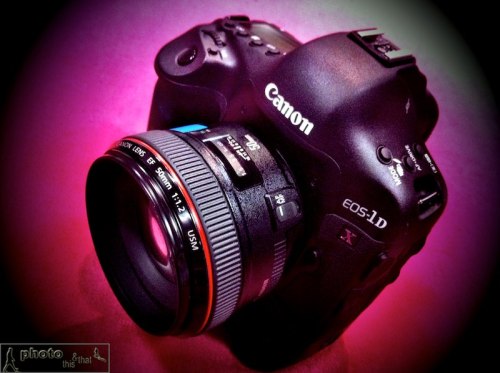
A pre-production Canon EOS 1DX. Photo: Edmond Terakopian

I’m fortunate to have had two opportunities to try out the new Canon EOS 1DX in private (thanks to Canon Europe for organising this) during the Pro Photo Solutions show earlier this week.

I need to firstly make it clear that as this was a pre-production camera, I wasn’t allowed to use my own CF cards for evaluating the images or video (which is fair enough as by the time the camera is released in March 2012, the firmware will have gone through several changes).

What I did get to do was try the camera fully, for both stills and video (checking results on the rear LCD screen), check out the completely redesigned menu system and chat at length with the extremely knowledgeable Graham Smith and Mike Burnhill from Canon.

I must say that I’m very impressed with this flagship camera. It carries on the 1D line and is a rugged workhorse of a machine which has been designed to be even more durable than it’s previous versions (I once stood in torrential rain on assignment for around 6 solid hours with a couple of Canon 1D MkII cameras and ‘L’ lenses. Although my Berghaus Gortex jacket leaked, the cameras carried on working perfectly and never gave any problems).

It’s fantastic having a full frame and fast drive camera, all in one. The 12 fps is just astonishing as is using the 14 fps (with mirror lock up – all of this at 18 megapixels). It’s something I have wished for, for years! The controls on the camera are new, with quite a few being fully programmable. The design and placement for all of these is pretty much spot on (the only problematic one perhaps being having the magnify button which is set low down, below the screen – perfect for reviewing stills, but is a problem for when shooting video and wanting to check focus beforehand (initially spotted by Dan Chung, with whom I’m in full agreement) – I’m sure by launch perhaps one of the more convenient buttons can be programmed via firmware to act as magnify if needed for video).

Shooting up to 51,200 ISO was just astonishing; extremely clean with accurate looking colours. Magnifying in to 100% on an 8000 ISO image made me double take as it looked clean enough to have been a 100 ISO shot! Absolutely amazing. I need to remind readers again though, these were all judged on a pre-production camera using the rear LCD screen.

The AF system is completely new and feels very responsive. The new modes and selection methods with overrides certainly impress.

Another hugely impressive fact is for video shooting the camera has a better file system and no longer drops lines when down sampling to HD. Another massively important addition is adjustable audio meters which display during shooting. Canon have stopped just short by not including a headphone jack. If the AV out port can stream during recording, then perhaps a headphone adapter could be fitted to monitor audio? Who knows!

As far as is the Canon EOS 1DX perfect, we shall have to wait and see. November 3rd is due to see a video product announcement by the company and the rumour sites are buzzing with the launch of the 5D MkIII some time next year.

This certainly seems like a perfect DSLR. Personally, I’d love (as would every single one of my colleagues) a lighter pro body, with a removable grip. Apart from this gripe, it really is an impressive DSLR and ticks almost every box. I can’t wait to test it out properly and see what it’s capable of, both in terms of stills and for video.

Travelling Light – iPad or Air?

Are the Apple iPad 2 or 11″ MacBook Air Viable Alternatives For The Photographer On The Go?

Most photographers have back pain or have suffered in the past. It’s the ridiculous loads we often carry. Camera manufacturers think that we all want huge and heavy cameras; a couple of those, a few professional spec lenses, lights and computer equipment results in a fair bit of weight. Always being on the lookout for ways of cutting down weight and size of gear, I was an early adopter of the first Apple MacBook Air. It was certainly thin enough but with the 13″ screen, it was still big. Now that Apple have released an 11″ version, the quest to see if a smaller laptop will work is on again.

The Apple iPad 2 and MacBook Air (images have been montaged from two originals). Photos: Apple

The iPad is another possibility. However with all the talk of it not being for content creation but consumption, it’s not had a great start with the majority of apps not catering for the professional photographer who wants to edit and send images. I have the original iPad; it’s far easier to always have with me, especially compared to my much larger 15″ MacBook Pro. In fact on a day off I was given an assignment by The Times, which I edited and sent from the field on my iPad. One major omission from the App Store was the lack of a RAW converter; now that there is one, things have become very interesting and the iPad is definitely a contender; with the iPad 2 there is now much more processing power, making it an even more attractive prospect.

Both are surprisingly similar in size, with the iPad 2 at 24.1 cm x 18.57 cm and 0.88 cm deep with a 9.7″ inch display (1024×768 pixels). The 11″ MacBook Air is at 29.95cm x 19.2cm and 0.3 to 1.7cm deep with an 11.6″ display (1366×768 pixels). Form factors though differ hugely, bringing with them their own advantages. The Air has a traditional laptop design, meaning a real keyboard and a screen that hinges open. The whole thing can be placed comfortably on a lap or desk and both hands used to type and control the touchpad. The disadvantage though is that it’s much harder to use on the move. The iPad 2 is held in one hand and easily controlled with the other using it’s touch screen interface. This means that for situations where one is mobile, like when covering a demonstration, it’s very easy to work, editing and sending whilst on the move. Although both are extremely light when compared to regular laptops, the 11″ MacBook Air weighs more at 1.06kg compared to 613g.

With Mac OSX, now at 10.6.7, being a mature and fully featured OS, imaging software is freely available. Apple’s Aperture, Adobe’s Lightroom and Photoshop along with Capture 1, Photo Mechanic an so on cater for all sorts of workflow. iOS on the iPad 2 though is much younger and finding professional imaging apps that are of use to the pro is a little harder.

iPad Apps

PhotoRaw

Essential for basic RAW processing. Although a little slow, it’s very usable and allow the photographer to shoot in RAW and not have to play around with a limited jpeg workflow. PhotoRaw is used for basic RAW processing, the image is saved as a jpeg and then opened in one of the following apps.

Photogene

Full on imaging software, allowing image processing, IPTC metadata and sending, via email and FTP. It has a very usable and easy to learn interface which works well. In tests this proved faster and more straight forward to use than Filterstorm Pro, so we used this for the timed trials.

MacBook Air Software

Any Mac OS X software will run on this machine. One has to be realistic though as even the top of the range model tops off at a 1.6GHz Core 2 Duo with 4Gb of RAM. In practice though, it does run Aperture well, which I used in this test (although I would definitely recommend switching off the processor intensive ‘Faces’ feature unless absolutely necessary).

Speed Comparison

The test was to import one Canon 5D MkII RAW file, process the image, add IPTC metadata and save a jpeg version ready to send to a paper, library or magazine.

iPad 2

Importing, basic RAW conversion using PhotoRaw and saving the file as a jpeg took 5 minutes and 11seconds (Camera attached using Apple’s camera connectivity kit). Photogene took 5 minutes and 10 seconds to process the image. Total time for the iPad 2 was 10 minutes and 21 seconds. I have no doubt that with practice a minute or two can be shaved off this time.

11” MacBook Air

By contrast, the entire procedure took 2 minutes and 59 seconds.

By including using an SSD, the speed gains are tremendous. From a cold start the machine is fully ready in 17.6 seconds compared to the iPad 2’s 28 seconds (which does include typing in a 4 number pin). Startup from sleep are a little different with the MacBook Air taking 4.5 seconds (including typing the user password) compared to one second for the iPad 2.

Final Thoughts

With either platform, all isn’t perfect though. Connecting to the iPad involves using a connectivity kit which allows for directly plugging in SD cards or using a USB cable to connect to a camera directly. I would really welcome a built on SD reader on the iPad and a USB port too. There are also issues with the metadata; I have heard from colleagues that this is being stripped by some FTP servers. Photogene seems to be more stable in this. One just has to make sure the image is exported via the app and not just saved. With the MacBook Air, the two built in USB ports are fantastic and a welcome departure of a single port on the original version. I do find myself hoping for more than the maximum 4Gb of RAM and wishful that it also had a FireWire 800 port.

Where both of these platforms come into their own though is their absolute portability; they are smaller and thinner than other solutions with great battery life. Apple’s figures quote the iPad 2 as having 10 hours of battery life and the 11” MacBook Air as five hours; in practice these seem pretty accurate and I would say the MacBook Air actually lasts longer.

For the photographer who wants to travel light on a quick foreign assignment or wants to minimize the gear they carry if on foot, either of these platforms will appeal. The MacBook Air though offers more; the ability to use fully mature imaging software and having built in connectivity gives it the edge. For quick and on the move editing the iPad serves a purpose and can do well. Also, the vast number of extremely useful apps and publications on the platform are fantastic. The biggest thing that’s missing though is a professional imaging App. Idruna, the company behind Phojo should be encouraged to support the iPad; this would then be a killer imaging tool.

I can recommend both; they both do their jobs well but in different ways. It’s up to the individual to decide which suits them best. I personally love the iPad and all the content and apps I get on the platform. For imaging though, the MacBook Air clearly has an advantage on speed, capacity and software.

Addendum: This article was originally written for the BJP in May 2011. Since then, a faster MacBook Air 11″ has been released by Apple as well as an app which I highly recommend for the iPad by Nik Software, called Snapseed.

The Passing Of A Genius

So sad to hear of the passing of Steve Jobs. An amazing man with astonishing ideas & foresight. RIP.

The Apple website with a touching tribute to the co-founder of the company:

A Kingdom For A Finder!

A tourist takes a picture of her friend using the rear LCD screen of a camera at the Houses of Parliament. London. September 17, 2011. Photo: Edmond Terakopian

Yesterday, on a walk through a park, I saw a gentleman with a Nikon (could not see which, but a ‘prosumer grade’ one it was) with a fairly long zoom. He had the camera on live view, holding it in front of him like a mobile cam, while he tried to frame his subject. There are whole generations of consumers who do not know what a camera finder is for.

I am not one of them.

Way back a hundred years ago, most cameras, including press cameras, had finders that forced you to hold the camera before you on semi-extended arms … like a latter-day mobile camera. Even the null-series Leica started out with one of these ‘Newton finders’. Fortunately, before the launch in January 1925, it was replaced with the reverse Galilean finder we all know (and which, much transmogrified, is still a part of the M9 rangefinder). This made the camera capable of framing quickly and spontaneously, even with a mobile subject. The Leica Way. Without that finder, the camera would have fallen flat. Those early buyers did not give a damn about the advantages of perforated 35mm cine film. What captured them was a camera that could be used quickly and spontaneously, in the midst of the stream of life.

Those Edwardian press photogs could use Newton finders because (a) their standard lenses captured a lot, and if the target was somewhere on the plate, he could be cropped in; and (b) because their subject matter was static. You have seen the old newsreels. The Prime Minister / Président de Conseil / Ministerpräsident emerges from his residence, stops, faces the cameramen, puts on a statesmanlike half-smile, raises his cylinder hat – rattle rattle bang as shutter curtains the size of small bandannas sail majestically across half-plate glass negatives – the dignitary nods benevolently at the Gentlemen of the Press, and these scurry away. The optical direct finder, just as much as the small negative, created a new, different style of photography.

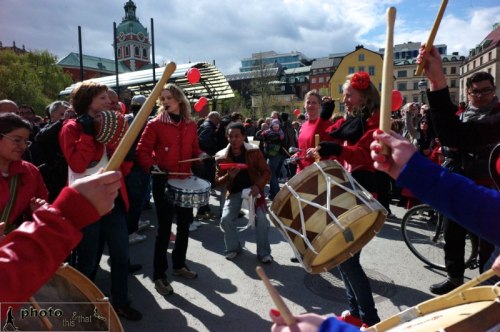
Mayday festivities in Stockholm. Leica M9, 25mm Biogon, zone focusing and 1/4000th. Photo: Lars Bergquist

With a rear display for ‘finder’, work is completely counter-intuitive, and hence slow. Even with a mirror reflex camera, SLR or TLR, you look at the matte screen, not at the subject. And with an electronic viewfinder, you look at a small TV. With for instance a Leica M, you do not look at the finder, but through it. You see reality, not an image of it. The finder does exist in your peripheral vision only. Therefore, cameras with optical finders are the instruments of choice for what one might call interactive photography, or even participating photography.

And now we seem to be back in 1910 again. I beg to be excused. I will never, under any circumstances, purchase a camera without a proper finder. Yes, I do own one. The letters on it say NOKIA.

By Lars Bergquist / Guest Contributor 

Leica Noctilux-M 50 mm f0.95 ASPH Review

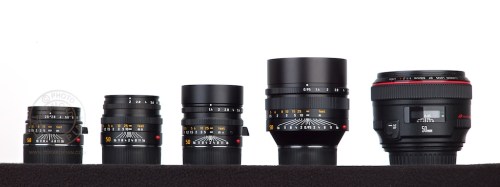
Comparison of current Leica 50mm lenses. Cheapest and smallest to the most expensive and fastest. L-R: 50 mm f/2.5 Summarit-M, 50 mm f/2 Summicron-M, 50 mm f/1.4 Summilux-M and 50 mm f/0.95 Noctilux-M, in front of a Leica M9 (Steel Grey). April 01, 2011. Photo: Edmond Terakopian

No other manufacturer offers as many 50mm lenses as Leica does for its M range. In the current line-up are four; the f2.5 Summarit, f2 Summicron, f1.4 Summilux and the f0.95 Noctilux. Along with 35mm, 50mm is the classic rangefinder focal length, so it comes as no surprise to find this many 50mm lenses available. Apart from purely the light gathering properties of them, each adds a unique signature to the image it creates; non more so than Leica’s Noctilux.

Comparison of current Leica 50mm lenses. Cheapest and smallest to the most expensive and fastest. L-R: 50 mm f/2.5 Summarit-M, 50 mm f/2 Summicron-M, 50 mm f/1.4 Summilux-M, 50 mm f/0.95 Noctilux-M and for size comparison a Canon EF 50mm f/1.2L USM lens. April 01, 2011. Photo: Edmond Terakopian

The Noctilux, meaning “Light of the night”, started in 1966 with an f1.2 version designed by Helmut Marx. A new design by Dr Walter Mandler in 1976 pushed the aperture to an astonishing f1.0 and along with redesigns of the lens body resulting in four versions, the f1.0 Noctilux continued until it was replaced in 2008 by the current f0.95 Aspherical Noctilux designed by Peter Karbe.

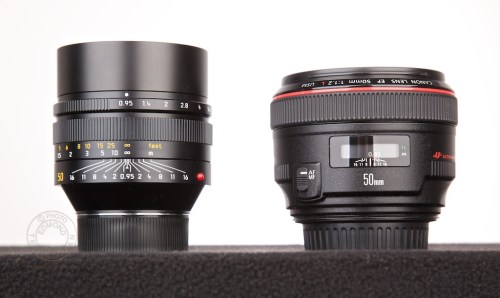
Comparison of current Leica 50mm lenses. The Leica 50 mm f/0.95 Noctilux-M and for size comparison a Canon EF 50mm f/1.2L USM lens. April 01, 2011. Photo: Edmond Terakopian

According to Stefan Daniel, Leica’s Director for Product Management, “the Noctilux 0.95/50 is one of the most demanding lenses currently in production and we can only assign production and assembly to the most experienced and skilled people in the whole company”. It is also the most expensive lens in the M and S range, costing £7348.00. It may therefor come as a bit of a surprise when one learns that it’s also one of the most in demand lenses with the longest waiting list (an honour it shares with the 35mm f1.4 Summilux-ASPH). According to the Leica Store Mayfair, one can expect up to a 12 month wait from the point of order.

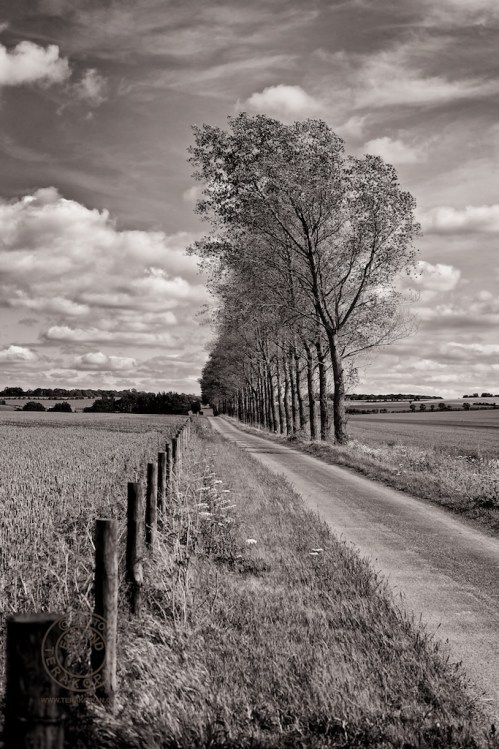
English countryside, around Royston, Hertfordshire. June 13,2011. Photo: Edmond Terakopian

Although the lens itself takes 16 hours to assemble by hand, it’s the raw materials and optics, some of which have a rumoured 12 month period to cool from being cast, which add to the length of time required. There is some very exotic glass used in this lens.

Shot wide open at f0.95, using a B+W ND filter to lower the exposure and allow shooting in this way during daylight. English countryside, around Royston, Hertfordshire. June 13,2011. Photo: Edmond Terakopian

For the seeker of a Noctilux, there is the opportunity to look for one of the older f1.0 versions, which depending on model and condition seem to range in the £3-5000.00 on the used market, saving money and time. Although the f1.0 versions are fast and will allow similar use in low light, all but the current f0.95 version have a smooth. soft and “glowy” signature look when shot wide open. It’s a beautiful look that works extremely well for certain types of portrait and still life, but not suitable for everything. This limits it’s use as an every day lens and makes it a special use lens, meaning one needs a standard 50mm as well. The same is definitely not true of the current f0.95 ASPH Noctilux which not only allows photography in even lower light, but does so with such pin sharp precision that it makes the lens suitable for everything. It is in fact a superb standard lens.

Portrait of Armenian singer Charles Aznavour in his suite at the Ritz Carlton Hotel in New York, NY, USA, ahead of an event by the Fund For Armenian Relief (FAR); 20 Years Of Armenian Independence Honoring Mr Aznavour. May 20, 2011. Photo: Edmond Terakopian

In the days of shooting film, the Noctilux opened up possibilities with shooting in low light that would have been impossible, even with an f1.4 lens. However, in the days of digital, this isn’t as big a problem as one can, up to a limit, just push up the ISO. There is more to choosing a Noctilux though and I would suggest that more people choose it now days for it’s signature look than they do purely for it’s speed in low light photography.

New York Fire Department (NYFD) answer a call on the streets of New York. New York, NY. May 19, 2011. Photo: Edmond Terakopian

Apart from it’s cost, another aspect which sets it apart from the other Leica M 50mm lenses is it’s size. The Leica shooter is generally used to tiny lenses. However, to any SLR shooter, the f0.95 can actually seem small compared to the f2.8 zooms and compares favourably in size to Canon’s 50mm f1.2L lens; currently the fastest 50mm lens available for the SLR market.

In Use

Along with my M9, 21mm, 35mm and 90mm M lenses, I took the Noctilux on a four day assignment to Glasgow. The Noctilux turned out to be by far my favourite lens to work with and apart from three occasions, I came to realise that I had shot the entire assignment on it and I must say that the results looked rather special.

British street party on Enfield Road and the Lord Nelson pub, Brentford, Middlesex on the occasion of the Royal Wedding of Prince William to Catherine Middleton at Westminster Abbey on April 29, 2011 in London, England. Sisters in wedding dresses watch the wedding on a TV inside the pub. Friday, April 29, 2011. Photo: Edmond Terakopian

It takes a short while to get used to it’s size on an M camera. It’s so well made though with such a beautifully buttery focus movement that it just comes to hand very quickly indeed. One thing that constantly surprised me early on was just how little light I needed to make pictures. I was constantly taking down the ASA and in other situations where I thought I needed a flash, I kept realising that the available light was more than enough.

British street party on Enfield Road and the Lord Nelson pub, Brentford, Middlesex on the occasion of the Royal Wedding of Prince William to Catherine Middleton at Westminster Abbey on April 29, 2011 in London, England. A young girl in a wedding dress watches the wedding on a TV inside the pub. Friday, April 29, 2011. Photo: Edmond Terakopian

I have worked extensively with the 50mm Summicron and 50mm Elmarit-M f2.8. Both amazing lenses with great image rendition. However, nothing I have shot with, including Leica’s discontinued 75mm Summilux f1.4 or Canon’s 85mm f1.2L II, produce images like the Noctilux. The Noctilux’s images just pop. Your point of focus is pin sharp and rendered perfectly. Shot wide open the background blur is phenomenal and absolutely unique. Even Zeiss, which is known for its background rendition, can come close to how this lens renders.

A passer by reads the plaque by The Force of Nature II, sculpture by Lorenzo Quinn, Berkeley Square, London. March 03, 2011. Photo: Edmond Terakopian

It’s not all roses though. This lens is challenging to work with at f0.95. The depth of field is practically non-existent and one has to be absolutely spot on with focus. It’s therefor a good idea to send your Leica rangefinder back to Solms with your Noctilux to have them calibrated to match perfectly. Leica products are very accurately calibrated to within tiny tolerance margins; however, shooting at f0.95, all it takes is for the camera to be plus in the tolerance range and for the lens to be minus in the tolerance range and the image is slightly out of focus. This is an absolute must as otherwise one would just give up on the lens, judging it too challenging to work with. A big mistake, as the magic of the lens will then remain undiscovered.

Also, when at f0.95, strongly backlit subjects do sometimes suffer from purple fringing and in these situations it’s best to stop down a little.

Conclusions

The Leica rangefinder has always been a favourite with photographers who like to work with available light. The lack of a reflex mirror means that it’s much easier to hand hold at slower shutter speeds. With this ethos in mind and the fact that the f0.95 is by far the fastest lens currently available on the market for any full frame camera, it makes absolute sense to have it’s abilities. It creates beautiful images with a amazingly soft and fluid bokeh (out of focus detail rendition) that its makes your subject pop; it gives more dimension and depth to every picture. I’ve even heard people commenting on the pictures it creates as being 3D.

Shots around the book sellers on London's Southbank. July 22, 2011. Photo: Edmond Terakopian

Is it worth the asking price? Perhaps not for some photographers, as you could buy an M9 and a 50mm f1.4 Summilux-M ASPH for a fraction more. However, in a world where everyone shoots with the same equipment, with a sea of 24-70s, firstly the Leica M9 and any Leica lens will set your work apart. The Noctilux then takes this much further and makes it unique. It’s good to be an individual.

To view more images, visit my Leica Noctilux set on Flickr. This article was first published in the BJP in June 2011.