Tag Archives: video

Rode VideoMic Pro Review

The Perfect DSLR Microphone?

Photographer and film maker Edmond Terakopian filming at the Royal National Orthopaedic Hospital in Stanmore, using a Canon 5D MkII on a Zacuto Striker with the new Rode VideoMic Pro (with a windshield fitted). In the foreground is the original Rode VideoMic. Filming in an operating theatre. May 16, 2011. Photo: Neil patience

When I reviewed Canon’s 5D MkII in 2009, I concluded that the easiest way to get good audio on the camera was to use Rode’s VideoMic. I’ve been personally using this microphone since and have been getting pretty good results. However in situations where I need to travel compact or when shooting in news type situations, I did wish the VideoMic was smaller.

Rode seems to have been listening and recently launched the much smaller VideoMic Pro. It’s 10cm shorter in length than the VideoMic, 2.2cm lower in height but 0.7cm wider. It’s also lighter with the new model being 85g compared to the VideoMic’s 176g. It is just the right size now and when mounted, it doesn’t stick out the back.

Price wise, the VideoMic Pro is more expensive. Studiospares have the VideoMic Pro at £124.17 exc VAT compared to the older VideoMic at £65.83 exc VAT.

In Use

I did a set of extensive listening tests comparing the VideoMic and VideoMic Pro, using a Canon 5D MkII with it’s audio gain set on automatic. The subject was in an enclosed area and recorded from a distance of 2 meters as well as one meter. I listened to the results playing back the video on a MacPro using Aperture 3. Initially I used a pair of speakers and then headphones. No matter how hard I tried to find differences between the two, I couldn’t. The larger VideoMic was already a superb microphone, and the VideoMic Pro, although much smaller, was as directional in it’s sound gathering and just as clear in picking up all the detail in the voice. If anything, the VideoMic Pro seemed to make a little less background hiss in the quite times, as the camera turned up the gain automatically.

As a result, it later came as no surprise when comparing the specifications of the two microphones to see that Rode have somehow managed to make them identical, even though the VideoMic Pro is so much smaller.
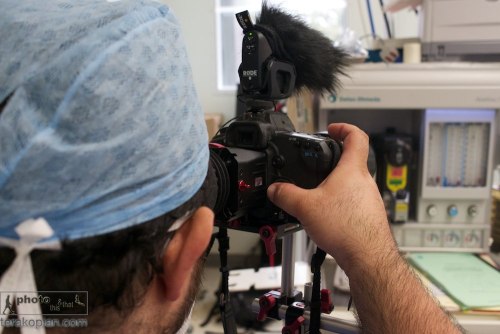
Photographer and film maker Edmond Terakopian filming at the Royal National Orthopaedic Hospital in Stanmore, with the Rode VideoMic Pro. Filming in an operating theatre. May 16, 2011. Photo: Neil patience

In listening tests, although I didn’t do a side by side comparison with it’s closest rival, the more expensive Sennheiser MKE 400 (£136.00 exc VAT), although I had previously tested the Rode VideoMic and in comparative listening tests, the Rode was the clear winner.

The new microphone is a completely different design, with a completely new suspension rig, which ensures camera noise doesn’t vibrate up to and get recoded by the microphone. I’m extremely glad to see that the on switch and all the filter controls are still at the back of the camera, where they are easily seen. There’s nothing worse that making a video recording and not switching on the microphone; with the Rode, an LED clearly shows when it’s on. The Sennheiser has these controls on it’s side where they are easily missed.

The smaller size naturally has it’s conveniences; it’s much harder to snag the microphone and naturally it takes up less room when packed. The shorter size also means that it’s now much easier to use ultra wide angle lenses.

Conclusions

If absolute quality is needed in audio, then currently with the video DSLRs on offer, one’s only answer is to record the audio separately and then sync it up afterwards when editing. I personally use a Zoom H4n audio recorder and Rode’s excellent NTG-3 microphone. However, this is extra equipment and expense, and demands a lot of extra time and expertise when editing. Even when doing dual audio, I still use the VideoMic Pro on a second body when shooting dual cameras (which I often do); this allows for a sound backup but also for a much cleaner audio track to synchronise externally recorded audio with. For the simpler and straight to camera audio recording, Rode’s VideoMic Pro has kept the superb sound of it’s older brother and packed it into a much smaller package. I highly recommend this to anyone wanting to use their DSLRs for video.
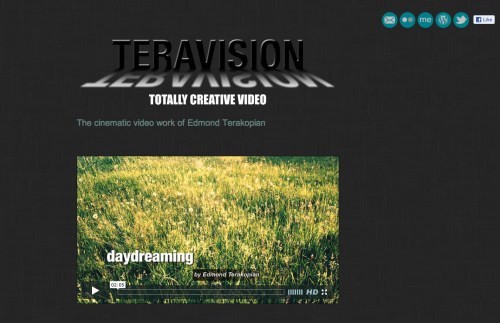
New Website For Video Work

TERAVISION

The Cinematic Video Work Of Edmond Terakopian

Some readers may not be aware of my film work; I embraced the Canon 5D MkII when it came out, not only as a photographic camera but also as a tool for shooting video. This opened the door to making films with the Olympus E-P2 Micro 4/3 camera and even a RED One. I love the creative avenue short films open and I can share some of my projects, especially the short films and montages, here on my new website:

Teravision – Totally Creative Video


Edmond Terakopian with a RED One camera (from NDP http://www.newdaypictures.com/ ) with a Rode NTG-2 microphone, whilst shooting "Daydreaming". June 12, 2010. Photo: Antje Bormann


Zacuto Striker & Z-Finder Review

Photographer and film maker Edmond Terakopian using a Canon 5D MkII, Zacuto Striker and Z-Finder Pro x2.5, Think Tank Photo Wired Up 10 bag, Zoom H4-n and Rode NTG-3 mic The wedding of Sheleen and Ben. August 28, 2010. Photo: Jeff Ascough

No one can deny the revolution that was started by Canon when it launched the 5D MkII. It certainly is a great stills camera but it was the quality of the video which stunned the world of video; everyone from the film student to the Hollywood studio.

There are some shortcomings of DSLRs for video though. The form factor being one. The image quality though is so stunning that most film makers are willing to make compromises in order to harness this unbelievable quality. To help overcome the form factor and make it easier to use the camera when handheld (or ‘run and gun’ to borrow a phrase by TV cameramen), several companies are making rigs to allow the camera to be held in a more conventional way, resembling the way a video camera is traditionally held. The two main companies making these rigs are Zacuto and Redrock Micro, with their ranges starting with minimalist hand held rigs, all the way to full on shoulder mounted and cinema rigs with follow focus units and balancing weights.

Part of the challenge for me was to find a rig that packed quite small yet gave maximum support. It needed to fit into my main work as a photojournalist yet feel at home on a short film set. After a lot of research and trying out equipment at trade shows, I had a long chat with Dave Beck at the Flash Centre and finally settled on the new Zacuto Striker as probably the ideal solution and a long term road test began in July.

Another shortcoming of these DSLRs is that the rear LCD screen is used when shooting video, making it awkward to check for focus on the fly or the checking of fine detail; these problems get even worse in bright conditions. The answer is to use a finder which attaches to the rear LCD. Zacuto are by far the leaders in this field. Their original Z-Finders required a frame to be stuck to the back of the camera and the finder attached to this. The new finders, the Z-Finder Jr and Z-Finder Pro, attach onto a frame which is held in place by a plate which screws into the tripod bush. I personally welcome this new adhesive free method as it overcomes many of the associated problems.

The Z-Finders

At £214.42 (inc VAT), the Z-Finder Jr is cheaper than the Z-Finder Pro which comes in x2.5 and x3 magnification versions, costing £326.75 (inc VAT). The main differences are the way the finder is held to the camera, with the Jr using a metal plate with a prong to clasp the eyepiece hood. This plate then needs either a tripod plate or a Gorilla Baseplate (not supplied) to attach itself to the camera. The Pro versions come with a Gorilla Baseplate which fits to the camera and then has two bushes for attaching the frame, with thumbscrews, to the back of the camera. The hood then snaps onto this frame. Whereas the Jr version is a more fiddly affair to attach and remove, the Pro versions simply snap on and off when needed. This is a huge feature in the field, especially when needing to switch to using the camera’s eyepiece for stills photography.

I found the Jr finder’s optics to be absolutely fine, but the Pro’s are better still and have a very neat focusing ring allowing you to tailor it perfectly to your eyesight. The Pro version also has an anti fogging eyepiece which is extremely useful.

Photographer and film maker Edmond Terakopian using a Canon 5D MkII, Zacuto Striker and Z-Finder Pro x2.5, Think Tank Photo Wired Up 10 bag, Zoom H4-n and Rode NTG-3 mic The wedding of Sheleen and Ben. August 28, 2010. Photo: Jeff Ascough

The Striker

I must admit that the first time I saw the prices for Zacuto gear I was shocked.  On the face of it (forgetting R&D for a moment), these rigs are just bits of hollow piping with a few locking mounts, a plate, handles and so on. What becomes immediately apparent though is just how solid these locking mounts are. The last thing you need is for your camera gear to loosen and wobble around or at worst crash to the floor whilst filming. Having seen less well manufactured rigs, it became obvious why Zacuto charges the way it does; it’s an extremely well engineered product.

Road Tests

I took this kit onto the filmset for a short film by Samuela Memmo (Sten & Stef Films) which we shot over four solid days. The filming was indoors, with some outdoor work, balcony shots looking down and even some shots inside a cramped car. The four days certainly gave the gear a proper workout. Although the majority of the shots were locked on a Gitzo tripod, the Striker really helped me use a second camera and do additional footage which enriched the film.

I didn’t once find a need to tighten any of the mounting clamps and the Striker worked perfectly. I wasn’t as happy with the Z-Finder Jr which had a tendency to move around when placed down in between shots. This led me to swap it out for the Z-Finder Pro x2.5.

There have been reports about the x3 magnifying the screen a little too much to the point that one can see pixels; these reports helped me in my choice of the x2.5 version which works perfectly. The mounting method is so much better than the Jr and this point alone is worth the extra money.

The next full-on outing for the setup was a wedding I filmed along with legendary wedding photographer Jeff Ascough. The compact nature of the rig meant that we could work very quickly and cover the entire day without issue. Shots were rock solid and the gear allowed for smooth working.

In Conclusion

On the Striker I changed the positioning of the downward handle, moving this from the side to directly under the camera; this makes things better balanced and even allows one handed operation.

The Canon 5D MkII opened my eyes to the possibilities of video; the Zacuto Striker and Z-Finder Pro have given me the ability to explore these possibilities even further. For any kind of hand held shooting, a rig is absolutely essential. My choice is definitely the Zacuto Striker.

Canon Pro Photo Solutions 2010

Business Design Centre, Islington,
London, 26 & 27 October

Canon Pro Photo Solutions is now in it’s second year and I have to say, its the best trade show I have ever been to. It’s more focussed towards professional photographers and enthusiasts who are at the top of their game. I really can’t urge you enough to check it out.

The format is in two basic forms; a large number of seminars and also exhibitors showing off their newest kit.

This slideshow requires JavaScript.

Photos By: Ant Upton, Antje Bormann, Jeff Ascough, LP & Luke MacGregor.

I’ll be there presenting my work and workflow (both photographic and video) in a seminar called “Moving Forwards With Photography & Video” over both days, in Seminar Room 1 from 14.00 to 14.50.

I’m also going to be with SnapperStuff (stand 49) showing my favourite ThinkTank Photo bags and helping anyone with their questions to do with bags or anything else to do with photography or video. Definitely try and pop by and see the new Retrospective and Sling range.

Hope to see you there!