Category Archives: viewpoint

Leica M9 – Full Review

Leica M9; the Marmite of the camera world

You either get it or you don’t!


“You’re so lucky”. This was the greeting I got from a wedding photographer; someone I had never met. Alas she didn’t seem to be talking about me, my dress sense, my personality or my photography. She was talking about the fact that I had a Leica M9 around my neck. There are occasions when cameras spark off conversations between complete strangers in the field, but I have to say that none have induced more talking and question asking than the Leica M9. It seems to be a magnet for chatty photographers from all spectrums of the profession.

Going back to me being so “lucky”. Actually, it was true. I was taking some photographs at a friend’s wedding, and all my kit which comprised of the M9, 24mm Elmar and finder, 35mm Summicron and 75mm Summicron lenses, fitted into a tiny Domke F5 shoulder bag with room to spare. The young lady making the “lucky” comment was weighed down by a back pack, two DSLRs with their big and weighty zooms and flashguns.

Whilst a DSLR is much more versatile in being able to help you photograph most situations, given the right lenses (which can range from fish-eye to macros and zooms to super telephotos) a small, light, precision made rangefinder is something else. If any camera can come close to being Marmite, it’s the Leica rangefinder. You either get it, or you don’t as much as you either love or hate Marmite.

The size of the M9 and the tiny lenses certainly has appeal, but it’s the way a rangefinder works and looks so non threatening that really appeals to me. Its been such a joy to use a Leica rangefinder for work again. In the days of film I used to use the Leica M4-2 and M6 for around 80% of my work. The rest would require long lenses and an SLR would be called into service. The number of times the people I’ve photographed have taken pity on me and told me that one day I’ll be able to afford a real camera. The first time seemed comical as they obviously had no idea about the cost or quality of Leica kit, but I soon realised that the advantage was that people were always relaxed in my presence as they didn’t take me as a serious professional photographer.

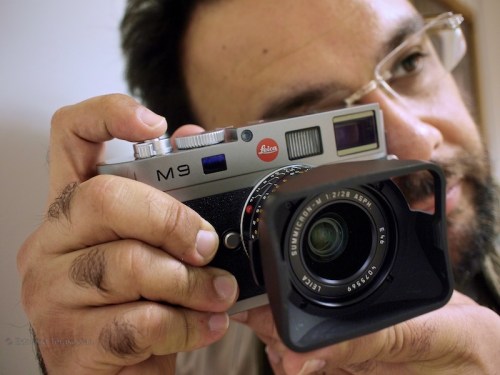
The Leica M9 in use. Photo: Antje Bormann


It’s All About The Lenses


I’ve been very fortunate in my career and have used and owned some fantastic lenses. Stunning lenses like Canon’s 35mm f1.4L or 85mm f1.2L II and the 50mm or 85mm f1.4 lenses from Zeiss have all been superb. These have been partially eclipsed by a superb 180mm f2.3 APO lens I had which was made by nowadays little known firm called Angenieux. However, by far my favourite optics have been Leica’s. The 21mm Elmarit, 35mm and 50mm Summicrons from days gone by have helped me make some of my favourite images on my Leica M cameras. The 90mm Elmarit on my Leica R6.2 also worked wonders.

Well, after the absolute disappointment of the M8 and the M8.2, the M9 is an absolute breath of fresh air. It’s not only full frame, but the sensor is great. It now opens up the digital photographer to the wonderful and amazing world of Leica optics; used how they should be used – full frame and without any multiplication factors. Thankfully, you can use the majority of the lenses ever made by Leica, dating all the way back to the 50s, with only a handful of exceptions (these are helpfully listed in the manual). To help out with older non-coded lenses, you can even manually set the lens in use on the camera using the menu system. Naturally there’s also the option of sending any old lenses to Leica for them to code it for you; at a cost.

The main thing with Leica lenses is that they just give a certain look to your photographs. I’d even say that some of the old Summilux lenses aren’t even that sharp, compared to the best modern lenses. However, they all have this magical ability of rendering light sources within the image beautifully and give you a beautifully contrasty image regardless of the light sources visible. In black and white you’d get an amazing tonal range and in colour the true rendition of colours as well as the tonal subtleties captured is wonderful. To finish off perfectly, you get beautiful bokeh. When shooting wide angle you also get such little distortion, as the design of the camera allows the rear elements of the lens to go deeper into the lens mount of the body.


I’ve used many camera systems during my career, starting with the Canon FD system, then the Nikon AF system, Nikon digital and for the past five or so years the Canon digital system. The one thing that remained constant through most of this time was the Leica M system and some R equipment too. What is also amazing is that Leica somehow has the ability to awaken a passion within photographers who generally only look at the equipment as a tool. Not only is it a passion for the cameras and lenses, but when the company gets it wrong, it’s almost taken personally. I have to admit to almost feeling heart broken when I tried the M8. The image quality didn’t live up to expectation, although in ideal conditions it would produce nice enough images, it just wasn’t consistent through its ISO range. To top it was the horrid problems with having to get IR filters for all one’s lenses. The cherry on top was the crop factor. I tried it when it first came out and then re-visited it around six months ago, and still, it was a disappointment. For a camera where zooms aren’t available and the majority of photographers don’t use the tri-focal lenses but stick to primes, it’s important to have full-frame; a 35mm lens should give a 35mm view. Well, thankfully the M9 and its full frame sensor have answered my criticisms of its predecessor. To top this, it’s actually a wonderful sensor and works rather well all the way up to 1250 ASA.
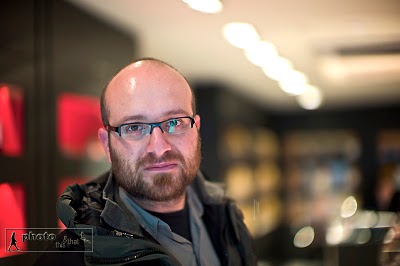

Portrait taken using the legendary 50mm f0.95 Noctilux at 400 ASA


Is It All Good?


You can probably have a suspicion that I’m rather fond of the M9; well, I am. As I mentioned earlier, it’s opened up the opportunity for us photojournalist types to use Leica for deadline work again, and this time, unlike with the M8, its with very little compromise. Its very nicely built and works extremely well.


The issues I came up with, apart from the sadness of only having it for a week and then returning it, was the buffer is easy to fill. I was originally shooting jpeg and RAW combined. I realised that shooting RAW (DNG) compressed made things much quicker and relatively snappy. It’s no Canon 1D MkIII when it comes to buffer speed, but compressed DNG works wonders. If there’s any visible quality difference between compressed and not compressed, I really can’t see it.


Another issue I came up with was the feel of the shutter button. Coming from the old mechanical rangefinders, it felt different. I could feel the stages in travel it has to have to accommodate the exposure lock for aperture priority use. However, the great news is that this can be changed in the custom functions. Another very useful function is to delay the wind on. I had these two custom functions (Soft and Discreet) constantly set and loved the way the shutter release now felt and worked. It’s still not the same silky smooth gentle release of the old mechanical Leicas, but then again having a yearning for it is unrealistic. After all, it’s a totally different camera.


Lastly, although thankfully there is now a dedicated ISO button, I’d welcome either a mechanical dial that showed the speed setting, or perhaps an LCD on the top plate showing the set ISO. For me it’s essential to be able to check this setting at a quick glance without having to go into the menu system.


In Use


I found the auto white balance to work amazingly well. It worked fabulously outdoors, like most modern cameras. However, it was under tungsten light where it excelled. The results are amazingly good. When shooting a series of images, you do occasionally get one in the set where for some reason the white balance jumps, but it’s generally completely constant. This in itself isn’t an issue if you shoot DNG as it’s very easily fixed.
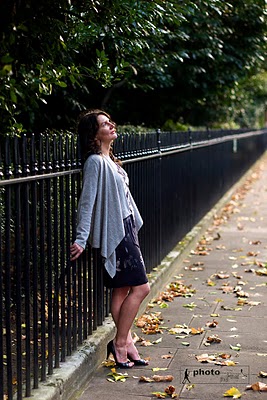

Photograph taken using the 75mm Summicron


Although Leica offer the camera with a full download of Adobe’s Lightroom, my software of choice is Apple’s Aperture. I do applaud Leica for not bringing out yet another RAW format and the files from the M9 processed beautifully in Aperture. Editing through the 18 megapixel images has been a joy and the image quality began to remind me of looking at Kodak Ektachromes on a lightbox. Maybe the Kodak engineers who made the M9’s sensor were looking at the look of Ektachrome? Main thing is that the files look fabulous.


With the M8, anything over 400 ASA started to look terrible, especially early on when the IR filtering issue was not yet publicly known. The M9 shoots beautifully at up to 1250 ASA and nicely at 1600 ASA. Its maximum of 2500 ASA can be used in emergencies, but I’d personally steer clear.


Whilst the menu system works well, it does take a little getting used to as it’s not as intuitive as some of the modern Japanese camera systems around. I’d for example love to see the SET button placed inside the direction buttons. I have a small gripe with the delete mechanism too. I have a dislike with any delete function which gives the option of delete all. If in the middle of a fast moving news job, it seems a little to easy to delete all images by accident, even if there is a confirmation needed.


On a positive note, the bright-line frame markers work perfectly. The M8 had serious issues with the frame markers not corresponding to image view photographed. This was partly addressed in the 8.2, but the M9 seems to work even better and I didn’t have a single issue.


Does It Make Sense?


If logic were to dictate, then no, not really. At £4950 body only, the M9 is a very expensive camera. Leica have always been expensive, but this is expensive, even by Leica standards. Leica are not a mass manufacturer and there’s a fair amount of hand assembly and finishing that goes on. To top this off the quality control is extremely high and has always been so. However, I just feel that the price tag is too high. It pushes it outside the grasp of most professional photographers and possibly makes it only accessible to the enthusiast photographer who has a well paid day job. Its a shame really.


The image quality, especially at high ASAs, doesn’t come close to my favourite DSLR, the Canon 5D MkII; the Canon produces smoother files at 2000 ASA than the M9 does at 1250 ASA. It also is more versatile and being a DSLR can take lenses from 15mm to 800mm, making it much more useful. However, the Leica M9, and these wonderful Leica lenses just produce images with life; there is a quality and look to the images which no other camera system can produce. Logic dictates that a large and cheaper DSLR makes more sense; the heart though, wants what the heart wants; after all, photography is a passion. Also the form factor is fabulous; this tiny camera takes up so little room and the lenses even less. It affords a very subtle and gentle way of working which is wonderful. I applaud and congratulate Leica on the M9; it’s an amazing camera and as soon as this recession lifts, I’ll be making a visit to the Leica Store in Bruton Place.


For a full range of photographs taken with the Leica M9, please visit my Flickr page. For a newer set of images, please visit THIS page too.


This article first appeared in the BJP on December 16, 2009.
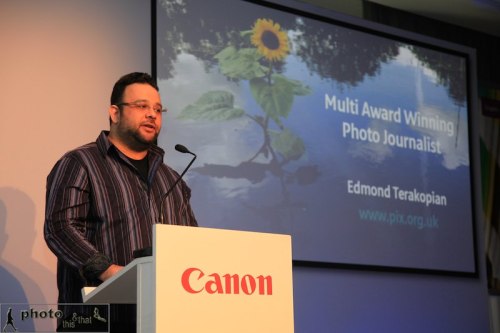
Canon’s European Launch of the iPF6300

I’ve been fortunate enough to have been asked by Canon to evaluate their new large format printer aimed at photographers; the iPF6300 which had its European launch yesterday in Lisbon. I’ve been testing it for a few weeks now with various papers and still have a long road ahead my tests on lots of papers from Ilford, Hahnemuhle, Olmec and so on. I’ll share these when I’m finished with my tests.

I’m sharing my presentation text below as it’s a great way to let you know my thoughts on this printer:

Canon Launch New Large Format Printers, Lisbon, Portugal

“Being from the school of hand printing to exhibition standard, for many years since the switch over to digital I’ve been making compromises when it came to prints made from my digital images. Having used desktop printers from Canon and Epson and also having had a variety of labs print my work, I’d never been fully happy with the quality of the prints.

I was then introduced to the Canon iPF6300.

Edmond Terakopian giving his presentation. Canon launch of iPF 6300 (and other models) large format printer, Corinthia Hotel Lisbon, Portugal. March 11, 2010. Photo: Graham Smith

As soon as I printed the very first image from the iPF6300, I knew it was something special. With it’s 12 inks I was expecting something amazing, but the quality achieved was just stunning and left me speechless – and this, was only after a test print!

The printer is of such a high standard that to the naked eye printing on the standard setting and the highest setting produce no difference to the quality of the print; what it does do is produce such a speedy output, utilising so little ink, that it has to be seen to be believed. However when ultra critical detail and subtleties have to be resolved, the higher print settings produce this at very close inspection. I was looking at the pupil and eye lashes from a studio model shoot and at the highest setting, every single eye lash is visible; every single line in the pupil, every colour change is rendered perfectly, no matter how subtle.

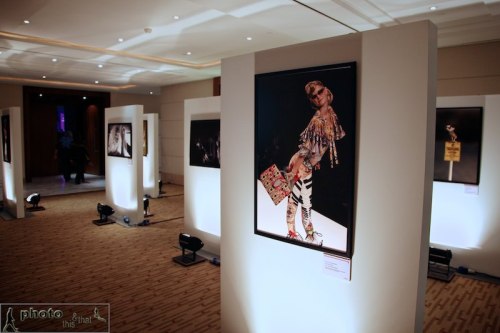
Pictures by Edmond Terakopian are exhibited at the event. Canon launch of iPF 6300 (and other models) large format printer, Corinthia Hotel Lisbon, Portugal. March 11, 2010. Photo: Graham Smith

Having tried a particularly testing landscape shot taken in the Lake District brought another smile. Every cloud, from the darkest to the lightest was rendered beautifully; every highlight and shadow detail, no matter how subtle was printed without any loss to this detail. It’s performance like this that elevates prints into becoming something special; something collectible. As a result, this printer is something special.

I then moved away from the Canon papers and started printing on the very popular Hahnemuhle Photo Rag which is a coated matt paper. Matt papers are very unforgiving to images with lots of dark shadow detail, so the first image I printed had exactly that – lots of dark shadows. I was astonished at how much of the subtle black detail was printed from a photo of a cafe scene. Throwing more and more images to this excellent but unforgiving paper kept producing great print after great print.

Images by Edmond Terakopian exhibited at the Canon launch of iPF 6300 (and other models) large format printer, Corinthia Hotel Lisbon, Portugal. March 11, 2010. Photo: Edmond Terakopian

I was also very pleased with the print driver and the Photoshop plugin. After around an hour I had come to grips with all that was possible using them. After getting the photograph and processing it correctly, it’s extremely critical to get the settings right in the driver and the way it has been designed makes life easy which is such a bonus. The ability to free print and send print jobs to a separate application to maximise paper usage is a fantastic feature, especially in this day and age of recession and awareness of conservation issues.

I also found the barcoding option on paper rolls extremely useful and an idea that is to be commended; with good quality paper demanding a premium, the last thing I would want is to mix up papers which would lead to wastage.

I also must comment on the printer’s quietness in use. My office is generally pretty quite and quite compact. Considering the size of prints capable, the unit’s relatively compact and amazingly quite when printing. The fact that it’s also such a speedy machine means that the printing’s done quickly and total silence returns very quickly; a must in a creative environment.

Having spent a couple of weeks with the iPF 6300, printing on various papers, both Canon and third party, I would have no hesitation in using it for my future exhibitions and collector’s prints”.

You can check out the iPF6300 HERE.

Aperture 3 – Quick Performance Tips

No doubt most Mac users have been trying out Aperture 3.0. On Twitter and some forums, there has been the occasional users who have upgraded to version 3 reporting slower performance to what they expected. The majority of what I’ve read though is reporting faster performance, which is something I totally agree with.


I have two tips to help out those who may be experiencing slow systems; before that though, you should ideally upgrade to 4Gb of RAM. Being a 64-bit program it can manage extra RAM extremely well, so the more loaded your system, the more obvious speed gains you will see.

Tip 1: In Preferences go to the Previews tab and only tick “Use embedded jpeg from camera when possible” and if you don’t need it, choose to ‘Never’ share previews with iLife and iWork.

Tip 2: Aperture 3.0 now has the Faces feature. It has to be seen to be believed; it still amazes me how it can pick out faces throughout my Library and start to recognise people after they have been tagged a few times. Whilst this feature will be of great use to some, you need to realise that it’s a very computer intensive process the first time it runs after an upgrade, or if you are using a trial and have imported many thousands of images. My suggestion would be to switch off the feature when you’re using the program and then switch it on to run over night. Once it has catalogued the many thousands of faces, you won’t notice a performance hit.

During my beta testing period, I used a 15″ MacBook Pro with 2.53GHz Intel Core 2 Duo and 4Gb of RAM. It’s definitely not the fastest in Apple’s line-up but by following the above suggestions, runs extremely fast with Aperture 3.0.

Lastly, check out Mac Create for some great information on Aperture 3.0.

Season’s Greetings To All

Try JibJab Sendables® eCards today!

I wanted to wish everyone a peaceful holiday season. A very merry Christmas to all who celebrate and a happy holiday season to all. I wish the new year to bring you all joy and good health; wisdom and luck too 🙂

Take care and keep well 🙂

Cops & Togs

Gaza demo, London. Photo: Edmond Terakopian

No doubt you’ve all heard of the Police’s “War on Photography”; not so much Axis of Evil, but f-numbers and shutter speeds. I have to say, that its becoming ridiculous. Photographers, professional and enthusiast, are being constantly bullied and their rights completely eroded by the Police’s misuse of Section 44. For those not in the know, this act is all about Terrorism and not photography.

Someone I know through Twitter even commented that all of this is making him stop coming to London to take pictures! Its an absolute disgrace, and all the Police officers who are guilty of misusing this power, be it the officer on the street or those sat behind desks and throwing down these orders should be ashamed. How disappointing that in this free country that we think so much of, the act of wanting to photograph something in public is being used as a reason to hassle law abiding people; be they news gatherers or people being creative. We are supposed to have freedoms in this country and I beg all officers around the country to take a step back and see the situation they have created. I wonder how the tourist trade might suffer if visitors to our shores realise they’re not allowed to take photographs outdoors?!

Now I fully understand that our country is under the threat of terrorism and I myself was on the front line in Edgware Road tube station after the bombing there. I applaud our intelligence services and the Police for all the successful operations they have carried out and for cleaning the streets of extremists who do not believe in our freedoms (the Police don’t seem to believe in these either). However, I would assume that a person involved in gathering intel would probably just log onto Google’s Street View (why doesn’t anyone shut this down? I’m guessing Google’s lawyers would be a match for anybody where as individual photographers are easy targets) from the comfort of their home. Or, I would assume that they would use small cameras and blend in with the thousands of tourists around town. Maybe they would even use spy type cameras in their ties, hand bags or hats?! Would they really used big DSRLs, sometimes on Tripods? Seriously? Is this what the intelligence tells us?

Being frisked by a security guard at Wembley Stadium. Photo: Stuart Emmerson

I’ve been a professional news photographer for over 20 years now, and it saddens me to see how much things have changed. Although relations with the Police haven’t always been brilliant, they have been miles better than this. We spend so much time stood at the same cordons that its ridiculous not to become friendly! There is no need for hostility, misinformation or game playing. There is room for respect for each other, honesty and humanity.

I remember in the early 1990s going to a light airplane crash (which unfortunately was fatal for the pilot) in an address in Harrow, Middlesex. The light plane had crash landed into the wooded garden of a mansion in the area. It was one of those rare occasions when I was suited and booted, and naturally the woodland was thick and the rain heavy and constant. After a few officers played their games and sent me on wild goose chases, I finally came across an officer who showed me where it was. He took one look at me and said that I couldn’t really get through the woodland with all my gear whilst wearing leather soled shoes. To my disbelief, he took my huge Billingham bag off my shoulder, My Canon F1n and 300mm f2.8 off the other shoulder and led the way! It was a long trek. He was kind enough to take me to the inner cordon and naturally asked me not to go inside – which is totally understandable. To this day I regret not making a note of his name and praising him to his superiors. Polite and helpful; a real gentleman.

In contrast, I was covering the Palestinian demos at the Israeli Embassy in London at the beginning of the year. As the night drew on, the Police started to kick out protesters, arresting those that they had special interest in. However, press or no press, we were thrown out of this area too. Not so much of a problem, but the TSG officer escorting me to a safe distance walked next to me, with a gentle hand on my arm. Once we got there (I need to point out that I was naturally doing as asked) the officer just drove both his arms into my chest and pushed me! Why he did this, I’m not sure. I think he was perhaps aggravated that I was doing as told. Again, I wish I’d taken a note of his number. Pointless!

* ‘Togs’ is a common shortening for ‘photographers’ *

Leica M9 & X1 – Hands On Preview

Leica M9

Edmond Terakopian tries out the new Leica M9. September 17, 2009. Photo: Antje Bormann

Yesterday I had the opportunity to have a look at the new Leica M9 and also the X1. The M9 was a final pre-production model, so it was pretty much what you would get if you bought one. However, the X1 was a mid pre-production sample so my comments should be taken lightly until I get a chance to try out a final sample.

A small bit of background info on me; I used to shoot quite a lot of my film work on Leica M rangefinders. I’ve had the M4-2, the M4P and the M6. My lenses back in the day ranged from the 21mm f2.8 to the 75mm f1.4. I’ve always loved the quality of the cameras and more so the lenses. The silent approach to picture taking has always suited me.

Test shots with final pre-production Leica M9 at Jacob's Pro Lounge, London. Antje Bormann. September 17, 2009. Photo: Edmond Terakopian


Alas the M8 put an end to the love affair and I had to definitely close the door on Leica; I just didn’t think the quality was there. Terrible image noise when trying to work in low light, a cropped sensor and that silly filters on every lens thing just put me off. I tried the M8 when it first came out and recently a few months ago, and it still didn’t do it for me.

Seems that the M9 has put a stop to that though and I find myself yearning to get back to my rangefinder days; well, the recession’s kind of getting in the way, as there’s no way for me to justify the £4850 price tag, but at least now its not the quality that’s putting me off, but merely the cost. As Richard, the chap from Leica said yesterday, it’s reassuringly expensive!

Test shots with final pre-production Leica M9 at Jacob's Pro Lounge, London. Antje Bormann. September 17, 2009. Photo: Edmond Terakopian

At first glance the camera’s very similar to the M8 but now thankfully has a dedicated ISO button. The interface is usable but no way is it near the ease of use offered by the latest Canon DSLRs. Still, its a big improvement on the M8.

Where the camera really shines though is that it now has a full frame sensor. The cropped sensor of the M8 was a huge disappointment for me. The other huge improvement is that there is much less image noise, so working in low light is again a possibility. Whilst the camera’s high ASA ability doesn’t come anywhere near matching a 5D MkII, its still very impressive and a million times better than it used to be on the M8. At 160 ASA its faultless; absolutely stunning. I pushed it higher to 1250 ASA and its still extremely good. There’s some grain, but it looks right and the colours also look right. I shot a load of tests indoors under mixed lighting and also outdoors in daylight and apart from some shifts in the auto white balance, the colours where great.

Test shots with final pre-production Leica M9 at Jacob's Pro Lounge, London. Antje Bormann. September 17, 2009. Photo: Edmond Terakopian

Whilst the shutter is no were near as silent as the old cloth shutters, it has several quite modes which allow the cocking to be done on release of the shutter button; this makes operation much more quite.

As far as the quality of the files concerned, I’m extremely happy with the jpegs which you can see here. As the camera has only just been announced, I’m waiting for Apple to release a RAW update so I can have a look at the RAW’s using Aperture. If the jpegs are this good, I’m sure the RAW’s will be a knock out.

As I mentioned earlier, I’m really happy with this camera; Leica and Kodak who make the sensor chip have done a great job and made the camera usable as a professional tool. With the M8, you got great shots if all the elements were right and the light was perfect; now with the M9, it looks like you can adapt to the elements and not just give up.

My full review of the Leica M9 is now available HERE.

Leica X1

The other camera of note which has recently been announced is the X1. Initial rumours suggested that it was based on the Panasonic Lumix GF1 which is a micro four thirds, interchangeable lens camera. It isn’t the case though, as the sensor is a bigger APS-C sensor with a lower crop. The X1 however doesn’t allow you to change its 24mm f2.8 lens as its fixed. This 24mm lens translates into 35mm in 35mm terms. I really wish that it was an f2 though.
Its a very handsome little camera and feels nice in the hands. I was rather impressed by the lens as distortion is very well controlled and the optics are pin sharp. However, I must admit that I wish they had made it an interchangeable lensed camera. However, to use this camera properly, I’d seriously suggest an external finder as otherwise its just a flashy compact camera. At 500ASA, the image quality was very good and noise was well controlled. Focusing was sure footed and pretty speedy. My only initial thoughts are that its a shame there is no face-detect, as this would work well when using the external finder – I have since found out that it does have face detect. Although an early sample, I must admit to being very impressed by the image quality.
As mentioned before though, I’m going to reserve full judgement as this was a mid pre-production camera.

For a gallery of images check out my Flickr.

Addendum 1: I was so impressed with the Leica M9 & X1 that I have since writing the review bought both cameras.

Addendum 2: You can now read my full review of the Leica M9 in the BJP (British Journal of Photography).