
Click on the image for a video message! Wishing you all a very merry Christmas and a superb new year 🙂

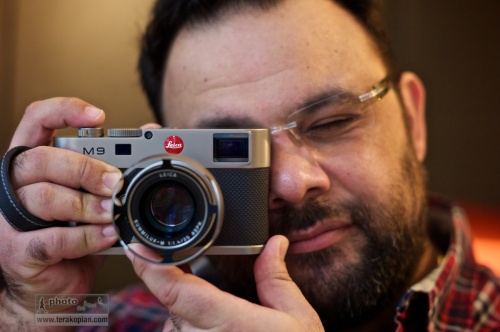
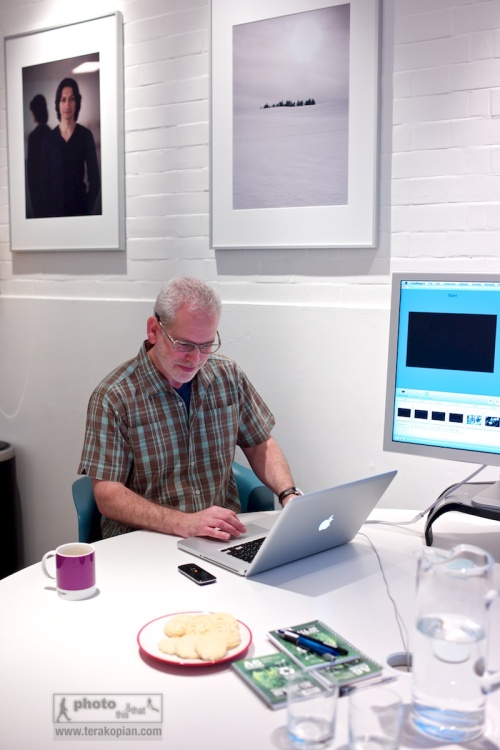
Photographer Edmond Terakopian tests the limited edition Leica M9 Titanium. November 12, 2010. Photo By Brett
There were rumours abound before Photokina 2010 about Leica bringing out a new camera; talk of an M9.2, a different digital M and even a digital body that would take the Leica R lenses. Well, the different digital M turned out to be right, but who would have thought it would be anything like the Leica M9 Titanium, or Titan as it’s also called?
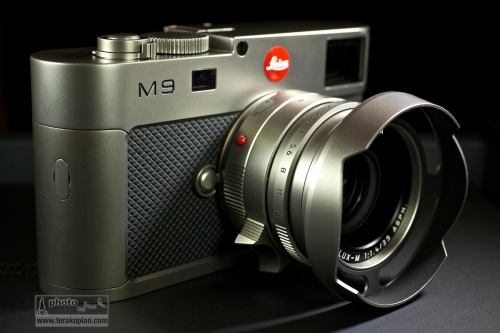
The limited edition Leica M9 Titanium, complete with Summilux-M 35mm f1.4 ASPH in Titanium. November 12, 2010. Photo: Edmond Terakopian
I must admit to not being a big fan of the limited editions that companies produce; I’m a photographer and want tools which are reliable and produce the utmost in imaging quality. I’ve often sighed to myself when I’ve seen limited editions of the M6 or M8. My thoughts at the time were always the wish that Leica would stop concentrating on these and put all their energy into making a ‘proper’ digital rangefinder. For me, the M8 and M8.2 just didn’t cut it. Well, the M9 certainly does cut it and ever since reviewing it for the BJP at launch, I’ve been saving for my own M9 which I recently bought. Leica has changed a lot in recent years; fresh thinking has brought amazing products like the S2 and some stunning M optics as well as the wonderful M9. So, considering the current lineup, I didn’t sigh when I first saw pictures from the launch, but was rather intrigued.
The M9 Titanium though is an absolute departure from putting exclusive leathers and other materials onto the normal camera’s outer casings. Although it has an M9 at it’s heart, it has a completely a new casing, even down to the base plate. There is also some new technology in the viewfinder, more of which later. As it’s name suggests, the material is Titanium; tough and light – pretty much ideal for a camera. Every piece of exterior metal is made from solid Titanium and the body is covered in beautiful high grade leather.
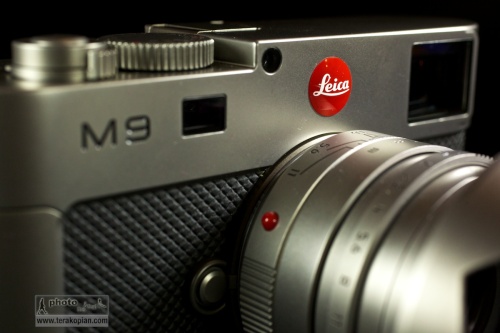
The limited edition Leica M9 Titanium, complete with Summilux-M 35mm f1.4 ASPH in Titanium. November 12, 2010. Photo: Edmond Terakopian
So, what to do about designing the camera? Well, the answer surprisingly was to approach a car designer; to quote Leica:
“The exclusive special edition Leica M9 “Titanium” is the result of a collaboration with Walter de’Silva, the prominent automobile designer. Responsible for groundbreaking design concepts for the latest models from the Volkswagen Group, the chief designer and his Audi Design Team have re-interpreted the design of the LEICA M9 just as he envisaged it. The outcome is a unique camera with a new interpretation of the characteristic features of Leica rangefinder cameras, which lends precision engineering, unique style and solid titanium to extraordinary formal design.”
It may seem a strange thing to do as cars and cameras are so extremely different, but seeing the camera, I must say that the collaboration is an absolute success. In the pictures first released, the camera and lens looked good, but in real life, it looks and feels superb.
In the days of film, I used to have a Leica 35mm f1.4 Titanium lens – I must say I always loved the way it felt. Well, this camera takes that feeling and multiplies it many times over. I can’t think of anything that can make an M9 feel cheap, but the M9 Titanium does just that! As much as I admire the look and the feel of the camera, I also absolutely adore the lens. The ‘kit’ lens is Leica’s extraordinary Summilux-M 35mm f1.4 ASPH. This too is created using solid Titanium and also comes with a beautifully crafted Titanium lens hood, specifically made for the camera. Even the red Leica badge is custom made from resin and hand-engraved with enamel for the camera. There is also an interesting leather holster for the camera, which again was specifically designed and made for the camera. All of this is packaged up in the most beautiful of presentation boxes, including a gorgeously printed book showing the journey of the camera’s design, from concept to reality.
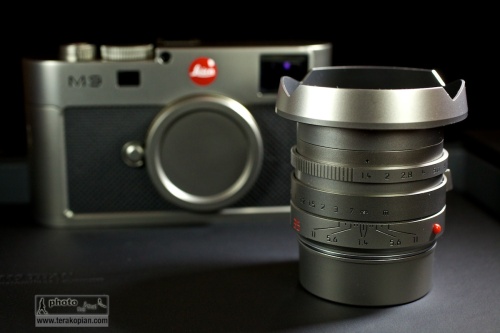
The limited edition Leica M9 Titanium. Summilux-M 35mm f1.4 ASPH in Titanium. November 12, 2010. Photo: Edmond Terakopian
The good news for the collector is that there are only 500 of these to be made. As I mentioned earlier, this isn’t one of the ‘normal’ limited editions, but a completely new design of camera, in solid Titanium. Price of such exclusivity is £19,800.00. I’m not really a collector, so don’t know much about such things when looked at as investment, but to me, a completely unique camera does make investment sense. Now, if only I could win the Lottery!
In Use
Thanks to the wonderful folks at Leica UK and the Leica Store Mayfair, I was able to spend a day with the M9 Titanium. Naturally all the testing was done in the office; even if Leica would allow it, I wouldn’t feel comfortable taking such an exclusive and irreplaceable camera out on the street. I need to add though that this camera isn’t part of the 500 but a pre-production proof of concept model; after all, the Leica Stores need to have cameras to show collectors before orders are placed. The one I used had the serial number 6.
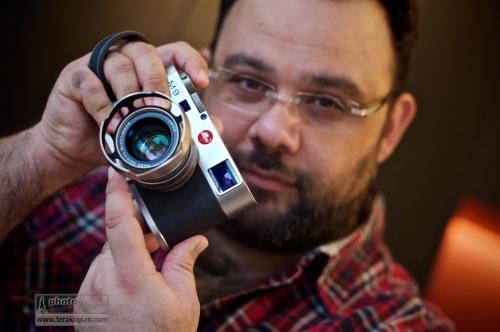
Photographer Edmond Terakopian tests the limited edition Leica M9 Titanium. November 12, 2010. Photo By Brett
In the hand, this camera really feels great. The weight and feel of the materials is just perfect. Aesthetically, I think, it works really beautifully, but the feel of the thing is also spot on. Every part of the body, and that gorgeous lens just work. It’s form, function and material in perfect harmony.

Test images shot with a Leica M9 Titanium. Photographer Brett from the Leica Akademie. November 12, 2010. Photo: Edmond Terakopian
One of the first things I wanted to see were the new LED illumintaed frame lines in the viewfinder. Traditionally, these are bright-line overlays. In use, these have served me well for a decade; however, in very bright conditions where the subject has a very light coloured background, they can disappear. The M9 Titanium has a completely new system where LEDs are used for illuminating red frame lines. These are much easier to see; very crisp and accurate. It took a few minutes to get used to, but I think I would welcome this system in future M cameras. Aesthetically this removes the need for an illumination window on the front of the camera, adding to a cleaner look.
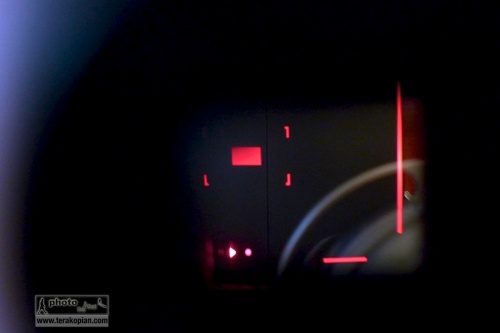
The limited edition Leica M9 Titanium. LED bright line frame lines. Unfortunately I couldn't photograph it showing the entire frame, so this image shows the bottom right hand corner. November 12, 2010. Photo: Edmond Terakopian
One thing which did surprise me was that the frame lines still showed the lens pairings as they have traditionally done, e.g. 28mm and 90mm. I was expecting that the system would show just one set of frames for the mounted lens. I guess though that this would need to read the 6-bit coding to differentiate between the lens pair. Perhaps in the evolution of the M line we shall see this function.
Looking at the outside, one thing which is absent is the manual frame-line selector lever. There are some die-hards on certain forums which mourn it’s loss, but I for one have never found a need for it. I already know the field of view a 50mm is going to give me compared to say a 28mm; the need for changing this manually before choosing lenses is, I think redundant. The M9 Titanium looks so much better and cleaner for not having it.
The Summilux-M 35mm f1.4 ASPH is a superb lens; the results just sing. To have it made from Titanium just makes it feel even better in the hand. It’s an absolute joy operating this camera, looking through that superb viewfinder and focusing this gem of a lens; it just feels absolutely spot on.
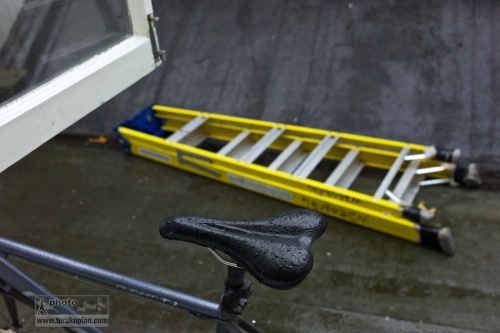
Test images shot with a Leica M9 Titanium. November 12, 2010. Photo: Edmond Terakopian
Apart from the material and design differences, it just handles like an M9; it just feels even better in the hand. I walked around the office taking portraits of some of the folks there and also some shots of the studio and other shots through an open window. I must admit that it’s the first time in my 21 years as a photographer that I’ve felt privileged using a particular camera; it was a real treat.
The Carrying and Holding Concept
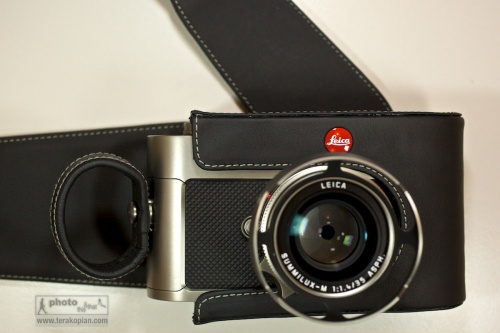
The limited edition Leica M9 Titanium. November 12, 2010. Photo: Edmond Terakopian The limited edition Leica M9 Titanium. The carrying system comprising of the leather holster and the finger loops. November 12, 2010. Photo: Edmond Terakopian
I think one of the obvious things is that this camera will probably never really be used as a photographic tool, but more of a collector’s piece. As a result, I’m looking at these ideas as concepts and not as real world suggestions for working with the camera. As concepts, they are very interesting. The holster is a new approach and is made beautifully out of very high grade leather. I for one would never use it in real life situations though.
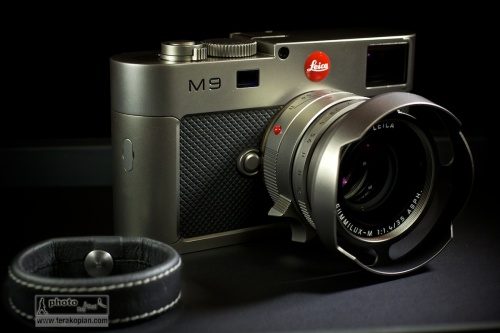
The limited edition Leica M9 Titanium, complete with Summilux-M 35mm f1.4 ASPH in Titanium. The finger loop is shown on the bottom left. November 12, 2010. Photo: Edmond Terakopian
The finger loops, which are metal and covered in leather (and come in two sizes) are slightly more usable. The very first time I held the camera (you insert two fingers through the loop), it felt strange but quickly became quite comfortable. With use, one acknowledges that it’s actually quite a neat system and very secure. I would probably opt for the included carrying strap though as I’m just used to having a camera on my shoulder. This new one sided mounting system does away with the traditional strap lugs at either side, again making for a very clean look.
Reality
I would love an M9 Titanium in black paint. I generally shy away from shiny cameras for my work. The less attention, the better considering some of the environments I work in. Titanium is wonderfully strong and light and is the perfect metal for these tools of ours. Alas, it’s expensive and harder to work with, needing special tooling. The M9 Titanium also has a special hard coating which is applied in Switzerland, so this camera, even if mass produced will never be cheap. Still, as a photographer, a black, or very dark and matt coloured Titanium Leica would be fabulous.
Test images shot with a Leica M9 Titanium. Photographer Brett from the Leica Akademie. November 12, 2010. Photo: Edmond Terakopian
The current M9 Titanium is a thing of beauty. Everything about it is pure elegance; not just elegance though as it’s combined with absolute usability and stunning design which marries the aesthetic with the practical. As someone who prefers black, I can look at this camera and I still appreciate it’s gorgeous looks and even the colour. How good does it feel? Just think about my earlier comment that it makes the regular M9 feel cheap.
For a set of picture taken with and of the Leica M9 Titanium, please visit my Flickr page.
©Edmond Terakopian
Posted in Camera Equipment, Leica, Photography, Review, viewpoint
Tagged collector, investment, leica, leica m9 titanium, limited edition, review, road test, test
Canon Pro Photo Solutions is now in it’s second year and I have to say, its the best trade show I have ever been to. It’s more focussed towards professional photographers and enthusiasts who are at the top of their game. I really can’t urge you enough to check it out.
The format is in two basic forms; a large number of seminars and also exhibitors showing off their newest kit.
I’ll be there presenting my work and workflow (both photographic and video) in a seminar called “Moving Forwards With Photography & Video” over both days, in Seminar Room 1 from 14.00 to 14.50.
I’m also going to be with SnapperStuff (stand 49) showing my favourite ThinkTank Photo bags and helping anyone with their questions to do with bags or anything else to do with photography or video. Definitely try and pop by and see the new Retrospective and Sling range.
Hope to see you there!
Posted in Bag, Business, Camera Equipment, Computers and Software, Exhibition, News, Video, viewpoint, workshop
Tagged aperture, apple, canon, exhibition, final cut, photo, photography, pro, show, talk, video
Over a week ago, I had the majority of my Leica equipment trashed by a negligent security guard who just allowed the bag they were in to fall off the end of the conveyor, turn upside down mid air and finally fall to the floor by his feet, after he had X-Rayed it. I need to add that under instructions, I was at the other end of the machine still putting on camera bags and other belongings into the machine as this happened.
The aim of my post isn’t about this though. After I Tweeted what had happened, I was overwhelmed and so touched by the number of people who offered up Leica cameras and lenses to help me out and to allow me to carry on working. I couldn’t possibly take any of you up on your extremely kind offers, but I just wanted each and every one of you to know how touched and appreciative I am. From the bottom of my heart, thank you all.
 Poster design by Tim Allen.
Carrying on from my previous post on the value of photography, I had a photographer who was a participant in a previous workshop on the phone to me. He had taken photographs for a client and the design firm who had designed the product (forgive my vagueness – I don’t want to cause any hindrance to this photographer’s situation) was trying to bully him into getting full international usage rights to the pictures; they were apparently adamant on it. This firm has no rights to the images.
This young photographer got on the phone in a panicked state, not knowing what to do. As I explained to him, the licensing rights and the full copyright belong to the photographer; cherish these and do not be forced to give them away. You can negotiate a license of usage to someone who wants to use the pictures. To find out how much to charge, some good guides are to use the automated pricing structure on Photoshelter; go to My Photoshelter page and ‘BUY’ any image. Then click the Downloads tab and fill in the drop down questions to suit the purpose your client wants. This will give you an idea of what to charge. Another is to refer to the NUJ’s Fees Guide.
A favourite of companies trying to get freebies is to promise work in the future in exchange for things like licensing, or to try and get a huge discount. These are just tactics and it’s highly unlikely this work will come. I operate in a different way; I wait for a client to become a regular client who books me constantly; I then offer them freebies – but never at the expense of my core pricing structure.
Photography is just like any other business; everything has it’s price. Stand firm and produce quality work.
If you’d like to buy any merchandise with the poster design on it, please visit Cafe Press.
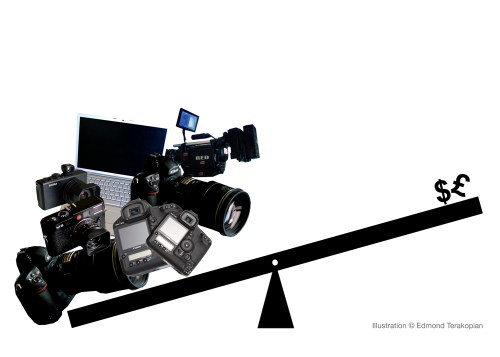
I’ve been a professional photographer for almost 21 years; it’s a job which I love and an industry which I fell in love with instantly. Photojournalism has always been my passion; never well paid but satisfying morally with an income that would help one get by.
In all this time, I have never seen a photograph be as devalued as it is now. Most companies believe it is a right for them to steal pictures and use them for free. They even set up dodgy ‘rights grab’ competitions which thousands enter into, signing away their copyright or at best giving away rights of usage to the organisers. Young freelance photographers straight out of college easily sign away their copyrights to the papers, being made to believe that is the norm.
The companies who do want to pay, make up fictitious small budgets as a way to say that they cannot afford to pay more than a certain amount and try to bully the photographer into submission. The same people would never dream of trying that on in a shop, but for some reason, photographers are fair game.
My thoughts are that we need to stick to our principles; pictures have a value; our copyright and the rights to our images need to be cherished. Have your rate card and stick to it. Turn away a client who is trying to take advantage. If we don’t do this, our work will continue to loose value and the equipment which now days cost twice what it did a few weeks ago will be well and truly out of our reach. Even worst and most importantly, the power and respect that a photograph has will be lost.
This short video makes the point very nicely; thanks to Keith Meatheringham for bringing to my attention. Definitely worth watching:


 Photo This & That