Here’s a video review from Digital Rev on my favourite ever lens; the Leica Noctilux-M 50mm f/0.95 ASPH.
You can see a selection of shots with this lens on my Flickr.

Here’s a video review from Digital Rev on my favourite ever lens; the Leica Noctilux-M 50mm f/0.95 ASPH.
You can see a selection of shots with this lens on my Flickr.
Photographer John Moore talks of his assignments in Egypt, Bahrain and Libya.
A fascinating behind the scenes look at how photographers cover the politicians of the US Congress.
Colour; it can be the cause of endless head aches. With digital photography, we’re in many ways quite lucky as we can set custom white balances and even dial in degrees of Kelvin (which is unit for the measurement of temperature and in our case, colour temperature).
However, most photographers are quite lazy in this and will shoot in auto white balance and hope to correct things later in post processing. This is not such a bad thing if one shoots RAW but I’ve seen many colleagues shoot jpeg and then try and correct the most horrendous colour casts and end up ruining perfectly good images as a result. Even for us who do shoot RAW, we’re still reliant on finding a neutral grey to click our white balance tool on and tweak the slider until it looks right. To do this, we’re also relying on our monitors and laptop displays to be accurately calibrated.
In the world of video it gets much more complicated and many times more time consuming. To make things worse, any extreme colour corrections can lead to a degradation in quality as unless you’re shooting with a RED One, you’re not shooting RAW.
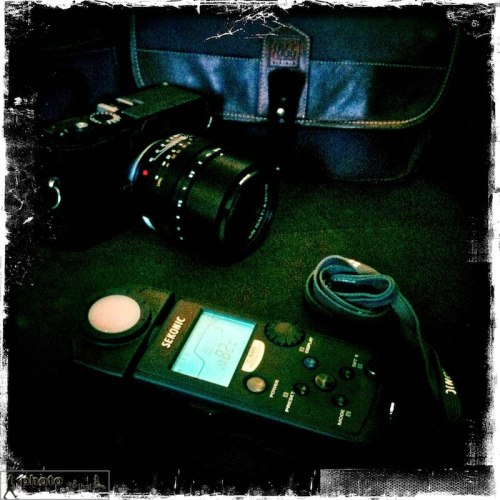
The Sekonic C-500 Prodigi Colour Meter. Photo: Edmond Terakopian
For anyone who hasn’t tried it, setting a custom white balance involves photographing a white (or grey) card and choosing that image as a custom setting. This works extremely well and allows for exact colours, even in pretty extreme lighting conditions. The only downside to this is having to stop and either use a white balance tool (EzyBalance) such as those made by Lastolite or try and find a notepad with white paper that is big enough to photograph. An extra step is then needed to set the white balance to custom and finally to choose this image as the reference for the custom white balance. It is rather longwinded.
If shooting on a tripod with creative and spot lighting, it can also be an extra head ache as the camera has to be taken off the tripod, brought to where the light is falling on the subject, white card photographed, then set and finally put back on the tripod and set up again for the shot. Even adjusting power settings or diffusion on lights can change the colour temperature.
This is where a colourmeter comes in to save the day. It involves the photographer holding the light receptor in the light being photographed, with it pointing back towards the camera. A measuring button is then pressed and it gives an exact Kelvin reading of the colour temperature. All you then have to do is to set this on the camera and shoot away. In a photographic situation I also sometimes just make a note of the temperature in different areas I’m working and then input these onto the RAW files when processing them on Aperture 3. Both systems work equally well. Naturally for video work though, one inputs the Kelvin reading into the camera before doing a shot.
Many years ago I tried using a Minolta colourmeter (designed in the days of film) with limited success; it certainly improved upon the auto setting but I still needed to tweak my shots. Sekonic, with the C-500 and C-500R (for pocket wizard connectivity) has brought out the world’s first digital and film colour meter. The spectral sensitivities of film and a digital sensor are different and by catering for both (you can change this in the mode setting) it works perfectly with digital cameras. For film shooters it can also give index readings for filters.
As is my way with tests, I took the Sekonic C-500 out with me on assignments. I used the meter with both a Canon 5D MkII (which uses a CMOS sensor) and a Leica M9 (which uses a CCD) and the results were great. On one event in the Army and Navy Club I photographed in a variety of artificial lighting conditions and the results were pretty much spot on. The meter can be tweaked to work with particular cameras even more accurately.
I also decided to do a set of video tests and using an X-Rite ColorChecker as a test subject, I shot film clips using the Canon 5D MkII in various lighting conditions from bright sunlight to extreme shade and also artificial light. The results again impressed.
All was not perfect though; although the meter has the ability to measure from 2300 to 20,000 Kelvin, it doesn’t seem to work in dim lighting and constantly gave an “Under” message. This happened even if the meter was brought right up to the light.
On the whole though, I have to say that I’m impressed with the meter and in all but the most extreme low light, it worked well. I think that any photographer who works in colour would do well to contemplate getting one of these and it’s an absolute no-brainer for anyone involved in video.
Posted in colour, Photography, Review, viewpoint
Tagged accuracy, accurate, color, color meter, colormeter, colour, colour meter, colourmeter, kelvin, measurement, measuring, white balance

I had the opportunity to have a quick play with the new Fuji X100 over dinner and took a series of images inside a dimly lit restaurant and it’s surroundings during Focus on Imaging in Birmingham. My full and proper review will follow once I get a review sample, but wanted to share a few images. These images can be found on my Flickr Page.

Posted in Camera Equipment, Photography, Pictures, Review, viewpoint
It’s not everyday that one get’s included in an app, so I was delighted when the folks at Kolekse got in touch to say they would like to feature my blog on their PhotoVerse app.
To quote the company, “PhotoVerse is a utility application developed by Photographers for Photographers. Photoverse collects information from multiple news sources and blogs related to photography, pools them and presents them to you in an easy to read scrollable list.It is a great way to keep tab of the latest happenings in Photography”.
It works perfectly and is a very neat and quick way of keeping an eye on the blogs that matter to you.
PhotoVerse works on your iPhone, iPad, iPod Touch and an Android version is in the works. You can grab it from the iTunes Store or just search for in in the App Store from your device.
To celebrate being in this app, I’m giving away five free codes for the app. I’ll randomly be choosing five people from Twitter (by Friday, March 4th, 2011) who Tweet the following:
RT @terakopian’s #blog https://photothisandthat.co.uk/ is now on the PhotoVerse App. #photography RT to win 1 of 5 free copies.
So, get Tweeting folks 🙂


 Photo This & That