Search
Bespoke Workshop
- Bespoke Workshops Bespoke 1 on 1 Workshops
This Blog
Photo This & That is the blog of multi award winning photojournalist, film maker and commercial photographer Edmond Terakopian.
All content ©. You may not use, copy, or store any of the content without written permission.
I do not condone nor can I be held responsible for reader comments published on this blog; they are the sole responsibility of the reader making the comment.
-
Join 3,063 other subscribers
FaceBook
Flickr Photos
-
Recent Posts
- Follow Photo This & That on WordPress.com
-
Tags
ap aperture appeal apple art award awards award winner award winning black and white business bw camera canon career collector competition Coronavirus dslr e-m1 e-m5 mark ii edmond terakopian Eizo em1 exhibition finalist fujifilm g-tech g9 image interview leica leica dg lightroom london lumix Lumix g9 Lumix s pro m9 m43 mac micro 4/3 micro four thirds mirrorless monochrome nik software nominee olympus om-d omd Panasonic photo photography photojournalism photojournalist portrait press press photography print processing reportage review rnoh rode S1 S1R sigma S Series street photography talk think tank photo tpoty video war workshopRSS
Archives
Category Archives: Camera Equipment
Leica M9 Review by Digital Rev
Thought I’d share this rather fun and funny, yet accurate review of the Leica M9.
Posted in Camera Equipment
Olympus E-P1 – Full Review
Photographer Edmond Terakopian trying out the new Olympus E-P1 with the 17mm lens and external viewfinder. June 27, 2009. Photo: Ghene Snowdon / http://www.gsnowdon.com
These are very exciting times for photographers. Admittedly, if the recession wasn’t on, it would perhaps be even more exciting as we would be able to afford these things, but nevertheless, in the past few months there has been a range of great cameras announced.
The first of these, and the subject of this review, is the Olympus E-P1. This is the first in a new genre; the micro four thirds non SLR interchangeable lens camera, which was announced earlier this year on June 16. Its a great little camera. In a nutshell, it has a 12.3 Megapixel sensor, shoots at 3fps, ISO range of 100 to 6400 and has a built in IS system. The camera was launched with two lenses; a 17mm f2.8 pancake (equivalent of 34mm) and a 14-42mm f3.5-5.6 (equivalent 28-84mm).
I first got to play with the camera for a couple of hours in June, and this first brief encounter left me smitten. The E-P1 was everything the Leica M8 should have been. I have yearned for a proper digital rangefinder since switching over from film and have been disappointed by Epson and Leica’s attempts. Having tried the M8 twice, alas it was clear to me that it just wasn’t for me. The sensor’s cropped size, terrible performance in mid ASA’s upwards and need of extra filtration has put me off for good. I really wish that they sort out these shortcomings instead of just focusing on limited editions and luxuries like mineral crystal LCD covers.
However, a lot has happened since then. On September 2nd, Panasonic announced the very interesting Lumix GF1, which like the Olympus is a micro four thirds camera with interchangeable lenses. Interestingly it has an optional electronic external finder. Having had a Leica Digilux 2 for several years, I’m used to this type of finder but not necessarily a fan; on the Digilux 2 fast panning movement would cause streaking and lag. I’m looking forward to testing the Lumix GF1 to see how its electronic finder works.
Leica also announced the M9 and X1 (which appears to be a Lumix GF1 but with a fixed lens and different body) on September 9. Although I have yet to test either of these cameras, apart from its price point, the Leica M9 looks like it just may be the camera to get Leica back into the world of working photographers. To add to these, Canon announced its G11 on August 19; whilst it differs from these cameras by having a fixed zoom lens (equivalent of 28-140mm) and being firmly in the compact camera category, it promises to be a great tool as it has thankfully left behind the megapixel war and concentrated on image quality, whilst being based on the very user friendly and sturdy G10 chassis. Whilst at launch, the Olympus E-P1 was totally unique and literally in a league of its own, it now faces some tough competition.
The camera has a fantastic feel to it. It’s solid and well built and for weeks I’ve had it on my shoulder. Its feel just encourages you to pick it up and take pictures. Eclipsed by only the Canon 5D MkII, I’ve never had a camera that has piqued the interest of my colleagues so much as the E-P1; on any type of gathering, it has instantly been the topic of conversation.
As my colleague Jonathan Eastland pointed out in his technical review (BJP 29.07.09) one instinctively brings the camera to the eye; alas there is no viewfinder and the rear screen is used much like any digital compact camera. Thankfully there is an option of an external optical viewfinder, the VF-1, which is matched to Olympus’ pancake 17mm lens. This tiny little accessory changes the camera completely. Olympus had difficulty in getting the VF-1 to me and for several weeks I carried the camera to jobs and couldn’t use it. I am of the school where a camera is raised to the eye and not kept at arm’s length. After this initial period I was very close to calling the camera a flash compact camera that had interchangeable lenses. However, fitting the viewfinder makes it a very useable tool.
I generally put the camera onto centre spot focus and could more or less guesstimate where the point would be in the external finder. This system works very well, both in terms of speed and accuracy and only failed on a small percentage of shots. Whilst the camera is generally fast to focus lock, it does rarely just take so long that the shot passes you by; as I mentioned though, this was for a small percentage of shots. Another focusing mode which worked surprisingly well in combination with the external finder was face detect; this would recognise faces in the composition and rather accurately focus on them.
Although the VF-1 is a snug fit, it needs a lock. To take this external viewfinder system to the next level, it would be fantastic if it incorporated some electronics in the form of focusing spot points, focus lock indicator and exposure values.
However, as things stand, the only four thirds lens with a matched external optical viewfinder is Olympus’ offering as reviewed here. Panasonic is launching a great looking 20mm f1.7 (equivalent 40mm) pancake lens. As Panasonic’s viewfinder is electronic, there is no matched optical version. My thoughts are that for this camera to really work and be useable, there needs to be a set of prime lenses with matched external optical viewfinders. My personal wishes would be for a 24mm or 28mm, 50mm and 85mm lenses to be added, all with their own matched finders. Ideally, the current 34mm pancake lens will also be replaced with an f2 or faster version. Whilst the silver version of the camera I have been reviewing looks great, the only other option is white. I have yet to see this in the flesh, but it does look great in the pictures. What’s really desperately needed is a black version.
The 14-42mm f3.5-5.6 (equivalent 28-84mm) zoom lens is a surprisingly good performer in good light. Its tiny size meant that I had it with me for “just in case” situations. Naturally this lens has to be used with the rear screen as there is no zooming external finder available. I must admit though, I was smitten by the little tiny 14mm pancake lens which is smaller even than my Leica M lenses. Its a fantastic performer, producing sharp, contrasty images full of colour. Flare was very well controlled too. My only wish, as mentioned before was that I just wish it was faster than f2.8.
Unlike the Panasonic GF1, the E-P1 does not have a built in flash. Olympus however do offer the dedicated FL-14 flash. Like the camera, its very well made and feels solid. In use, it has a tendency to occasionally over-expose the first shot and then is fine for remaining shots. For its size, and considering it uses two AAA batteries, its amazingly quick to recycle. Using it on aperture priority with slow shutter sync enabled produced some excellent and very well balanced results.
This camera performs rather well in higher ISOs. Its never going to come anywhere near a Canon 5D MkII for low light work, but as far as Olympus cameras are concerned, it does do an extremely good job. I did a whole series of shots from 100 to 1250 ASA, and all of the images impressed. 1600 and 2000 ASA were usable, and anything above is really for emergency use. The fact that the camera has IS and the 17mm is f2.8, does mean that you can work in pretty dim situations.
The camera has a 3fps motordrive which is pretty impressive. It’s very responsive and the drive speed makes it very usable. The unfortunate thing is that the camera is very loud. It’s not even the drive; the shutter is just too loud, even on a single shot. Considering there is no mirror to move, the camera should be much more quiet.
The main use I put the camera to, especially when the finder finally arrived, was street photography. It just seems to be in its element on the street. Although it was shiny silver, the size meant that it could be easily hidden and taken out for a picture. I found it very usable and really enjoyed making pictures. It just so happened that when on most of my news assignments, although I had the camera with me, I didn’t use it much. This was purely down to not having the external viewfinder yet.
So, who’s this camera aimed at? It’s not a compact and not an SLR; think of it as a modern day rangefinder style camera. For me, its ideal for features, reportage and street photography. However, its usefulness depends on the lenses released in the future. These need to be fast prime lenses with matched external viewfinders. Newer models really need to be much quieter (I’ve used DSLR’s which make less audible sound). But even with these improvements, it’s not all clear cut; the offerings from Canon, Leica and Panasonic will need to be considered. Having said that, I congratulate the birth of this new format and wish it longevity.
Originally Published in the BJP, September 2009
For a full set of images shot on the E-P1 please visit my Flickr page
Posted in Camera Equipment, E-P1
First Open Workshop
A montage of images of me at work, ranging from 1994 to 2009
I’ll be having my first ever open workshop on November 28th, 2009. The general themes will be photojournalism and street photography. It’s going to be most suited to intermediate and advanced photographers, both amateur and professional. Although having done many workshops, lectures and presentations in the UK and abroad, this is the first ever open one, meaning anyone can book and pop along.
Part of the workshop is also a portfolio review, so if you think your work might benefit from some one to one attention, you can also book this.
I’ll be showing some work from my 20 year career as a press photographer, answering any questions you may have and then getting down to the actual workshop, so make sure your batteries are charged and your cameras ready!
The business and booking side of things is being dealt by Ghene Snowdon, so visit the Photosocialise site to make bookings.
As it’s a first and there’s a recession, we’ve decided to keep it mega cheap. These prices will definitely never be repeated again, so if you’re interested, do make a booking sharpish – places are limited and are booking up already!
To see a report from the workshop, click HERE.
Posted in Camera Equipment, Computers and Software, News, Photography, Pictures, workshop
Leica M9 & X1 – Hands On Preview
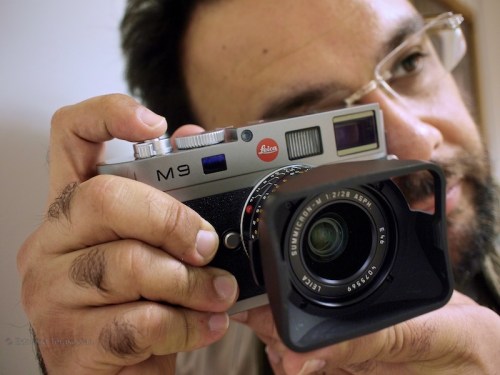
Leica M9
Yesterday I had the opportunity to have a look at the new Leica M9 and also the X1. The M9 was a final pre-production model, so it was pretty much what you would get if you bought one. However, the X1 was a mid pre-production sample so my comments should be taken lightly until I get a chance to try out a final sample.
A small bit of background info on me; I used to shoot quite a lot of my film work on Leica M rangefinders. I’ve had the M4-2, the M4P and the M6. My lenses back in the day ranged from the 21mm f2.8 to the 75mm f1.4. I’ve always loved the quality of the cameras and more so the lenses. The silent approach to picture taking has always suited me.
Alas the M8 put an end to the love affair and I had to definitely close the door on Leica; I just didn’t think the quality was there. Terrible image noise when trying to work in low light, a cropped sensor and that silly filters on every lens thing just put me off. I tried the M8 when it first came out and recently a few months ago, and it still didn’t do it for me.
Seems that the M9 has put a stop to that though and I find myself yearning to get back to my rangefinder days; well, the recession’s kind of getting in the way, as there’s no way for me to justify the £4850 price tag, but at least now its not the quality that’s putting me off, but merely the cost. As Richard, the chap from Leica said yesterday, it’s reassuringly expensive!
At first glance the camera’s very similar to the M8 but now thankfully has a dedicated ISO button. The interface is usable but no way is it near the ease of use offered by the latest Canon DSLRs. Still, its a big improvement on the M8.
Where the camera really shines though is that it now has a full frame sensor. The cropped sensor of the M8 was a huge disappointment for me. The other huge improvement is that there is much less image noise, so working in low light is again a possibility. Whilst the camera’s high ASA ability doesn’t come anywhere near matching a 5D MkII, its still very impressive and a million times better than it used to be on the M8. At 160 ASA its faultless; absolutely stunning. I pushed it higher to 1250 ASA and its still extremely good. There’s some grain, but it looks right and the colours also look right. I shot a load of tests indoors under mixed lighting and also outdoors in daylight and apart from some shifts in the auto white balance, the colours where great.

Test shots with final pre-production Leica M9 at Jacob's Pro Lounge, London. Antje Bormann. September 17, 2009. Photo: Edmond Terakopian
Whilst the shutter is no were near as silent as the old cloth shutters, it has several quite modes which allow the cocking to be done on release of the shutter button; this makes operation much more quite.
As far as the quality of the files concerned, I’m extremely happy with the jpegs which you can see here. As the camera has only just been announced, I’m waiting for Apple to release a RAW update so I can have a look at the RAW’s using Aperture. If the jpegs are this good, I’m sure the RAW’s will be a knock out.
As I mentioned earlier, I’m really happy with this camera; Leica and Kodak who make the sensor chip have done a great job and made the camera usable as a professional tool. With the M8, you got great shots if all the elements were right and the light was perfect; now with the M9, it looks like you can adapt to the elements and not just give up.
My full review of the Leica M9 is now available HERE.
Leica X1
The other camera of note which has recently been announced is the X1. Initial rumours suggested that it was based on the Panasonic Lumix GF1 which is a micro four thirds, interchangeable lens camera. It isn’t the case though, as the sensor is a bigger APS-C sensor with a lower crop. The X1 however doesn’t allow you to change its 24mm f2.8 lens as its fixed. This 24mm lens translates into 35mm in 35mm terms. I really wish that it was an f2 though.
Its a very handsome little camera and feels nice in the hands. I was rather impressed by the lens as distortion is very well controlled and the optics are pin sharp. However, I must admit that I wish they had made it an interchangeable lensed camera. However, to use this camera properly, I’d seriously suggest an external finder as otherwise its just a flashy compact camera. At 500ASA, the image quality was very good and noise was well controlled. Focusing was sure footed and pretty speedy. My only initial thoughts are that its a shame there is no face-detect, as this would work well when using the external finder – I have since found out that it does have face detect. Although an early sample, I must admit to being very impressed by the image quality.
As mentioned before though, I’m going to reserve full judgement as this was a mid pre-production camera.
For a gallery of images check out my Flickr.
Addendum 1: I was so impressed with the Leica M9 & X1 that I have since writing the review bought both cameras.
Addendum 2: You can now read my full review of the Leica M9 in the BJP (British Journal of Photography).
Hands On With The Olympus E-P1
Every once in a while a product comes along, out of the blue, that you’ve been wishing for. For me, the Olympus E-P1 is this product. For years I’ve been spouting off to manufacturers and resellers about the need for a digital compact camera with interchangeable lenses. I’ve even gone into in-depth detail about exactly how this should be done, and alas, its all fallen on deaf ears. Thankfully, Olympus has answered this call (which I never made to them) with the E-P1.
In the film days, for well over a decade I’d been a Leica rangefinder user, having had M4-2, M4P and M6 bodies and most M lenses available. I made most of my favourite pictures with these tiny cameras and those great lenses. Having tried the M8 twice, alas it was clear to me that it just wasn’t for me. The sensor’s cropped size, terrible performance in mid ASA’s upwards and need of extra filtration has put me off for good. I really wish that they sort out these shortcomings instead of just focusing on limited editions and luxuries like mineral crystal LCD covers.

Its because of the lack of a decent digital rangefinder that in my opinion there’s a niche in the market that needed to be filled. Straight off, I’ll say that so far, the optics on the little Olympus don’t come anywhere near the quality of Leica optics, and and the build quality, whilst excellent, isn’t as sturdy as a Leica. However, the costs aren’t even comparable! Digital image quality however, is. I had just under three hours with the E-P1, and I must say that I’m really very impressed by it.
It just feels right in the hand. Its sturdy, comfortable, ergonomic and well made. The construction is really very impressive. Those “retro” looks are quite cool too. One thing I’m definitely unhappy about through is the fact that there isn’t a black version available, though the photograph release by Olympus at launch, seems to hint that a black one will become available. Whilst I’m on this subject, please Olympus, make sure all lenses, finders and flash are available in black too.

I immediately took off the zoom lens and fitted the tiny pancake 17mm f2.8. Its even smaller than my M lenses! The focal length of fitted lenses doubles, so most of the pictures you’ll see were shot at 34mm. Rather upsettingly, the camera doesn’t have a built in optical finder. I would love a large, bright, optical finder with lines for the focal length in use. I really dislike working without an optical finder, so I fitted the crystal clear and nicely made external viewfinder. One thing I wish the lens had though was focus distance markings; one often likes to set the distance on a lens and snap candidly.
This little lens is superb though; its sharp, contrasty and performs well with flare. I just wish it was f2 (or faster) and not f2.8. With the smaller sensor, getting out of focus backgrounds is trickier as the smaller sensor increase depth of field; as a result, it would be preferable to have faster apertured lenses. Naturally this also opens up the world of available light photography.

Talking of which, this camera performs rather well in higher ASAs. Lets get one thing straight though, its never going to come anywhere near a Canon 5D MkII or a Nikon D700, but as far as Olympus cameras are concerned, it does do an extremely good job. I did a whole series of shots from 100 to 1250 ASA, and all of the images impressed. 1600 ASA is usable, and anything above is really for emergency use. The fact that the sensor has IS and the 17mm is f2.8, does mean that you can work in pretty dim situations.
Whilst the 14-42mm zoom is tiny and handy to have, its not where this camera is at. It felt superb and produced its best images with the 17mm. I really hope that Olympus is going to concentrate on fast prime lenses. 24mm, 35mm, 50mm and 75mm f2 lenses (35mm equivalents), all with matched external finders would be my personal wish. The current 17mm is fine for the time being though. I would also love to see an ultra fast 50mm (equivalent), say an f1.2 or an f1.0.
Performance wise, I found the AF (which I only tested in single focus mode) to be sometimes sluggish. It was generally quite snappy though, but on a couple of occasions I completely missed the shot as it just wasn’t quick enough. You have a choice of various focus modes, but as I was using the external finder, I preferred the fixed centre point focus spot. For some reason though, occasionally the camera would go into auto focus spot selection mode; very annoying! The other complaint I have is the exposure meter has a tendency to slightly over expose. During my test I shot in A (aperture priority) and it was generally fine. The auto white balance worked well outdoors but in tungsten light was off, producing results which were far too warm.
At the time of writing, there’s no RAW conversion software, so all the images shown here are jpeg files. I did shoot RAW + jpeg though, so I’m looking forward to processing the RAWs through Aperture when they’re supported. The jpegs where fine though.
Thankfully, the camera supports SD cards and Olympus haven’t tried to force XD cards on us. Another interesting development is the availability of converters. Olympus already has a converter allowing the use of four thirds lenses and another allowing the use of Olympus OM lenses (in manual focus and stop down metering). As far as I know, the Panasonic Leica converters should also work on this camera; I would love to try out some Leica M and Zeiss ZM lenses on this camera.
So, who’s this camera aimed at? Its not a compact and not an SLR; think of it as a modern day rangefinder style camera. For me, its ideal for features / reportage and street photography. I would definitely recommend it as a second camera to an SLR user.

Me and the Olympus E-P1 with the 17mm f2.8 and finder. Photo: Ghene Snowdon
After my three hours was up, I had to return the camera. I must admit, I did this reluctantly. I was fond of this camera when I first saw the concept, and even more so as I saw the pictures of the finished camera and read the specification sheet. Well, having now actually used the camera and seen the results, I’m a little smitten. Its not perfect yet, and has a few flaws, but as a first generation product, on its first firmware, its pretty special.
If the E-P1’s made available in black and has a few descent fast prime lenses with matched optical finders, then I wouldn’t hesitate in getting this camera. Lets hope Olympus keeps this up and expands the product line.
For a gallery of images taken with the E-P1, visit my Flickr page.
Posted in Camera Equipment, E-P1, EP1
Zeiss 50mm f1.4 Planar on my 5D MkII
We spend so much time talking about how sharp a lens is. It may come as a surprise for me to then talk about a lens, in this case the Zeiss 50mm f1.4, and concentrate firstly on how it resolves the out of focus elements in the image. It does this so beautifully!
As a newspaper photographer, I need to be able to cope with any situation. As a result, I need to carry a fair amount of equipment and my bags are laden with Canon prime lenses (from 15mm to 500mm) and Canon L zoom lenses (from the 16-35mm f2.8L II to the 70-200mm f2.8L IS). I’m a huge fan of Canon’s lens technology; pin sharp, fast and reliable. Some of my lenses have seen daily use for around five years, in all kinds of weather, and they’re still going strong.
By far though, my favoured Canon lenses are the stunningly good 35mm f1.4L and the 85mm f1.2L MkII. I can’t recommend these lenses highly enough and I’m at my happiest when I’m on a job and using these optics.
However, for all the technical superbness of these optics, there’s something missing. In the film days I used to have an Angenieux 180mm f2.3 APO lens for my Canon F1n and T90. It was a superb lens. After this period I switched to Leica M and R systems. On the rangefinder my favourite lenses were the 21mm f2.8 Elmarit, the 35mm f2 Summicron and the 50mm f2 Summicron. On the SLR system, the 90mm f2.8 Elmarit was my favourite. All of these Leica lenses and the Angenieux had something special about them. It wasn’t that they were just sharp or well made, or that they had a superb focusing action. It was something else.
This brings me back to the first thing I said; how out of focus elements within the image are resolved. On the Canon 85 mm f1.2L MkII something magical happens when you use an aperture of between f1.2 to f1.6. The out of focus detail is given a lovely dreamy look which makes you image pop.
The Leicas and the Angenieux did this. However, they went one step further. There was a different look. The Zeiss 50mm f1.4 Planar in the ZE (Canon EOS) mount has taken me back to those days, and reminds of this special characteristic. Its not just a nice softness to the out of focus areas; its something more, something not easy to verbalise. To top this, the Leica, Angenieux and Zeiss also go one step further when you have a light source in the image; be this sunlight or the bright spots of artificial lights. They resolve both of these in a way that even the best Japanese lenses just don’t do. You somehow manage to keep the sharpness and contrast of your subject even if its strongly backlit.
On another note, the Zeiss also brings back fond memories of the good old days when lenses and cameras were made of metal! Its a solid and beautifully made metal lens with a lovely metal lens hood. Naturally, all of these Zeiss lenses are manual focus and the manual focus action is beautifully fluid and a joy to use. Its going to take getting used to after relying on AF for so long, but its such a lovely sensation to manually focus with such a beautifully engineered piece of equipment.
If you get a chance, give the Zeiss lenses a try; you won’t regret it.
Posted in Camera Equipment, viewpoint