
The RNOH Appeal Film
I was very honoured when Neil Patience (an extremely talented video editor) invited me to take part in a project he was going to be involved in. He mentioned it was the RNOH, a hospital which I had already done several assignments in (photographing Princess Diana and on a separate occasion my first ever award winning picture; a wheel chair basketball game, to mention a couple).
In April 2011 we had a meeting with Rosie Stolarski (Head of Fundraising, RNOH Charity) and Professor Tim Briggs (Consultant Orthopaedic Surgeon), the subject of which was to make a fundraising appeal film. The original brief was for a very short, straightforward appeal type film, but after the first few days of shooting, Neil and I had decided to go for more of a documentary feel. Neil put together a rough cut of what we had already and we were overjoyed when the RNOH went for it and changed the brief.
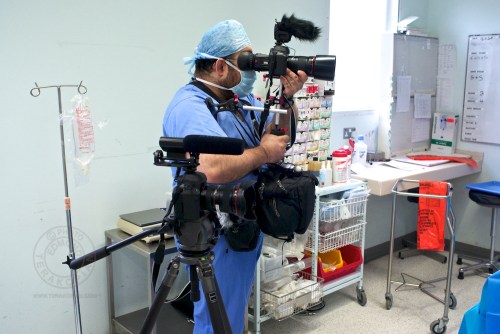
Photographer and film maker Edmond Terakopian filming at the Royal National Orthopaedic Hospital in Stanmore. Filming in an operating theatre with two Canon 5D MkII camera, one on a Gitzo (GT3531LSV + G1380 head) and the other on a Zacuto Striker with the Zacuto Z-Finder Pro attached). Both cameras have Rode microphones attached for ambient sound recording. The VideoMic (closer) and VideoMic Pro. A Think Tank Photo Multimedia Wired Up 10 belt pack is also being used. May 16, 2011. Photo: Neil Patience
We spent a long time planning various aspects of the film, including the patient interviews. With the hospital team, we chose a cross section of their previous patients who had had the full gamut of operations, thus transforming their lives. We covered a wide age range and conditions to paint a full picture.

Photographer and film maker Edmond Terakopian filming at the Royal National Orthopaedic Hospital in Stanmore. Filming in an operating theatre with a Canon 5D MkII camera on a Zacuto Striker with the Zacuto Z-Finder Pro attached and the Rode VideoMic Pro. A Think Tank Photo Multimedia Wired Up 10 belt pack is also being used. May 16, 2011. Photo: Neil Patience
The flip side to these life changing stories though was the conditions in which this amazing staff have to work. Huts that serve as wards dating back to the 1940s, crumbling, leaking building, sloping corridors that require special locomotives to pull beds along. A truly extreme juxtaposition of amazing medical work in such atrocious conditions.

Photographer and film maker Edmond Terakopian filming at the Royal National Orthopaedic Hospital in Stanmore. Filming in a prosthetic limb manufacturing section run by Blachleys. A Canon 5D MkII camera, on the Gitzo (GT3531LSV + G1380 head) tripod, with a Rode VideoMic Pro microphone. Extra equipment needed for the shoot is carried in a Think Tank Photo Multimedia Wired Up 10. May 16, 2011. Photo: Neil Patience
Having an amazing client though is the start of great work and I really must thank the RNOH in helping us be creative, change the brief to make it a more powerful film and for all the logistical help. All the coordination by Rosie Stolarski for the entire project and the patience of her team members Jenny Blyth and Sam Bowie when they accompanied us on site was paramount. A huge word of thanks goes to head of communications Anna Fox who spent the most time with us on site, making sure everything was planned and helping us get the shots we needed. We’d like to thank all the amazing surgeons who invited us into their operating theatres and all the physiotherapists, nurses, prosthetics team and other medical staff for their help. A big thanks also go to the ushers and the security team for all their help.
The biggest words of thanks go to the former patients who let us into their lives and inspired us with their strength and courage. Our thanks go to HRH Princess Eugenie of York, Molly Poole, Carol West, Phil Packer, Phil Coburn, Kat Reid and the amazing Caitlin Kydd.
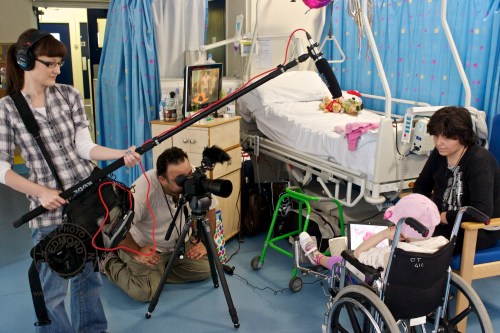
Camera assistant Nicola Taylor recording audio, using a Rode NTG3 on a Rode Mini Boom pole, onto a Zoom H4n audio recorder. This is in a Think Tank Photo Multimedia Wired Up 10. Edmond Terakopian uses a Canon 5D MkII and 135mm f2L and Rode VdeoMic Pro on a Gitzo (GT3531LSV + G1380 head) tripod. RNOH Children’s Ward, Stanmore. July 19, 2011. Photo: Neil Patience
Along with the invaluable help of my assistant Nicola Taylor (an amazingly creative photographer in her own right), Neil and I shot the project over a nine month period.
If you haven’t yet seen the film, you can watch it HERE.
Techniques & Technical

Behind the scenes photographs of the filming of the appeal DVD. Showing film maker Edmond Terakopian & Editor and Producer Neil Patience. An iPad is used for interview questions. RNOH, Stanmore. Photo: Nicola Taylor
I shot the entire video using two Canon 5D MkII cameras, using a range of Canon lenses; 15mm f2.8, 16-35mm f2.8L II, 24-105mm f4L, 35mm f1.4L, 50mm f1.2L and a 135mm f2L. My main tripod was a fluid head Gitzo (GT3531LSV + G1380 head). For the locked off shots with the tighter lens (135mm f2L) I used a carbon fibre photographic Manfrotto tripod. For the handheld shots, I used a Zacuto Striker and Z-Finder Pro eyepiece. Having to cover long distances across the hospital grounds and wards with the kit meant needing to plan not only the right and relevant kit, but the right bags too. We used a Think Tank Photo Airport Internal v2 and also a Multimedia Wired Up 10. On the last interview with Consultant Orthopaedic Surgeon Professor Briggs, I also used a Marshall 5” monitor (V-LCD50-HDMI).

Behind the scenes photographs of the filming of the appeal DVD. Showing film maker Edmond Terakopian, editor and producer Neil Patience, Rosie Stolarski (head of fundraising) and ex-patient Phil Packer. RNOH, Stanmore. Photo: Nicola Taylor
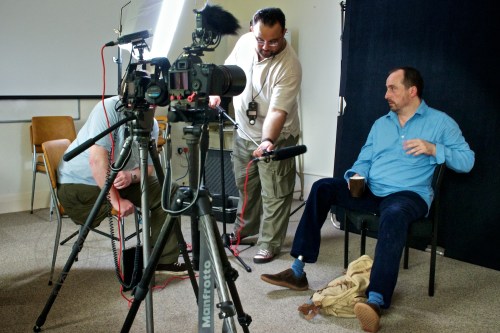
Behind the scenes photographs of the filming of the appeal DVD. Showing film maker Edmond Terakopian and ex-patient Phil Coburn. RNOH, Stanmore. Photo: Nicola Taylor
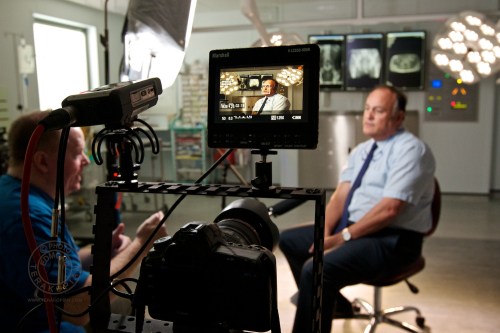
Operating Theatre 4 with Prof Tim Briggs. A Marshall 5″ monitor (V-LCD50-HDMI) is used to check focus, lighting, composition and exposure). The light on the left is a Kino Flo Diva Light supplied by New Day Pictures. September 21, 2011. Photo: Edmond Terakopian
To keep the same feel and uniformity with the ex-patient interview scenes, we decided to shoot them against a black background. One of the problems though was that although some interviews would be done at the hospital, these were at different days and in different rooms. The other interviews would be on location at ex-patients’ homes. We needed a proper light absorbing black, but also a background which was sturdy and stable. On top of these requirements, it also needed to be highly collapsible and portable. After having a chat with our friends at Lastolite, we found just the trick. The Lastolite Plain Black Velvet Collapsible Background (which has a collapsible frame) and the Lastolite background support (1109).
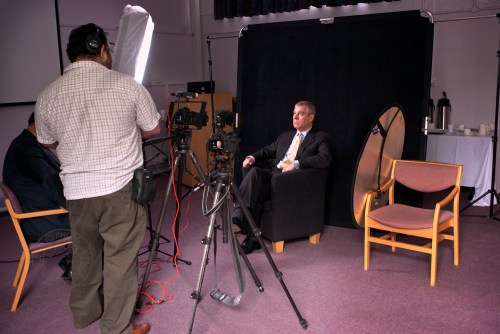
Royal visit to the Royal National Orthopaedic Hospital (RNOH), Stanmore, Middx. HRH Prince Andrew being filmed by Edmond Terakopian. For this shot two Canon 5D MkII cameras were used. One on a Gitzo (GT3531LSV + G1380 head) tripod. The other is on a lightweight Manfrotto carbon fibre tripod. The camera further away (Camera A) is mounted inside a K-Tek Norbert cage (mount frame) and has a Zoom H4n audio recorder mounted on it. This in turn is plugged into a Pinknoise splitter cable, with one end going to camera (to record audio in camera) and the other to headphones. A Rode NTG3 microphone is used for the main audio which is recoded onto the Zoom H4n in WAV format with the passthrough recording in camera. The B camera also has a Rode VideoMic Pro recording audio onto it. The black background and supports are Lastolite and were used in all the interviews. The lighting is by a single Kino Flo Diva Light (supplied by New Day Pictures) and a Lastolite reflector. June 02, 2011. Photo: Nicola Taylor
The other aspect to keeping this consistency was to make sure the lighting was as identical as possible. After consulting with the specialist hire company New Day Pictures, we went for a Kino Flo Diva Light (shot through it’s softbox diffuser). This has been the most amazing light I’ve ever worked with.
Audio
For audio, I used Rode microphones throughout. The cameras where fitted with the Rode VideoMic and VideoMic Pro for all of the cutaway and GV scenes. Although we had originally thought that all their audio would be replaced with the interviews with Professor Briggs, Neil ended up using a fair amount of the audio from them. The main audio, which was for all the interviews, was done using a Rode NTG3, recoding onto both camera A (using a Pinknoise splitter cable) and onto the Zoom H4n (in WAV format). We mounted the mic on a mic stand and had it just outside shot.
The Royal Connection

Royal visit to the Royal National Orthopaedic Hospital (RNOH), Stanmore, Middx. HRH Prince Andrew being filmed by Edmond Terakopian. For this shot two Canon 5D MkII cameras were used. One on a Gitzo (GT3531LSV + G1380 head) tripod. The other is on a lightweight Manfrotto carbon fibre tripod. The camera further away (Camera A) is mounted inside a K-Tek Norbert cage (mount frame) and has a Zoom H4n audio recorder mounted on it. This in turn is plugged into a Pinknoise splitter cable, with one end going to camera (to record audio in camera) and the other to headphones. A Rode NTG3 microphone is used for the main audio which is recoded onto the Zoom H4n in WAV format with the passthrough recording in camera. The B camera also has a Rode VideoMic Pro recording audio onto it. The black background and supports are Lastolite and were used in all the interviews. The lighting is by a single Kino Flo Diva Light (supplied by New Day Pictures) and a Lastolite reflector. June 02, 2011. Photo: Nicola Taylor
The first of our interviews was with HRH Prince Andrew, who not only only was the patron of the hospital, but is also the father of a former patient; Princess Eugenie. We also did an interview with the Princess and both pieces added so much to the film. These weren’t only essential, but were also an absolute joy to shoot.

Royal visit to the Royal National Orthopaedic Hospital (RNOH), Stanmore, Middx. HRH Princess Eugenie being filmed by Edmond Terakopian. For this shot two Canon 5D MkII cameras were used. One on a Gitzo (GT3531LSV + G1380 head) tripod. The other is on a lightweight Manfrotto carbon fibre tripod. The camera to the left (Camera A) is mounted inside a K-Tek Norbert cage (mount frame) and has a Zoom H4n audio recorder mounted on it. This in turn is plugged into a Pinknoise splitter cable, with one end going to camera (to record audio in camera) and the other to headphones. A Rode NTG3 microphone is used for the main audio which is recoded onto the Zoom H4n in WAV format with the passthrough recording in camera. The B camera also has a Rode VideoMic Pro recording audio onto it. The black background and supports are Lastolite and were used in all the interviews. The lighting is by a single Kino Flo Diva Light (supplied by New Day Pictures) and a Lastolite reflector. June 02, 2011. Photo: Nicola Taylor
Editing Workflow

Editing the fund raising video for RNOH at New Day Pictures’ Final Cut Pro editing suite in Surrey. Assistant Nicola Taylor and video editor Neil Patience at work, discussing the interview transcripts. November 08, 2011. Photo: Edmond Terakopian
After every day’s shoot, we would make copies of all the CF cards (video) and SD card (audio) onto both Neil and my MacBook Pros. Once back at our respective offices, we would both also make backups onto our Mac Pros and RAID systems. On top of this, I also made multiple off-site backups. With a project that has so much data and is shot over such a long period of time, it’s not worth risking losing something before delivering the final cut to the client. With this workflow we had multiple copies (RAID 1 and RAID 5) across three geographical locations.

Editing the fund raising video for RNOH at New Day Pictures’ editing Final Cut Pro suite in Surrey. L-R: Cameraman Edmond Terakopian, assistant Nicola Taylor and video editor Neil Patience at work. November 08, 2011. Photo: Edmond Terakopian
Once Neil had put together a long assembly, Nicola and I met with Neil at the New Day Pictures’ editing suite. Although able to edit video myself, I never thought of myself as anything but having rudimentary skills. Watching Neil at work was an amazing education. The philosophy behind editing is the most crucial thing; watching him operate the keyboard, mouse and various break out boxes full on knobs and sliders like a concert pianist was amazing, but understanding the reason behind constructing edits was just mind blowing. The three days that I spent with Neil were invaluable. The film naturally did take much longer than that to do though. If you’ve never worked with a professional editor, I highly recommend it; in fact, it’s essential.
To find out more about the editing, have a read of Neil’s post, Making The RNOH Appeal Film.
The Premiere
Our first screening was for the RNOH fundraising team. The silence and sniffles, combined with the teary eyes confirmed for us that we had succeeded in making a powerful and emotive documentary. It’s always difficult to fully judge a project until you’ve shown it to someone outside of the team. Close colleagues who had seen it had all been positive, but it was only when our clients at RNOH approved, that we were completely happy.
The premiere of the film was at the launch of the RNOH Funding Appeal at St James’s Palace, at an event hosted by HRH Prince Andrew and Princess Eugenie. Along with the screening was also a photographic exhibition of my work documenting the hospital. I must admit to being quite nervous when the film was shown; it’s again the fear of not knowing how it will be received. The huge room (bigger than a typical hall) fell quite and stayed quite for the entire length of the film, the silence only being broken by the occasional sniffle. As the film approached it’s end, the sniffles grew not only more frequent, but louder. A gentleman in front of me, who is the father of the amazing Caitlin who is featured in the film was in fact crying fully. It’s hard not to be moved and humbled when witnessing such an amazing reaction to one’s work. After the film finished, there was silence; a silence which carried on for a good five seconds and then the room burst into applause. Later, Neil and I shook hands.
Proud. This is one word which kept coming up between the TAPTV team; we were all proud of what we achieved with this project. When I look back at my career which started in 1989, although I give my all to everything I do, certain assignments stand out and I feel proud; this is certainly one of them.
My hope is that we have helped this amazing hospital to raise some of the money they need; they do amazing work there. I hope that you will help by making a donation HERE.
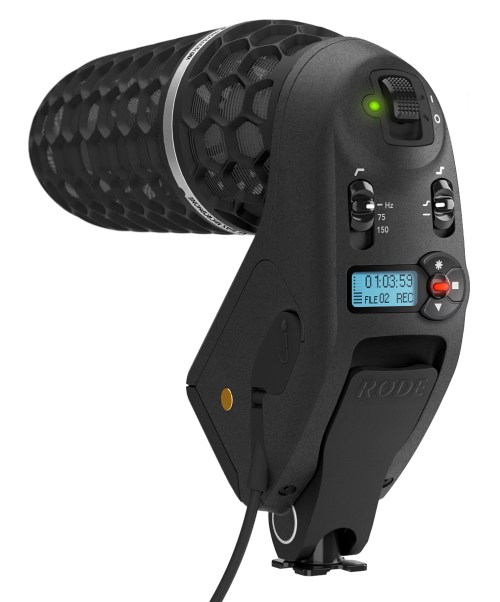

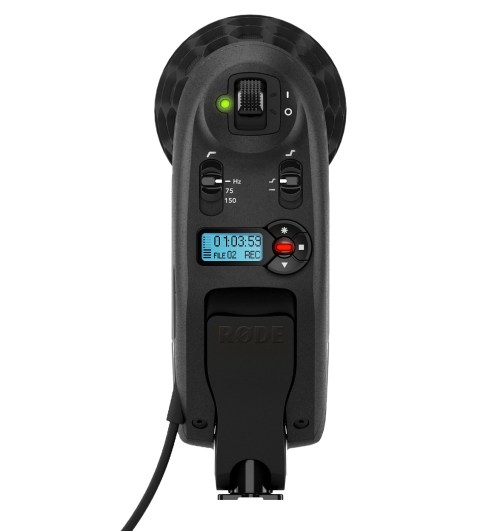

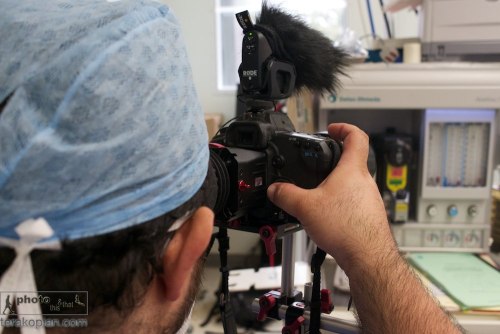


 Photo This & That