Search
Bespoke Workshop
- Bespoke Workshops Bespoke 1 on 1 Workshops
This Blog
Photo This & That is the blog of multi award winning photojournalist, film maker and commercial photographer Edmond Terakopian.
All content ©. You may not use, copy, or store any of the content without written permission.
I do not condone nor can I be held responsible for reader comments published on this blog; they are the sole responsibility of the reader making the comment.
-
Join 3,063 other subscribers
FaceBook
Flickr Photos
-
Recent Posts
- Follow Photo This & That on WordPress.com
-
Tags
ap aperture appeal apple art award awards award winner award winning black and white business bw camera canon career collector competition Coronavirus dslr e-m1 e-m5 mark ii edmond terakopian Eizo em1 exhibition finalist fujifilm g-tech g9 image interview leica leica dg lightroom london lumix Lumix g9 Lumix s pro m9 m43 mac micro 4/3 micro four thirds mirrorless monochrome nik software nominee olympus om-d omd Panasonic photo photography photojournalism photojournalist portrait press press photography print processing reportage review rnoh rode S1 S1R sigma S Series street photography talk think tank photo tpoty video war workshopRSS
Archives
Third-Parties, Take the Mac Platform Seriously
A Nikon LS9000 connected to a Mac Pro.
I’ve had such a nightmare. It all started out simply enough. All I wanted to do was to connect a Nikon LS9000 medium format scanner to my Mac Pro (Intel cpu running OS 10.5.6) to scan in several hundred 35mm and medium format colour negatives.
I then discovered on the internet that many were having problems using Nikon Scan software on Intel Macs running Leopard. I decided to try it and surely enough failed. The software installed fine but wouldn’t recognise the scanner, even though a demo version Vue Scan did, and scanned just fine. I then decided that the only way to go would be to get Parallels and buy a copy of Windows XP OEM, which I did. It all went swimmingly until I discovered that Firewire 400 isn’t supported by Parallels or any other virtualisation software! At this stage I was beginning to get rather annoyed.
My next plan was to use Boot Camp and install Windows XP. This went swimmingly too, until Microsoft refused to activate my copy of XP Pro, saying that it was either a pirate copy or it had already been activated on another machine, and that I would have to pay for another license; this was in the period of an hour, using the same machine! I have yet to phone them, but am hopeful they will see sense and let me activate XP (for which I now have no use).
So, I went back to trying to get Nikon Scan working on the Mac OS. After some help from folks on Lightstalkers, I unplugged everything and it all worked! The scanner was seen, the scan window opened and I began to preview the first strip of negs….and then the first scans. Hurrah! (It seems that the scanner was having some sort of conflict with the four FW400 hard drives I had plugged into the Mac!).
The annoying thing is that as far as I can see, that piece of software hasn’t been updated on the Mac platform since 2004. For an expensive piece of equipment like the LS9000 which is still in demand and use to this day, that’s ridiculous. I’m using Nikon as an example here, but others are to blame too. I had similar issues with a Minolta 35mm scanner before they went bust.
On the whole, Apple Macs account for a smaller percentage of the computer users market compared to PCs. However, in the creative sector, Macs account for a huge chunk of users. I think its extremely short sighted of companies to not realise this and spend time and resources perfecting and supporting their software and drivers on the Mac platform. A survey done by the BPPA in 2005 of their members found that 56% used Apple Macs and given the choice 66% would use Apple. One thing to remember is that staff photographers with AP, Reuters, Getty and PA (almost all) are forced to use Windows machines; I know personally that a great deal of these colleagues would prefer to use Macs.
Come on people, its about time you took the Mac platform seriously; you’ll do your business the world of good.
Posted in Uncategorized
BeachTek Accessories for 5D MkII
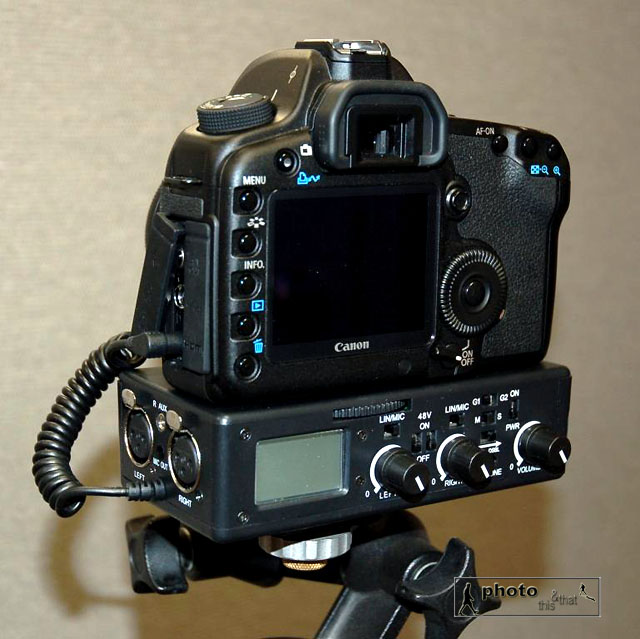
BeachTek have recently announced a couple of video accessories for Canon 5D MkII users. The first is the DXA-5D XLR adapter which has a host of very interesting and useful controls on it. It allows the use of professional quality XLR microphones with the 5D MkII, but it goes a step further by allowing the user to override the camera’s built in AGC and set an input volume manually and also to use a headphone to monitor the sound being recorded. Anyone who has shot any video on the camera will appreciate just how crucial these features are.I’m eagerly awaiting a review model, so watch this space!
KELOWNA, CANADA – April 9th, 2009 – BeachTek is happy to announce their new DXA-5D XLR adapter that has been highly anticipated for the Canon 5D Mark II camera. The DXA-5D provides an easy way to connect professional microphones and other audio gear to this popular camera. This adapter brings a whole new functionality to the Canon 5D Mark II that was previously unavailable. It is now possible to capture professional sound with control and monitoring ability. The suggested list price of the DXA-5D is $379.00 in the United States. Expected shipping date is May 26th, 2009.
The DXA-5D features dual transformer-balanced XLR inputs with phantom power and built-in level meters. In addition, the built-in headphone jack allows the user to monitor the audio – a feature missing on this camera. The trim controls allow the user to dial in the proper signal levels for optimum recording quality.
Most importantly, is the unique AGC Disable function which was the most sought after feature by users of this camera. The AGC Disable circuit is activated by a switch which controls the wild swings of the Auto Gain Control in the camera to reduce the hiss generated by the preamplifiers during quiet moments of recording. It works by sending a high frequency inaudible tone to the left channel of the camera. This feature greatly decreases the camera noise which has always been a problem in the past.
The DXA-5D also provides an unbalanced mini-jack input for many wireless receivers that use mini-plug connectors. There is an additional mic level output jack for connecting the adapter to external audio recorders such as the popular Sony PCM-D50 when very high quality recording is required. The LCD display shows the state of the various switches and battery life, as well as a vu meter that shows the audio levels from – 54dBu to -33dBu. This allows the user to verify the proper recording levels and eliminates any guesswork.
BeachTek is the original and most popular maker of XLR adapters for DV camcorders. The company specializes in making unique audio accessories for demanding video professionals.
BeachTek is located in Kelowna, British Columbia, Canada. For additional information on BeachTek or the products that they offer, including full specifications on the DXA-5D, visit their web site at www.beachtek.com or call (416) 690-9457.
The second item is a rig called the Multimount 5D which allows several hotshoe accessories to be mounted onto the camera.

Too Much Reliance On Photoshop
I grew up shooting film and got into the profession when we were shooting black and white film for the papers. There was always the art of the darkroom where pictures were brought to life, but for colour, one had to basically reply on getting it right in camera for colour negative and much more so for slide film.
Compared to Photoshop, the level of change one could bring to a black and white image in a darkroom was miniscule. We now live in a digital age and I have for the most part embraced this age of megapixels and terabytes and given up the days of D76 and Multigrade. However, these are just tools and the importance of the photograph is as has always been; there is a purity and a challenge to get it right in camera and I for one will keep this approach to photography. If we’re talking of any form of photojournalism, then the viewer has to be able to trust the image and its content.
I’ve lectured and made presentations in several venues, including Cambridge University, and judged several competitions as far and wide as the Russian Press Awards to the British Regional Press Awards. The one thing that I’m seeing more and more, as each generation of photographer who joins our ranks of professional image maker, is the total reliance of all things digital and binary, and up to a point, a loss in the purity of getting it right; the art of taking a picture.
My comments aren’t about the aesthetic of composition, the content nor the timing, but the finished product. Photoshopping, to Photoshop, has become a commonly used verb, and alas has also become a commonly used technique to spruce up a picture. I’m not talking about the extreme crimes of removing or adding elements, but of ridiculous use of contrast, saturation, luminance, dodging, burning and masking. I see this more and more.
Recently, three Danish photographers were asked to submit their RAW files to the Picture of the Year competition in Denmark. The judges felt that they could not trust the images they were looking at and wanted to see the original untouched images. I for one applaud this. Photography is about presentation, but most of it is actually in the picture taking part. Its more challenging and is harder, but trust me, its so satisfying when you get it just right.
Give it a try! Set your camera’s to shoot neutrally. Zero adjustment on all things and take the time and care to expose your images properly. Try a hand held incident light meter or learn to use the spot meter properly and choose the manual mode. All digital images, be they scans or digitally taken images need some tweaking; white balance correction (in camera or after the fact), some sharpening and a tweak in luminance using levels or curves. The image should look like what you saw, not what you can imagine!
Posted in Photography, viewpoint
Feature Length Film on a Canon 5D MkII
Searching For Sonny: Elliot Teaser/Canon 5d Mark II from Andrew Disney on Vimeo.
Ok, must admit, I had the idea of shooting a full length feature film on a Canon 5D MkII a couple of months ago and toyed with the concept a lot…..but alas, it just stayed in my mind! Well, congratulations to Andrew Disney and Jeffrey Waldron for making it real!
It seems that the whole film, “Searching For Sonny”, is not yet shot, but the trailers were released on April 15. I wish them the best of luck and can’t wait to see the finished film.
UPDATES:
Behind the scenes / “how to” info by Andrew Disney.
Flickr album of photos from the set
Posted in Uncategorized
Skype For iPhone
Although I’ve been using Fring on my iPhone, I’m delighted to see that Skype will now be available on the iPhone and should be on the App store sometime tomorrow (Tuesday, March 31).
CNET have had a first hand look and a bunch of screenshots, so check them out.
Posted in mobile phone, News
Afghanistan’s Failing Army by John D McHugh
Our good friend John D McHugh has his latest film “Afghanistan’s Failing Army” on The Guardian’s web site. Its a very interesting look at the subject of the ANA’s ability to succeed as an army.
For further reading, check out the post on John D McHugh’s blog.
Posted in Video


