A Big, Huge Thanks!

Over a week ago, I had the majority of my Leica equipment trashed by a negligent security guard who just allowed the bag they were in to fall off the end of the conveyor, turn upside down mid air and finally fall to the floor by his feet, after he had X-Rayed it. I need to add that under instructions, I was at the other end of the machine still putting on camera bags and other belongings into the machine as this happened.

The aim of my post isn’t about this though. After I Tweeted what had happened, I was overwhelmed and so touched by the number of people who offered up Leica cameras and lenses to help me out and to allow me to carry on working. I couldn’t possibly take any of you up on your extremely kind offers, but I just wanted each and every one of you to know how touched and appreciative I am. From the bottom of my heart, thank you all.

Panasonic AG-AF100 / AG-AF105

Very Tasty Looking Bit Of Kit!

I’m completely drawn to video and the creative abilities DSLRs have brought to the table; from constantly rejecting it, I’m now drawn to it. The DSLR does have drawbacks though as it’s form factor isn’t ideal for video and things like audio have been overseen. Panasonic’s new AG-AF100 though is absolutely tasty. have a look at the video for all the info on this beast! I can’t wait to see what Canon’s response is to this; as the leaders in video DSLR, I imagine they must be working on some very nice gear indeed!

Final Cut Pro Training

Depending on your point of view, these are either exciting times or times filled with fear and uncertainty. All this talk of convergence of media, multimedia, video and so on either makes us smile as we realise they are new tools to allow us to tell stories or channel our creativity through, or makes us run away wishing for the good old times.
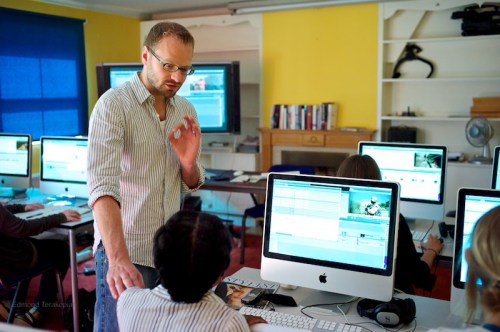
Simon Ruben commenting on an edit

Typically, the latter behaviour is often a fear of the unknown. The best action is then to learn about these tools, technologies and methods, then make up our minds.

Just as photographers we know how to edit our images; for video, we need to gain a knowledge of how to edit video. By far the most elegant way of editing video and the industry standard is Final Cut; in it’s cut down version of Final Cut Express and it’s fuller version Final Cut Pro (which comes as part of Final Cut Studio).

I’ve been using Final Cut Pro for a couple of years now, initially for doing complex photo slideshows and then for editing video. With practice and research I taught myself how to get by and even got an award for my editing. However I wasn’t fully proficient; I wanted to become efficient and take my editing to the next level. My desire was to begin editing like a professional editor.

Already a fan of The Frontline Club and a regular visitor to their excellent events of talks by prominent journalists, I was overjoyed to find that they hold Final Cut Pro Training Courses. I had already had the pleasure of meeting editor Simon Ruben, and when I realised he was teaching the course, I signed up immediately.

The course ran for five days at the club. All equipment (Apple iMacs, headphones, footage to edit with, course notes and really good coffee!) are supplied. I can’t recommend the course highly enough. Simon’s teaching style is wonderful; a very relaxed way that communicates knowledge in a way that’s natural and effortless. It’s definitely well worth taking off five days and doing the course. It’s helped me take my editing to the next level and I’m much more efficient in my workflow.

The great news is that the next course starts on October 18, so get booking!

To Be Unique

Unique. Not run of the mill. That’s what’s we strive for in our work. The constant battle to produce original and creative work. In this digital age though, it’s often too easy to have this work copied and for it’s value to be lost.

Although an award winning hand printer (I have two awards from Kodak), I have completely embraced digital printing with Canon’s excellent iPF6300 large format printer. When combined with paper from Hahnemuhle and Ilford, the results are simply stunning. The downside is that due to the nature of it, it is hard to distinguish original and authorised prints from anyone unscrupulous enough to have stolen the image and run off their own prints.

As well as signing the work, I decided to look into embossing and following a chat with a good friend, decided have my own one made by the folks at City Co Seals. I now emboss my collector’s prints and also use a custom made stamp to authorise and help the collector prove that they have an original.

Give them a call and ask to speak to Grant; they are extremely helpful and very efficient. Do pass on my hellos if you call!

Interview On AUN

Photo: ©Richard Chambury/Richfoto.com

A quick post to let you know that there’s an interview with me on the Aperture User’s Network done by Thomas Boyd.

Stand Firm

Value Your Work

Poster design by Tim Allen.

Carrying on from my previous post on the value of photography, I had a photographer who was a participant in a previous workshop on the phone to me. He had taken photographs for a client and the design firm who had designed the product (forgive my vagueness – I don’t want to cause any hindrance to this photographer’s situation) was trying to bully him into getting full international usage rights to the pictures; they were apparently adamant on it. This firm has no rights to the images.

This young photographer got on the phone in a panicked state, not knowing what to do. As I explained to him, the licensing rights and the full copyright belong to the photographer; cherish these and do not be forced to give them away. You can negotiate a license of usage to someone who wants to use the pictures. To find out how much to charge, some good guides are to use the automated pricing structure on Photoshelter; go to My Photoshelter page and ‘BUY’ any image. Then click the Downloads tab and fill in the drop down questions to suit the purpose your client wants. This will give you an idea of what to charge. Another is to refer to the NUJ’s Fees Guide.

A favourite of companies trying to get freebies is to promise work in the future in exchange for things like licensing, or to try and get a huge discount. These are just tactics and it’s highly unlikely this work will come. I operate in a different way; I wait for a client to become a regular client who books me constantly; I then offer them freebies – but never at the expense of my core pricing structure.

Photography is just like any other business; everything has it’s price. Stand firm and produce quality work.

If you’d like to buy any merchandise with the poster design on it, please visit Cafe Press.