Category Archives: Camera Equipment

Hands On with the 5D MkII, G10 & 24mm f1.4L MkII

A day after the announcements I was fortunate enough to be one of the few invited by Canon to check out the new additions. Before I continue, its important to point out that all of the equipment was pre-production and as experience has shown in the past, final production products are much more polished in both performance and quality terms.


I headed straight for the 5D MkII. This camera has huge shoes to fill as the 5D has without a doubt been responsible for being revolutionary in the digital SLR market. I’m happy to announce that it most definitely doesn’t disappoint.

The camera has a familiar feel to it; anyone who has a 5D will feel right at home. It does feel better in the hand though. It has a tougher feel to it and the fact that its weather sealed  will add to the usability of this camera.

The focusing system, although the same as the 5D, has a new processor, the Digic 4 and a new algorithm; although I didn’t put it to a proper side by side test, it certainly felt faster than the 5D.

On paper, the camera has a 0.9 fps faster motor drive (in fact, compared to the way fps used to be calculated, its 4fps, but as this system has now changed, Canon have had to call it 3.9fps!). Although I definitely would’ve preferred 5 or 6fps, its still quick enough for the kind of work its aimed at.


Alas the control dial still doesn’t have a lock on it. Although the dial’s quite stiff and clicks round with a reassuring resistance, I’m sure like the 5D, in a situation where you’re running around or stuck in a rush in the middle of a riot, the dial will again move. Whilst addressing disappointments, its a shame that there is a dedicated button on the back of the camera for “Picture Styles”! How many people use this?! Mine are always set to neutral and remain this way. This button should have been programmed as a lock to protect / tag chosen images. Hopefully this can be changed with a future firmware upgrade.


The two big headline features for me are the high ASA range and the video recording abilities of the camera. I shot a load of images with the pre-production camera and it really is very impressive. As non of the RAW converters can yet convert the to be released camera’s files, I was shooting jpegs. The quality of the images (both in terms of colour accuracy, detail and image noise) was stunning at 3200 ASA. Even at 6400 ASA the images are crisp and beautiful. I wouldn’t hesitate in using this camera at this high sensitivity settings. The camera doesn’t disappoint as you get higher either; it produces results that weren’t even imaginable until Nikon brought out the D3. Talking of which, side by side tests shown by Canon at 25,600 ASA showed the 5D MkII producing a more detailed, crisper and less noisy image. Astonishing!


The video recording aspect is equally mind blowing. Canon had several movies shot on the camera playing at full 1080P HD on 42” flat screen TVs; the quality is absolutely out of this world. Just think of the possibilities; you can use your full range of SLR lenses and shoot with minimum depth of field – even in wide angle. It just opens up so many creative possibilities. Also, you no longer need to invest in and carry more equipment; its all there in your bag. Just add an external microphone (for better sound recordings). Also do remember not to hold the camera in an upright position!

The camera has a newer battery which I guess was changed to be able to handle the extra power needed for video. There’s also a new grip and most interestingly another grip with built in WiFi.


Around half the shots I took with the 5D MkII were with the new 24mm f1.4L MkII. I had the original version of this lens and must admit that I was never a big fan. On my 1DS MkII or 5D it just didn’t produce great results. However, this version is mind blowingly good; absolutely pin sharp, great colour and resolving ability. Also, somehow, at f1.4 there seems to be less depth of field than I remember getting with my lens – brilliant!


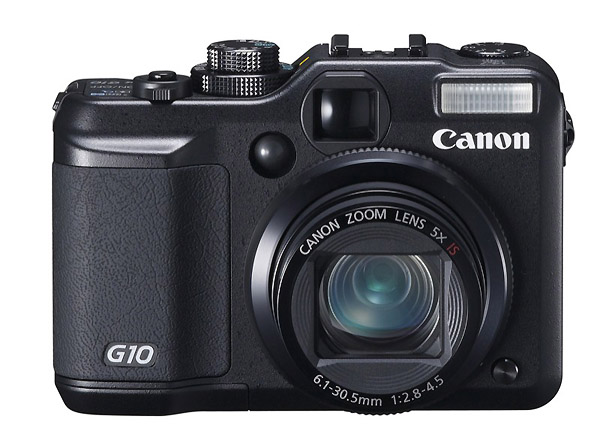
Now onto the G10 – the new compact camera that I envisage will be draped off every photographers’ shoulder! 

The body design is superb; its as tough as the G9, but is chunkier with a better grip and a bigger optical viewfinder (I wear spectacles and could look through it with ease). They have introduced an exposure compensation dial to the left and the ISO and mode dials are on top of each other and on the right – very neat!


Also the long needed 28mm wide end is finally here! I took a load of shots with this camera too (again, on jpeg) and I’m very impressed. The images are crisp, detailed and have great and accurate colour, even on auto white balance. The camera produced better results than the G9 up to 400 ASA and much better results at 800 and 1600 ASA. It has a new high ASA noise filtration system which actually works really well and doesn’t soften the image in any way. This is the first time in my career where I’ve actually enthused about this kind of system, as they never work.

Canon have also improved on the exposure metering; the G9 always had the tendency to over expose (mine’s permanently got -0.3 dialed in). The G10’s exposure was spot on.

I absolutely rate this little camera – definitely get one folks!


All said and done, the day did end with disappointment; I now need to somehow find a way to pay for a couple of 5D MkII bodies, a G10 and quite possibly the 24mm f1.4L MkII too!!


Addendum 1:  I now have a full production model which I’m reviewing for a magazine – check HERE for more on the camera.


Addendum 2: For my short film shot with a 5D MkII, please check THIS post.


Addendum 3: FULL REVIEW of Canon 5D MkII: Part 01 and Part 02
The New Canon G10


Visa Pour L’Image in Perpignan was at one time the place where you would see the largest number of Leica rangefinders in one place; it was the camera most photojournalists had hanging off their shoulders or around their necks. This year however, the one camera everyone had was the Canon G9.

Well, its been replaced by the G10. At long last this has 28mm on the wide end, and zooms to 140mm. The body design looks even sturdier and now has a dial for exposure compensation, and a better grip. The sensor is 14.7 Megapixels and produces more shadow area detail.

Canon Announce 5D MkII


Canon today announced the new 5D MkII. Two things which caught me by surprise are the 21.1 Megapixel sensor (I thought it would be in the 16 Megapixel range) and a very welcome 1080 full HD video recording mode (with an input for an external microphone).


The original Canon 5D revolutionised digital photography by offering a compact body with a full frame sensor which produced stunning results, even in low light. They seem to have taken this formula and added what we all hoped for to it. The new camera has a faster drive, a new focusing system and is weather sealed.


Press Release:

05.00am 17th September 2008 – Canon redefines the future of photography with the announcement of the photo industries most anticipated Digital SLRs, the EOS 5D Mark II. 

The EOS 5D set the benchmark for image quality, low noise at high ISO and was the first affordable full frame sensor camera. The EOS 5D Mark II sets new presidents for image quality, high ISO performance and operation for the most demanding user and added enhanced functionality.
 

This is the 1st DSLR camera with a Full 1080 High Definition movie recording.


Features of the EOS 5D Mark II

–        21.1 Megapixel Full Frame Sensor
 
–        Expanded ISO Range of 50 – 25600 with new 4 level high ISO noise reduction
 
–        14 Bit image processing with DIGIC 4
 
–        3.9 Frames per second, up to approx. 78 large/fine JPEGS & approx. 13 RAW
 
–        3.0″ LCD screen with 930,000 pixels and dual anti-reflective coating with 170 degree viewing angle
 
–        Lens peripheral illumination correction, 26 lenses are preloaded on the camera with a total of 40 lenses available to be stored via EOS Utility
–        Auto light optimizer with the aid of Face Detection Technology automatically lightens and corrects dark areas of the image
 
–        Copyright information can now be added to the camera with EOS Utility
 
–        Full HD (1920×1080) and SD (640×480) video recording at 30fps
 (up to 29 minutes 59 seconds per clip)
–        HDMI Output
 
–        Enhanced “Live View” with Quick Mode phase detection, Contrast AF and Face Detect
 
–        Improved menu screens
 
–        External light sensor to automatically adjust LCD brightness
 
–        AF microadjustment, up to 20 lenses can be registered
 
–        Improved environmental protective seals
 
–        Highlight tone priority
 
–        Compatible with UDMA Mode 6 CF cards
 
–        Self cleaning sensor unit with dust delete data acquisition and florine coating on low pass filter for easier cleaning with blower
 

Also announced is a brand new and fully redesigned 24mm f1.4L MkII lens.

Canon 50D

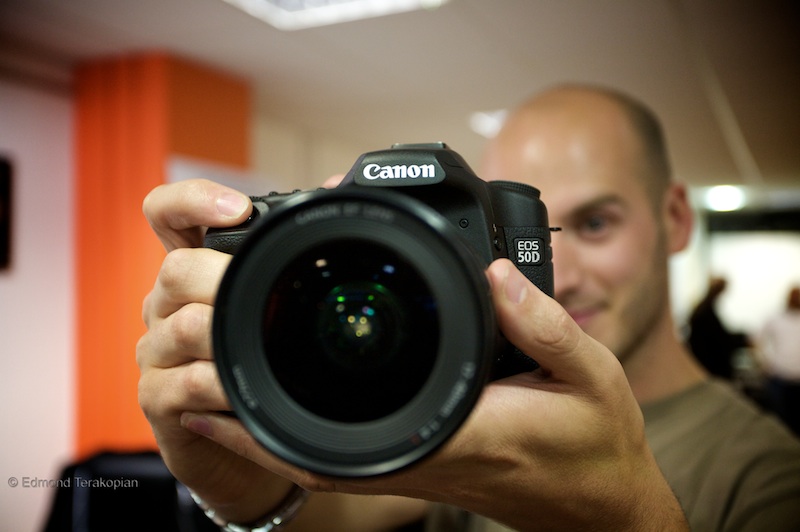
Leon Neal kindly modelling the camera.

I attended the UK launch of the new Canon 50D at Jacob’s Pro Lounge Yesterday. I have to say, for the price and size of this camera, its rather impressive.

Before I carry on with my observations, I need to point out that this was an early pre-production model. Experience has shown that final products are a lot more polished in all aspects of performance, so take this into account.

Firstly, a quick run down on the main specs of the 50D. Amazingly, the camera has a 15 Megapixel chip. To get this kind of size would have set you back well over four times the cost of the camera a few years ago. The other astonishing, and so far for Canon, unique thing about the 50D is its ASA range, which goes from 100 to 12,800. All of this is married to a continuous shooting speed of 6.3 fps. It also has a nine point AF system, of which all nine are cross-type sensors. The sensor is self cleaning. Lastly, the flash sync is 1/250th.

In had a few minutes to play around with the camera and took a few test shots. The camera falls to hand very nicely and anyone who has used a digital EOS in the past will feel right at home. The size of the camera feels a little smaller than a 5D and feels good in the hands. The focusing was quite nippy and managed to lock on to focus with accuracy. Having shot a fast sequence in AI Servo mode whilst photographing a friend walking through the shop, there were around 20% not quite pin sharp. However, as this is an early prototype, that’s actually not bad at all.

Having looked through the test pictures I shot with the camera, the auto white balance worked very well and very little was needed to do as far as colour balance was concerned. I ended up shooting from 1600 to 12,800 ASA to see how the chip performed. All the way up to 3200 ASA, the pictures were stunning; very smooth with very accurate colour. There was no visible noise at all, even in shadow areas. The story changes a bit at 6400 ASA where noise is present, but still much less than even the brilliant 5D. At 12,800 ASA, as one would expect, noise is abundant. However, the level of noise isn’t too distracting, and has the look of 1600 ASA colour neg film, pushed one stop. A bit of Noise Ninja (my favourite noise reduction software) and the image looks great. Even without filtering, the image is more than useable and I wouldn’t hesitate using this setting when the situation dictated it.
One very neat accessory which wasn’t available at the launch is the very neat WiFi transmitter which looks and fits on like a grip extension. Its a very neat solution and I’m sure will come in very handy for a lot of news and sports photographers.

So, would I get one? My short answer is no. The only thing that puts me off is the x1.6 crop factor. This is fine and is an advantage when using long lenses. However, I tend to like working in close, and it just wouldn’t fit in with my approach to picture taking.
The best thing from my experience with the camera was that it gave me an insight as to what we might expect from the replacement to the Canon 5D; the 5D MkII (or 6D, or what ever its going to be called) is going to be stunning. For me, that’s the camera I’ll be waiting for. With a bigger full frame chip, and I would guess a higher mega pixel count, we are in for one hell of a camera. Roll on September and Photokina!

Selling Cameras From A Plastic Bag – by Tim Bishop

At any party there’s always bound to be a few guests who are a pain.  It may be just a little bit too much wine.  They might get loud and shout.  There’s a scene.  Asked to leave, and it all gets aggressive. These are the people that may even have been just passing by, heard the noise, fancied a free drink, and slipped in without an invitation.

But the worse guests are the ones who were invited, but just didn’t know how to behave.

So at the start of the celebrations for the UK only press photography awards since the demise of the Picture Editors’ Awards (PEG), The Press Photographers Year (PPY), supported by Canon Cameras, four hundred squeezed into the foyer of the Lyttleton at London’s National Theatre complex on the South Bank to see the pictures, buy the book, and watch the winners get their prizes.

These are not photography awards as we have known them.  Forget the grand guest speakers to tell us how clever they are, with some obscure connection to photography: a politician, a celebrity, someone who has had to cope with ‘being photographed a lot’.  Even strike that black tie. As for seating plans: there are no seats.

It will come as no surprise that the PPY, who charge next to nothing for press photographers to enter, and is free for members of the British Press Photographers’ Association, needs to be heavily supported, and simply wouldn’t exist without the long term support of Canon. But in keeping with the emphasis on the pictures, Canon have been content to keep the branding low, and the marketing opportunities by reputation. It wasn’t even noted that all but one of the winners in the twelve categories of the PPY used Canon. No product on show.  Let the images speak. It’s all about pictures, not photographers, images not cameras.

So what did happen to that 35mm camera so many professionals used to use? Surely not everyone shoots Canon? What about Nikon?

Back five years ago, Canon readily agreed to be a sponsor for a project called ‘Five Thousand Days’, put together by the British Press Photographers Association (BPPA).  A number of  BPPA members who were not then Canon users, were keen to involve their camera manufacturer, Nikon, as well. We asked Canon if they might agree to a ‘joint sponsorship’ for the ‘good of the profession’. Then, to our astonishment and delight, Canon tentatively agreed. This would have been a first, and particularly brave of Canon, who had nothing to lose, as they were already by then the market leader in professional 35mm cameras. 

A small group of dedicated long term Nikon champions arranged a meeting. All seemed promising, as Nikon had recently announced they were pulling out of sponsoring the ill-fated PEG awards. These three BPPA members, who between them had scooped dozen of photographic gongs, including World Press, met at the corporate offices of Nikon in South West London.  It didn’t go well. At the end of the meeting, two of the three, Jeff Moore, the Chairman of the BPPA, and Edmond Terakopian, BPPA committee member and a World Press Photo winner, immediately decided to switch to Canon. Since then, they both have become major champions of the ‘Canon brand’, and between them have encouraged many others to switch.

What happened?  The boys were told by Nikon that ‘press photographers were not a target market’. Nikon just didn’t get it did they? It really wasn’t about marketing: It was support. Nikon firmly shut the door in the face of the five hundred or so members of the BBPA. At a conservative estimate, BPPA members have a total spend on cameras in the millions of pounds annually. Nikon’s contempt for press photographers spread through the trade like wildfire, and they couldn’t have made a bigger marketing blunder. Nikon were already losing the technical battle in the digital scrum to produce the quality, speed, and design professionals craved, now they lost the goodwill too.

Imagine the organisers surprise at this year’s PPY, to see amongst the packed opening, someone working the crowd with a mission.  Not unlike a replica watch salesman in Nanking Road, Shanghai, there was a hiss in your ear, and turning, photographers were face to face with a well know representative of Nikon Cameras.

Those Chinese watches certainly look very like Cartier, they sparkle and all is gold, but you don’t have to be a horologist to know that you don’t buy expensive designer watches from a man in the street with a plastic bag.  I suppose by the same token, you’d be pretty silly to be excited by a rude guest pushing a ‘top end’ professional camera from a plastic bag as well.

I’ll leave out the ‘I wonder if they’re fake’ jibe, though it’s tempting. And quite a few camera makers must want to build their own Canon 5D, the camera that many would argue has changed the way many news photographers work: light, small, highest quality full frame file size, and low cost.

“Pssst..want to see the new Nikon D700?”

Author: Tim Bishop

24mm to 60mm f2-2.8 Lens On A Compact!


Panasonic has announced the new Lumix LX3 which has a 24mm-60mm f2-2.8 lens. Thankfully the manufacturer has stuck to 10 Megapixels rather than jumping on the bandwagon of cramming more in (although in my opinion 10 is still too high for a compact with a small sensor).

According to Panasonic the low light capabilities of the camera are an improvement on its predecessor.
It can go up to 3200ASA at full resolution and shoot at 2.5fps.
Accessories include an 18mm wide angle converter, external optical finder and a flash.
No idea how this camera’s going to perform, but the press release makes interesting reading and on paper the camera seems superb.