Category Archives: Camera Equipment

Does Size Matter?!

Ok, I’ve done the unthinkable! As photographers we need the most powerful laptops we can get our hands on so we can edit quickly in the field. So, what possessed me to leave my super fast Apple MacBook Pro at home and decide to take the MacBook Air on my assignment to France (mentioned in an earlier post)?

Well, it was all down to weight. I wasn’t sure what the level of access would be on the job, or how much trekking would be involved. On the camera equipment front, I decided to take the bare minimum, so I packed a couple of 1D MkIII bodies, a 16-35mm F2.8L MkII, a 70-200mm f2.8L IS, the 50mm f2.5 macro, a 15mm f2.8, a 580EX II flash and a couple of teleconverters. I really wanted to take the 300mm f2.8L IS, but decided that as I was going to be on foot and in the mud, it would’ve just slowed me down and brought excess fatigue. Anyway, the 70-200 and the x1.4 converter are a superb combination.

I’d originally packed my 15” MacBook Pro, but after I lifted the backpack (a ThinkTank Photo Ultra Light and Artificial Intelligence laptop sleeve) onto my back, it was just going to be too heavy to carry all day.

I’d originally got the MacBook Air to use as a laptop for holidays and to have with me on days off (I always have some camera gear with me). I’d played around with Aperture 2.1 on it and it worked fine, but was slower than my other Macs. I decided to risk it and packed the Air instead.

I was really glad I did! As it turned out, I only had around a mile of trekking to get to and back from the site, and I did this a couple of times a day. But having less weight to carry, really helped. As it was, after filing throughout the day and then late into the night, sleep was usually around four hours; so, anyway to cut down on fatigue was welcome.

We’d found a lovely little cafe in Romelles and this turned into a media office for our stay. The battery power on this tiny machine is amazing. Using it full on, I was getting over three hours of power. The single USB slot was a bit annoying, but usable. I do wish it had a Firewire 800 port as this is what I normally use for importing images. So, my workflow was to plug in the USB 2 card reader, import into Aperture 2.1, edit and prepare the images for FTP. Then I’d plug in the 3G modem, wire and unplug. This was followed by plugging in an external portable hard drive and backing up all images.

The only problem was that the machine was noticeably slower in use as I was editing hundreds of RAW images, however it was useable. Aperture’s minimum requirements are 2Ghz processors and the Air has 1.8. Also, not having a dedicated and powerful graphics processor is also an issue. But, as I mentioned, it did work and I didn’t miss any deadlines. As the assignment finished three days later, I evaluated my choice, and considering that there was a fair amount of trekking, I decided that the choice to bring the Air was the correct one. My back was certainly thankful (as were all the locals and other journalists who couldn’t believe the MacBook Air’s size!).


One thing I forgot to mention; I’ve got the 64Gb SSD version and I’ve never seen any computer, on any platform or any price point, boot up, start programs or shut down as quickly as my Air! Also moving files around either from the Air, or onto the Air is seriously quick too.
Canon 5D MkII?!

Perhaps the most eagerly awaited DSLR this year is the Canon 5D MkII. Naturally there are rumours aplenty, but Amazon is listing a digital field guide for the camera! This may well be another elaborate hoax, but its a good one if it is.

This raises the question of should one wait or buy the current 5D. Well, the 5D is probably my personal favourite camera because of the quality of images it produces and its size and weight. The prices for the current 5D are ridiculously cheap now. The new model will naturally be a lot more expensive and if you need the camera right now, then you don’t have much choice. The 5D won’t let you down.

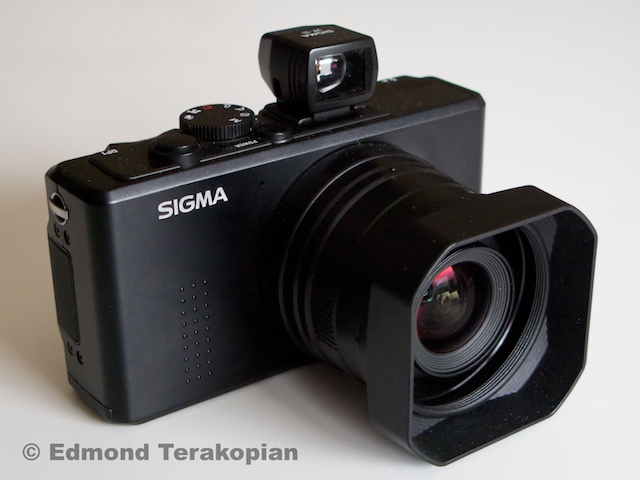
Sigma DP1


Sigma’s DP1 is finally here and in the shops. I’ve borrowed one from a friend for a week now and it does impress in certain ways and is a let down in others.

Firstly, kudos to Sigma for making such a camera. The idea of using a larger sensor in a compact camera is genius. The problems with compacts is that they use tiny little sensors which means that there’s digital noise. This married to the fact that all the manufacturers are trying to cram in more megapixels just adds to the problem, often making shooting over 100 ASA an absolute no no.
The DP1 produces amazing files. At upto 200 ASA it looks just like an SLR file. The colours are superb as is the definition and lack of noise. Its maximum ASA is 800, which considering the fixed 28mm lens (which is superb optically) is a slow f4, is a bit stingy. This together with the fact that there’s no optical stabilization means that low light pictures without a tripod are practically impossible unless one is very steady. At 800 ASA, the image is noisy; however, its the best I’ve seen from any compact at this setting. I just wish that it went up to 1600 ASA.
Other problems with the camera are that the focusing is really really slow, and gives up totally in anything but ideal light. Its got an interesting manual focus dial on the rear which works well, but this isn’t the ideal solution. An AF camera should focus! The problems carry on to when you’re actually taking pictures. Its very slow when writing to card. It takes a couple of seconds to write to card after a single shot in jpeg. After a burst (which is a speedy 3fps), it takes almost ten seconds to write the jpegs to card. Whilst its writing the camera is unusable and you have to wait ’till its finished before taking any more pictures.
This is all a huge let down. I really like the feel of the camera and with the optional optical finder and lens hood its a joy to hold and is very comfortable in the hand. I’ve been really looking forward to this camera since its introduction; I really wanted to like it, but alas, I don’t.
The concept is great, and to be fair, its Sigma’s first attempt. I hope that they carry on producing this line and address the issues. I feel that the major camera manufacturers need to look at this concept and make their own.
To wrap up, if you photograph slow moving or static subjects, then this camera’s for you. If you want the perfect street camera to use in any situation, then alas, move on.
I’ll be sticking with my Canon G9.

Camera Bags


Its strange, but one of the most common questions I get asked is “which bag should I get”!


After years of searching, I think I’ve found the answer. Its a relatively new American company called ThinkTank Photo. The good news is that you can now buy their range in the UK from SnapperStuff.

There was a little profile on what I use from the range in the last catalogue and here’s a section from it:

 
“Its always a struggle” says Edmond. “Sometimes the work can be very challenging and demanding, both physically and emotionally. The last thing I need is for my equipment to be a barrier and distract me from the assignment at hand”.
 
“I spend a lot of time researching what’s available. In the old days, the camera stayed more or less constant. It was film and paper which kept changing and getting better. Nowdays there’s such a huge progression in the quality of digital cameras, computers, software and transmission means that if one doesn’t want to fall behind, one has to put in the research time”.
 
“I find that Canon’s range of lenses and cameras fit the way I work very well. I’m delighted to have discovered Apple’s Aperture and the new MacPro and MacBook Pro which work a treat and have never let me down”.
 
“Its one thing having found the photographic and computer gear and a different thing altogether when it comes to carrying the equipment. My storeroom is filled with various bags, of all shapes and sizes, and from all different manufacturers. I’m ashamed to say that a month wouldn’t go by without me buying a new bag or pouch in an attempt to find that most elusive of goals; the perfect bag. I’m happy to say that this habit is well and truly behind me now after I discovered ThinkTank Photo on the internet several years ago, even before they were available in the UK. A quick email to Doug Murdoch resulted in a phone conversation and a great professional bond. It was very refreshing to find someone who was so very passionate about what they did, had a very good understanding of the professional photographers’ needs, but even more importantly was open to new ideas and suggestions. I must admit that in all these years I have yet to find any manufacturer of bags and pouches that puts so much effort into perfecting design and quality of manufacture”.
 
“I use an Airport Security to transport most of my gear. A Glass Taxi carries one of my long lenses and a few other bits. I also use an Urban Disguise to carry two further bodies and four prime lenses. The one bag that I adore over all others for anything that involves working fast whilst on the move is the Change Up. I’ve had a prototype version of this and can’t even imagine going to work without it. If I need to carry any more gear, I attach one or two Chimp Cages to the side. It’s a superb system that just works well”.